Billionaire and ex-Google CEO Eric Schmidt is making drones for Ukraine. What drives him?

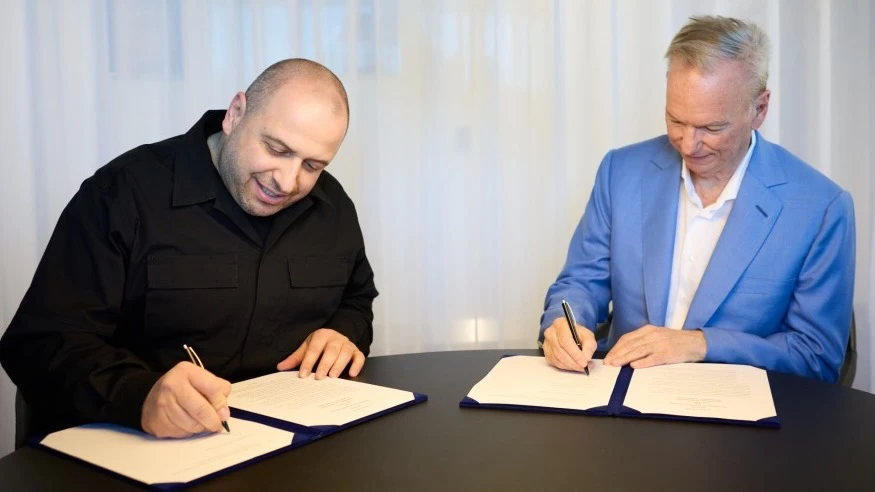
Earlier this month, in Denmark, President Volodymyr Zelenskyy looked on as then-Defence Minister Rustem Umierov and Swift Beat CEO Eric Schmidt signed a memorandum on long-term strategic partnership.
After the meeting, a photo was taken of the attendees in what appeared to be just another episode of diplomatic protocol. But what would warrant arranging a personal meeting with the head of a country at war for a private company?
The reason is that Schmidt is not just a former CEO of Google. He is someone who has shifted his focus to the military use of artificial intelligence and has chosen Ukraine as a testing ground for a new technological revolution.
The entrepreneur assembled his dream team over several years. Their task: to develop drones and drone autonomy systems. One of Schmidt’s UAVs is now the most effective interceptor of Shahed drones.
This makes Schmidt a strategically important partner for Ukraine – and the cooperation is mutually beneficial. For Ukraine, it’s an opportunity to gain access to cutting-edge technology without bureaucratic delays and waiting on permits from Washington. For Schmidt, now 70, it’s a chance to take on a new role: not just architect of the digital civil revolution, but leader of a new era in military technology.
All this makes Schmidt’s connection with Ukraine not merely intriguing, but controversial too. Despite the clear benefits, attitudes towards him vary within Ukraine’s miltech community, where some are sceptical, mistrustful and concerned about his true motives. What is Schmidt doing in Ukraine? Why is his influence growing, and why is not everyone happy to see him?
From Google CEO to arms dealer
Schmidt will go down in history as the person who transformed Google from a promising startup into a global tech giant. After taking the helm at the company in 2001, he succeeded in making Google the leader in internet searches, online advertising and cloud services.
His influence extended far beyond engineering solutions. He was the key "adult in the room", complementing the young founders, Larry Page and Sergey Brin. Ultimately, it was Schmidt who built Google's management structure, enabling the company to scale up aggressively without losing control.
After stepping down as CEO in 2011 and leaving the board of Alphabet, the holding company that includes Google, Schmidt began to gain political clout in the tech industry and the US national security sector. He became an adviser to the US government on AI, cybersecurity and technological strategy.
Schmidt chaired the National Security Commission on Artificial Intelligence, a government body that shaped US policy on AI development in the context of competition with China.
Schmidt is respected in Silicon Valley not only for his achievements at Google, but also for his intellectual authority and strategic thinking. His views on the future of technology, warfare and global competition have greater resonance than those of current corporate leaders. Though he no longer manages large corporations, his informal influence on US policy, business and security is hard to overestimate.
Strategy is one of Schmidt’s greatest strengths. The former Google CEO has a strong sense that the time has come for technology that can transform the course of humanity. While previously he focused on internet search and user experience, in recent years he has been increasingly speaking about military technologies.
In interviews, articles and speeches, Schmidt has reflected on how drones and autonomous technologies could become the key to a new military revolution. He is convinced that the outcomes of future wars will be determined not by the number of soldiers, tanks or fighter jets, but by the autonomy of systems and the power of algorithms.
His statements indicate that he senses that we are at a technological tipping point, one that became particularly evident after the start of the full-scale war in Ukraine. In fact, he speaks about this quite openly. With Mark Milley, former chair of the US Joint Chiefs of Staff, Schmidt co-authored an article in Foreign Affairs warning that America is unprepared for the kind of war already unfolding in Ukraine.
"[American] troops are not fully ready to fight in an environment in which they rarely enjoy the element of surprise. Its jets, ships, and tanks are not equipped to defend against an onslaught of drones. The military has not yet embraced artificial intelligence. The Pentagon does not have nearly enough initiatives aimed at rectifying these failures – and its current efforts are moving too slowly. Meanwhile, the Russian military has fielded many AI-powered drones in Ukraine. And in April, China announced its largest military restructuring in almost a decade, with a new emphasis on building up technology-driven forces," the article states.
At the same time, the authors acknowledge that as yet, no state mass-produces combat robots or possesses fully functional software for autonomous weapons.
"Eric has a great understanding of innovation and the direction the world is moving in," says Rudolf Akopian, Director of Strategic Communications at the Centre for Unmanned Systems Research. "His company, Swift Beat, could become the next Lockheed Martin in the world of AI-powered drones, which perform a range of functions from reconnaissance to precision strikes."
Ultimately, this is what has compelled this computer scientist and technological visionary to become a weapons manufacturer. For now, this is primarily to meet the needs of Ukraine, but his target market lies far beyond the borders of the Ukrainian state.
Akopian believes Ukraine is serving as a testing ground for Schmidt – a place to trial the technologies of the future, especially drones. And he makes no secret of that: in one interview, Schmidt advised the Pentagon to "get rid of the tanks and buy drones instead".
What Schmidt is doing in Ukraine
Schmidt has visited Ukraine regularly since the start of the full-scale war. The first public report of his visits dates back to September 2022, when he met with Andrii Yermak, Head of the President’s Office, and then-Defence Minister Oleksii Reznikov in Kyiv. The outcome of the meeting is unknown. The official statement contained only vague wording about the potential of technology to speed up the de-occupation of Ukrainian territories.
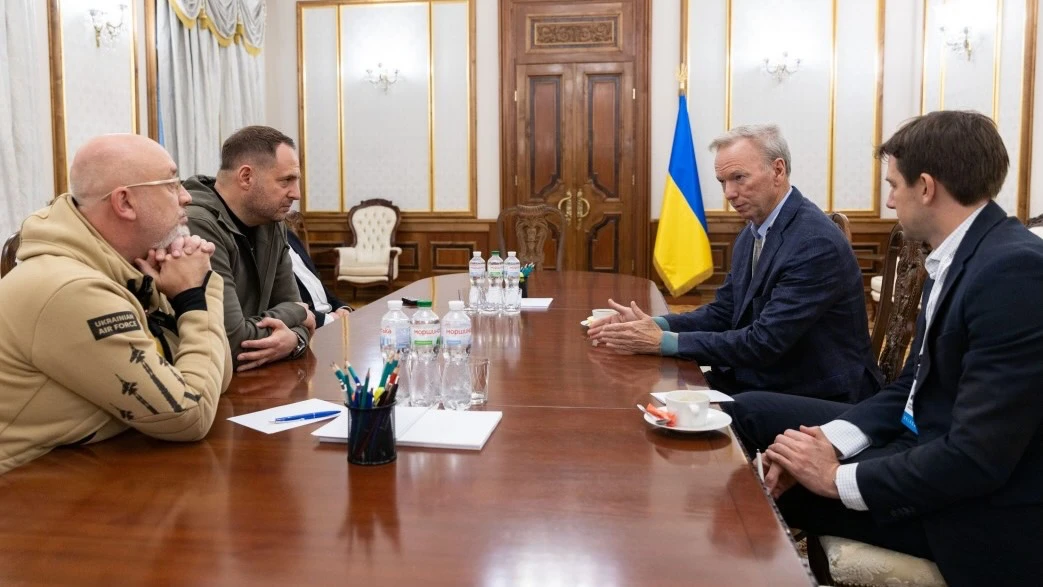
Most of Schmidt’s visits to Ukraine are not public. What is he looking for in a country where fighting is ongoing? Above all, he seeks confirmation of his vision of the wars of the future.
"He has a clear vision that drones, autonomous systems and AI will be key on the battlefield and will determine the outcomes of wars. His descriptions resemble the plots of the Terminator films," says an Ekonomichna Pravda source within Ukraine’s military leadership.
Over nearly three years, Schmidt and his team have made an extensive study of Ukrainian combat technology and the companies that have emerged in the defence sector.
"Schmidt has a clear understanding of what's going on here. He’s travelled to the front lines several times to meet with brigades, he’s talked to commanders, he’s watched UAV operators and individual units at work. He understands how technology is affecting the course of combat operations in Ukraine," said an Ekonomichna Pravda source who has attended several such meetings with Schmidt.
In 2024, Forbes reported that a representative of Schmidt's team had attended special demonstrations by the 14th Unmanned Aerial Vehicle Regiment, which specialises in reconnaissance and attack drones. More than one Ekonomichna Pravda source has reported that Schmidt has also held several meetings with Ukraine's top military and political leadership. The American billionaire’s involvement in Ukraine is evident at every level from the front line to government offices in Kyiv.
During one of these meetings, a significant moment occurred, a source said. Schmidt was not taken seriously at first. One of the command representatives had assumed the meeting would be a formality at which the American businessman would simply express his support and general intentions to help. But when the conversation turned to specific technical characteristics of future developments and potential funding from Ukraine, the atmosphere changed.
"Swift Beat, like most miltech companies, is private; its developments are not made public," says Akopian. "We know that some of the world's best engineers from Tesla, Apple and Google work there. Their key task is to make AI-guided drones that can perform a wide range of tasks."
Ekonomichna Pravda has learned about three types of drones that Schmidt has been involved in developing. Although the specific product names have not been disclosed for security reasons, they are known to be interceptor drones (usually used against Shaheds), medium-range (Middle Strike) attack UAVs, and kamikaze drones (FPVs). All of them combine artificial intelligence and modern unmanned technologies.
Most of the sources Ekonomichna Pravda talked to in the preparation of this article said that Schmidt’s interceptor is one of the most effective in efforts to combat enemy drones. It is able to detect targets in the night sky with extreme precision. These systems account for about 90% of the Shahed drones downed.
One brigade representative told us that Schmidt's kamikaze drones are equipped with their own communication system that is unaffected by Russian electronic warfare equipment. He said the drones have built-in AI for detecting and hitting targets, which has performed well in combat.
Several teams are involved in these projects. They work simultaneously in Ukraine, the US, and a European Union country, probably Poland or Estonia. An AI solution for drones has been developed by a Ukrainian team. Prior to signing the memorandum with Ukraine’s Defence Ministry, Schmidt sought to keep his military activities quiet.
Secrecy above all
In early 2024, it became known that Schmidt had moved from visionary speeches to action. Forbes reported that the billionaire had secretly founded a company called White Stork which produces drones for military use. Following the publication of the article, the company's name was changed to Project Eagle.
To obscure the ownership structure, the project was registered through a series of companies and related firms. One of them is Merops, which was registered in 2023 by former SpaceX employee Jared Vander Lind and another ex-engineer from the company. Forbes reported that Merops' official purpose is "aerospace engineering research and development". In Ukraine, it will likely develop interceptor drones.
Other companies associated with the project include Aurelian Industries, Swift Beat, and Volya Robotics. Estonian-registered Volya Robotics was founded by Hillspire, an investment fund associated with Schmidt.
There is a charity called White Stork which delivers humanitarian aid to Ukraine. It was founded before Schmidt gave his startup the same name. Forbes speculates that this may have been done deliberately to confuse everyone.
Schmidt has chosen to use the tactic of indirect presence in his venture capital investments as well. The Dare to Defend Democracy (D3) Foundation was set up in 2023 to focus on supporting defence startups from Ukraine and allied countries. Schmidt's name was not publicised.
"It was originally meant to be an accelerator. Then the focus shifted to the foundation. Initially, Schmidt was not supposed to be mentioned despite being one of the main investors. Then when news of his involvement reached the media, he had to admit it," a source from the venture capital market told Ekonomichna Pravda.
D3 has invested in 16 companies, mostly Ukrainian, working in the field of drones, AI, electronic warfare and cybersecurity. The fund received US$5 million from the Danish government (EIFO) in July 2025 and has expanded its work in the European Union amid declining US support.
Why is Schmidt so cautious? Our sources cite several reasons. The first is that AI for military purposes is a sensitive issue. There is constant debate about the ethics and risks of using AI even in civilian applications. Using AI for warfare is an even more sensitive topic, especially in Silicon Valley.
The second reason is political. Schmidt is a longtime supporter of the Democratic Party. With the Republicans currently in power, he is keeping his head down to avoid becoming a target for criticism, especially given his ties to the Pentagon. And the third reason is that the Kremlin could throw a spanner in the works of his Ukrainian assistants.
Why not everyone is a fan of Schmidt
Schmidt isn’t just a strategic ally who wants to help Ukraine: he’s also testing out his own ideas in practice. He is first and foremost a tough and pragmatic entrepreneur.
"Just look at how Google gained the lead. It’s not likely that that happened without Schmidt's involvement," says a representative of a fund that invests in Ukrainian startups.
In this context, it’s hard to see Schmidt purely as a benefactor. The entrepreneur himself has often said privately that he does not make a profit in Ukraine. The most common complaint Ekonomichna Pravda heard from Ukrainian miltech representatives is that Schmidt wants to get his hands on Ukrainian technologies for free through Ukrainian military personnel and manufacturers so that later he can sell them at a much higher price.
As a businessman, Schmidt understands that founding defence companies without testing their products on the front line means remaining outside the context of modern warfare.
For example, Russia is establishing mass production of Shaheds. Shooting them down with missiles is economically unsustainable, and traditional turrets with machine guns are of limited use when drones fly at high altitudes. One obvious solution is interceptor drones.
Schmidt began working in this area long before it became public knowledge. Perhaps his entrepreneurial instincts kicked in, but his drones are the most effective in this niche area. Meanwhile, the confrontation with Shaheds is gaining momentum. Next up is optical guidance for intercepting jet-powered UAVs. Schmidt’s team is likely to increase its expertise in this area.
But some Ukrainian manufacturers caution against relying entirely on Schmidt’s technology. They fear the businessman will push them out of the market. He has the ability to strike a balance between his own investments and local production. According to Ekonomichna Pravda sources, a significant part of Schmidt's drone production is based on contracts with Ukrainian companies that produce hulls.
Why did Zelenskyy need to be at the Denmark meeting? An informed source explained that the president's presence served as a guarantee that the state would enter into contracts with Schmidt's company. Only time will tell whether this will happen, but the billionaire himself was very pleased with the outcome of the meeting.
Author: Ihor Pylypiv
Translation: Anastasiia Yankina and Yuliia Kravchenko
Editing: Teresa Pearce