

The daily life of Kherson telecommunications technician Viktor Zhuravlov is one of constant fear.
His brother died in April. He lived in the town of Beryslav, Kherson Oblast, and one day went up onto the roof of a half-ruined five-storey building to call his family. In an area where many mobile phone towers had been destroyed, it was the closest place to find reception. It was there that he was attacked by Russian drones. The first drop of explosives from the drones riddled him with shrapnel, the second wounded his leg, and the man fell. The last struck his stomach. He died three days short of his sixtieth birthday.
Zhuravlov recounts this tragedy to the echo of rifles. Somewhere nearby, the soldiers have detected a Russian drone and are trying to shoot it down, he concludes. He has learnt to distinguish by ear where rocket artillery is firing, where tubed artillery is operating, where a tank is pounding and where a mortar is. Knowledge he would rather never have acquired. Skills that, over the past two years, many residents of Kherson Oblast have also gained.
Just a few days before our conversation, three shells struck Zhuravlov’s Khrushchev-era apartment block and tore off the roof, smashed through the ceilings and ripped the windows out by the roots.
His house in Kherson’s Dniprovskyi district is in the "red zone", that is, the most dangerous area, close to the line of contact. Safety in Kherson is more of an abstract concept, as today drones can reach any part of the city. But it's clear that the closer to the Dnipro River you are, the louder it gets.
Along with this proximity, the way of life changes too. To the warning "smoking kills", Zhuravlov could add the word "instantly", because the glow of a cigarette on the balcony is a potential target for a Russian drone operator. The Zhuravlov family spends each evening without turning on the lights – at the most, they will use the light of a mobile phone. Otherwise, the Russians may notice that someone is living in the flat and send a drone through the window.
Zhuravlov calls what's happening around him a safari. But here the Russians are not hunting lions, but civilians.
"For example, our hospital was recently attacked by a kamikaze drone. Four people had gathered near the morgue for a burial. They heard a drone above them and ran to the hospital reception. The drone flew in after them. As a result, four people sustained injuries", says Zhuravlov. "This is in answer to the question of whether they deliberately target civilians."
In August, the Russians carried out almost 10,000 drone attacks (FPV drones and drops of explosives) on Kherson Oblast. Kherson Oblast Military Administration says that a year ago, there were about 700 strikes per month, and now there are 2,700 per week. In total, since the start of the full-scale war, about 600,000 Russian munitions have landed on the right bank of Kherson Oblast.
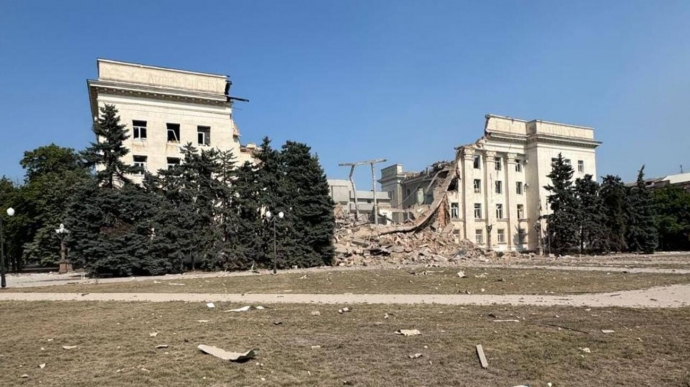
However, the worrying trends concern not only the number of strikes but also the places being hit. At the end of August, Kherson Oblast Military Administration reported possible restrictions on movement along the Kherson–Mykolaiv motorway, the city’s main external transport road. Drones have begun to reach here too, attacking any vehicle that comes into view. This has caused a new fear: that one day the city may find itself under complete siege.
"When we have four fatalities and ten casualties, that's just statistics. But when the same happens in other regions, they declare a day of mourning. So we live in two different realities", an Ukrainska Pravda source complains, speaking about being besieged not only physically but also by the way information is presented. It seems to him that Kherson residents have been left alone with their pain and struggle.
So this article is another window into Kherson’s reality. About life under daily Russian attacks. About how the local authorities and the city’s residents are trying to counter the threat from the skies. And about people who are striving to make their lives self-sufficient, even if it means going underground.
Every drone must be regarded as though you are its target
Ten seconds – that is how much time may pass between a shot fired from the opposite bank of the Dnipro River and the explosion, says Yurii Antoshchuk, coordinator of the public safety working groups network in Kherson Oblast. The air-raid warning will not signal an artillery strike, just as it will not signal a drone attack. That is why, when the siren sounds, Kherson residents think first of aerial bombs. As for the other threats, there remains only one option – to listen intently in order to react in time.
In May, Antoshchuk created guidelines for Kherson residents titled Recommendations for Civilians: Protection from Russian Drones. If you were to reduce the 40 pages of this booklet to to one sentence, it would read: every drone must be regarded as though you are its target.
This is not an exaggeration and not an attempt to frighten anyone. It is a grim reality in which anyone can become a victim. A soldier is always more "interesting" than a civilian for a drone operator. A group of people is more "attractive" than a single person. A car is a bigger target than a pedestrian. And someone standing in the open is more vulnerable than someone who has hidden under a tree.
However, the point is that while you might be the least "interesting" target, you could still be attacked – for example, because the drone’s charge is running out and the Russian operator decides anyone will do.
Antoshchuk says Russia is using Kherson as a military training ground. "This is outright terror, and it can only be called a safari on people. But – and this is confirmed by the military, the police and intelligence – it is also about training drone operators, practising their manoeuvres. And of course, their main task is to make civilians’ lives as unbearable as possible, so that they leave. And thereby clear the territory for further active operations."
The so-called "red zone", like a pandemic, is engulfing more and more territory. Just six months ago, drones did not reach Antoshchuk’s office. Now they are striking places nearby.
It is no surprise that Kherson residents interviewed by Ukrainska Pravda no longer call their city a frontline city, that is, a city close to the line of contact. For them, it is entirely a city directly at the front. The first sign of this is the constant feeling of danger.
"If a person is always looking up at the sky or is surprised by those who are simply sitting on a bench, then I understand that they have come from the 'red zone' – to buy food and then go back home again", says Dementii Bilyi, an expert from the Black Sea Centre for Political and Social Studies.
His district cannot be called safe either. It is not close to the Dnipro River, but Bilyi's apartment block has been hit twice by Grad multiple-launch rocket systems (MLRS). A neighbour was killed.

People from nearby neighbourhoods told him that although they had local grocery shops, they were a few streets away, so rather than risk the walk, they preferred to take a trolleybus and in a few minutes reach the neighbouring district, where they felt calmer.
Russian attacks have also affected public transport. Some routes have been shortened, some temporarily cancelled – for example, to the Korabel district, located on an island. However, the Russians have not managed to paralyse transport completely.
"I believe that our transport drivers are real heroes. Not only them, but also electricians, emergency crews, rescue workers", says Bilyi. "In peacetime, Kherson residents were always dissatisfied with the work of public utilities, but now they have the highest level of trust in them."
His words are confirmed by survey results. In March 2025, Kherson residents were asked what community resilience meant to them. Fewer voted for physical security than for the stable operation of critical infrastructure. And when it came to who was important for this resilience, the first two places were shared between the Armed Forces and townspeople, while public utilities took third place.
Kherson residents believe that another pillar of resilience is business. And this is no surprise. Under unpredictable threats, risky logistics, losses from Russian attacks and fewer customers, entrepreneurship has turned into a form of social support.
"Businesses in the 'red zone' operate at a loss", says Oleksandr Vlasov, owner of a local chain of bakeries, "because you could say the population there is bankrupt. In other districts, business survives only because of the soldiers, who receive salaries, and in this way some circulation of money in the city is maintained."
Since the start of the full-scale invasion, he has lost part of his business, his home and several premises. Logistics has turned into a daily trial: previously suppliers brought goods; now Vlasov himself has to drive to Mykolaiv for half a tonne of supplies. Any attack on the district, and there will be no customers at the nearest bakery that day. If a munition hits infrastructure and an emergency power outage occurs, the ovens stop – which means another lost day.
Yet despite everything, Vlasov continues to keep his bakeries running even in the "red zone". If there were no one willing to work, he would close them. But people still come in for their shifts, even under attacks. One of his bakeries has been hit three times.
"The bakery near the hospital is constantly bombarded", he says, "but the doctors want it to remain open. And the workers – women whose relatives have left – come to work because the doctors need them. "It’s hard to explain. We are not needed anywhere else. But in Kherson a circle of communication has formed, where people feel their importance to others and that is why they come to work."
"They are simply trying to live an ordinary life"
Recently, Oksana Pohomii, a member of the Kherson City Council from the European Solidarity party, told her husband that she missed romance.
"Then let’s go to Shevchenko Park", he suggested.
"Well, I’m not so romantic as to walk in parks at a time like this", she replied.
Her day begins at 8am (Pohomii admits she never gets up earlier) and lasts until 3pm – although there are still six hours left before curfew which now begins at 9pm.
"After 3pm you will hardly see anyone on the streets, except cars passing by. Or in the districts far from the Dnipro River, you might see people in cafés. And those who go to the centre try to finish their business by 2pm. Our volunteer centre also works until 3pm, and then everyone disperses", she says.
Recently, Pohomii visited her daughter in Mykolaiv. When she saw that it was already after 3pm, she instinctively began hurrying her, saying they needed to get to the grocery shop in time. This amused her daughter – there, shops are open until nighttime.
For Pohomii, as for most Kherson residents, leaving home turns into a series of rituals, each of which can save a life. First, check the local Telegram channel where townspeople send reports about spotted UAVs.
If walking – keep close to the trees and listen carefully: is a drone buzzing overhead? Some people have got used to scanning the sky, while she looks down, checking whether any Butterfly mines are scattered about. At first, the Russians sowed Kherson Oblast with these anti-personnel mines, and now they are being found in the city itself.
If driving – no music, windows open to hear UAVs. Often speeding at nearly 100 km/h. Some residents have installed drone detectors in their cars: they can signal the presence of an FPV drone nearby, and sometimes even display an intercepted image from it. The scariest thing is to see your own car on that screen.
Anti-drone nets in the streets could at least provide partial protection, but they only began to be widely installed in Kherson recently.
Why so late? Pohomii explains it simply: there is no large amount of money involved there – "you can’t skim much off nets", so that’s not a priority for the politicians.
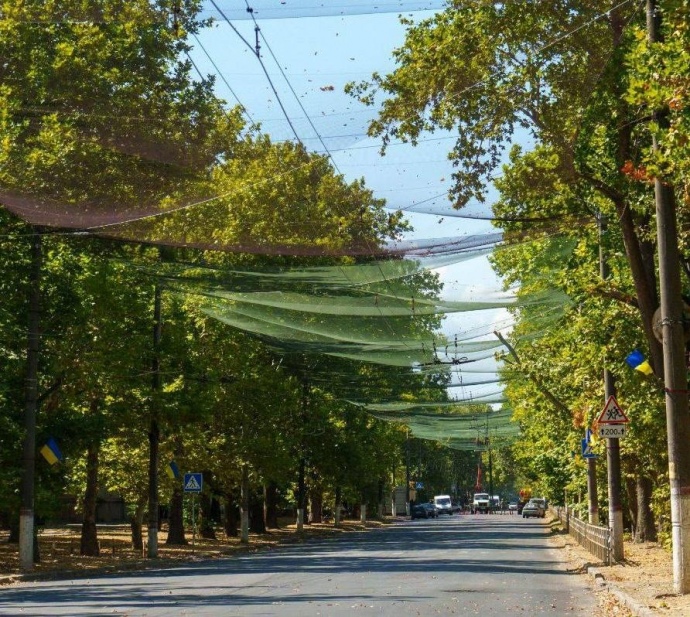
Oleksandr Tolokonnikov, deputy head of Kherson Oblast Military Administration, cites other reasons: "We must understand that we are doing everything from scratch. At first we helped the military, meeting their needs. Then it was necessary to cover public utilities and critical infrastructure from drones. When we started building corridors, it became clear that the nets used for utilities were not suitable here.
"We even created a separate testing ground where nets were tried out with drones. We will cover the main transport roads with nets, and as for other roads, we will decide depending on the situation. You cannot cover all the streets, it’s impossible."
The main protection against Russian drones remains electronic warfare systems. According to Tolokonnikov, they jam four out of five UAVs. Mobile fire groups also patrol the city. But the Russians take counter measures as well: if they notice electronic warfare in action, they may shell the district with artillery or drop aerial bombs.
Today, about 60,000 residents remain in Kherson, and 150,000 in the entire region. Before the full-scale invasion, the figures were 330,000 and 500,000 respectively.
At the beginning of August, the Russians struck the Ostrovskyi Bridge with bombs – the only road connecting the Korabel district with the mainland. Now there is not a single apartment block left there that has not been damaged by attacks. Most residents were evacuated, but about 240 Kherson residents (as of early September) refused to leave their homes and even signed evacuation waivers.
"We see that there are always about 10% of people in frontline regions who want to stay, no matter what", Tolokonnikov says, before moving on to describe life in Kherson more generally: "I would never have believed this was possible under such intensity of attacks, but unfortunately people get used to everything. They sit in parks, meet for coffee and even go to children's playgrounds. They are simply trying to live ordinary lives."
***
One summer day this year, the Russians attacked a bus with passengers right in the centre of Kherson. Meanwhile, the Kherson Oblast Academic Theatre was preparing for a performance. The organisers were meeting the audience in the inner courtyard, covered with an anti-drone net, to lead them into the shelter.
"The scene was like this", recalls the theatre director, Oleksandr Knyha. "A woman ran in, all dishevelled, in tears, saying 'Oh, I just got off the bus, and there then was an explosion. The bus is on fire. I was running to the play. And you’re still here?'". "That is, she ran straight from an attack, but when she saw that we had not cancelled the performance, that we were here, she calmed down and went to watch the play. We looked at one another, and I told my team: 'You see, we are like a pill – calming, encouraging and emotional all at once.'"
He realised long ago: for some people these performances are an opportunity to put on festive clothes, do their hair and return to normal life for at least an hour and a half.
Before the full-scale war, the regional theatre staged 40 performances a month and had nurtured its own audience. And now, in times of trial, it has not left them alone with dark everyday life.
Kherson shudders from explosions, hides from drones, is sometimes cut off from the power grid and left without public transport due to the attacks. Its pedestrians walk with their eyes lifted to the dangerous sky or, on the contrary, fixed on the ground searching for mines. Its streets empty long before curfew. And violent death regularly strolls around these streets.
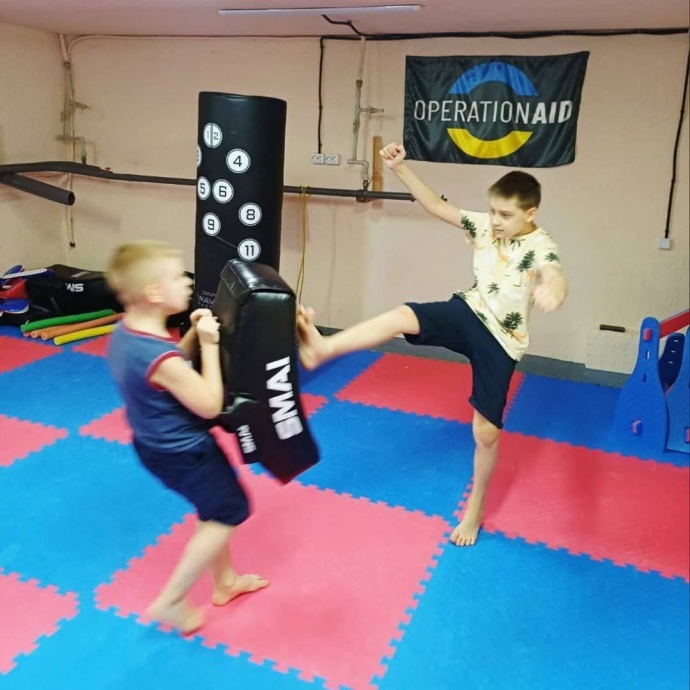
And yet Kherson lives on. But some of this life has moved into shelters and underground spaces throughout the city. Here the theatre has staged 15 premieres in just eight months this year. Here audiences attend concerts and watch films. Here people practise sports and compete with one another. Here children study robotics, and elderly people learn to paint.
Today, Kherson is a vivid illustration of what any city could turn into if Russia were to come close enough. Nevertheless, it is also an example of true resilience, when life, despite everything, again and again strives to overcome death.
Author: Rustem Khalilov, Ukrainska Pravda
Translation: Myroslava Zavadska
Editing: Shoël Stadlen