Ukrainian mid-range drones are consistently wiping out Russian air defences: results over the past year

It was a year ago that Defence Intelligence of Ukraine (DIU) released the first video showing the Prymary (Phantoms) unit in action in Russian-occupied Crimea. The footage showed Ukrainian kamikaze drones, bearing the distinctive features of the Rubaka model, striking 21 pieces of high-value military equipment over several days, most of them air defence systems. The strikes marked the start of a sustained campaign against Russian air defences in the temporarily occupied territories.
This effort was made possible by mid-range kamikaze drones, commonly referred to by Ukrainian weapons engineers and soldiers as "middle-strikes", operating at ranges of up to 250 km from the front lines. It is at this depth that air defence positions, temporary deployment sites, logistics bases, airfields, repair facilities, supply depots and other high-value assets are located.
Over time, the Prymary unit became frequent visitors to Crimea and mid-range drones began to be deployed by other units from Ukraine's defence forces across multiple sections of the front.
The development of drones of this type is effectively an attempt to partially fill the niche of the US-supplied HIMARS multiple-launch rocket system, which has a strike range of up to 80 km.
Fixed-wing drones, used to strike targets tens of kilometres deep, have both their advantages and drawbacks. The key point is that Ukraine is manufacturing them independently and adapting them to the challenges of the battlefield. Kyiv is already attempting to extend their range and turn rear areas into a dangerous place for Russian forces.
Ukrainska Pravda has analysed the first year of operations of Ukrainian-made mid-range drones. The author of this story compiled data from open sources on several hundred Ukrainian strikes at ranges of up to 250 km. The analysis identifies which Russian assets were struck most frequently and which drones were used to carry out the strikes.

The number of strikes is on the rise
To investigate the phenomenon of mid-range drones, the author analysed 365 rear-area strikes carried out by aircraft-type kamikaze drones at ranges of 50-250 km that were reported by Ukrainian military units between 19 March 2025 and 9 March 2026. In most videos and military reports, it is possible to clearly identify the drone model, the unit responsible for the strike and the type of target hit.
Only a subset of strikes against Russian forces was included in the analysis – those assessed by the military command as safe for publication and, in most cases, successful. Consequently, the statistics omit rear-area strikes that were not made public for security considerations or other reasons.
However, the available data is sufficient to observe the dynamics of the strikes and identify a number of notable details and trends.
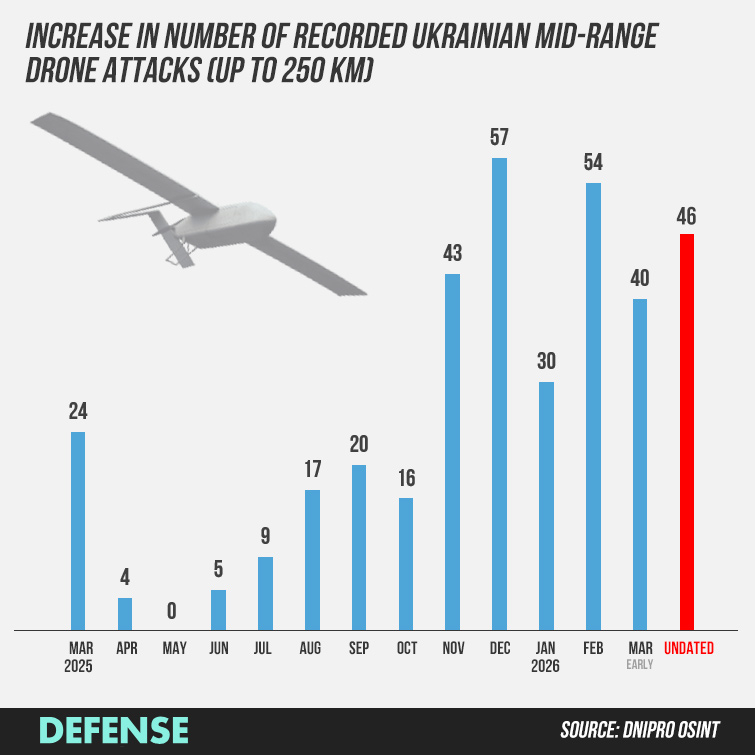
As a matter of fact, Defence Intelligence of Ukraine was among the first to begin releasing reports on mid-range strikes. The Prymary unit operated mainly along the coastal areas of Crimea, gradually increasing both strike frequency and operational depth. Until autumn 2025, the number of publicly reported strikes remained steady at around twenty per month.
However, from November 2025 onwards, the average number of strikes doubled almost immediately. This increase came after the Special Operations Forces (SOF), the Unmanned Systems Forces (USF), and the Security Service of Ukraine (SSU) began reporting such strikes as well. At this point, operations were no longer focused solely on Crimea but had expanded across the entire line of contact.
Overall, the author identified 365 strikes over the year, more than a third of which occurred in the final three months. This suggests a steady escalation in the use of mid-range drones.
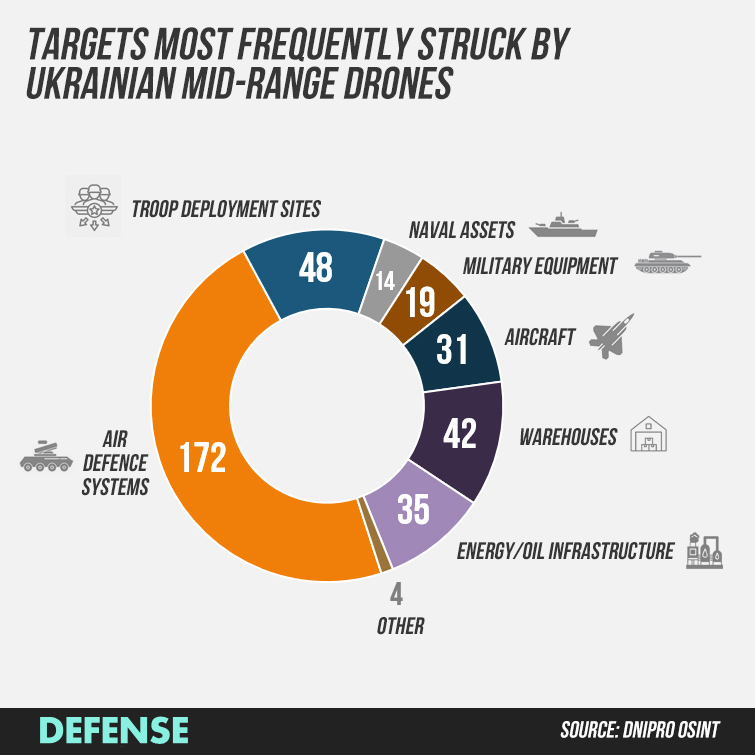
The drones go after a wide range of targets: deployment points, headquarters, repair bases, ships, energy facilities, warehouses, aircraft and helicopters. Still, Ukrainian operators appear to focus heavily on air defence, with nearly half of all strikes aimed at Russian radars, launchers and other air defence assets.
Such prioritisation points to a systematic attempt by Ukraine's defence forces to erode Russian air defences at operational depth. Over time, weakening these systems could open the way for more Ukrainian strikes on other key targets long tracked by DIU.
Ukraine has multiple capabilities for striking Russian assets at this depth, including smaller-warhead drones such as the Bulava and RAM-2X. They are less destructive, but their surgical precision enables them to hit vulnerable Russian equipment.
Other drones carry slightly larger warheads, such as the Rubaka used by DIU, while some feature much larger payloads, like the FP-2.
The FP-2 is effectively a variant of the FP-1, a drone developed by Ukrainian company Fire Point and a mainstay in Ukrainian service. It is used to strike Russian assets hundreds of kilometres deep. The mid-range version differs in that it is pilot-operated and carries a larger warhead of up to 100 kg, while its range is shorter.
Each type of drone comes with its own strengths and weaknesses in terms of accuracy, navigation and detectability by enemy air defences. For nearly every Russian asset, depending on conditions, characteristics and cost-effectiveness, there is a Ukrainian mid-range drone suited to the job.
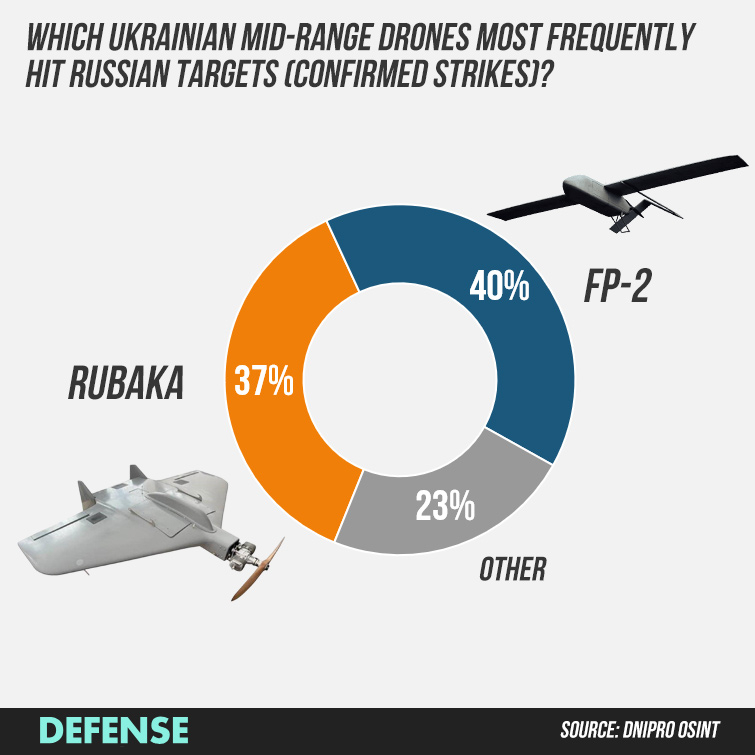
Among the strikes recorded, two main types of drones have been identified. This can be determined from the on-screen display (OSD), additional strike footage, or reports issued by the units themselves specifying the drone used.
FP-2 and Rubaka drones dominate the footage, indicating their widespread use against Russian forces and the rapid expansion of production of these systems for Ukraine's defence forces.
There is a noticeable trend towards increased use of the FP-2 in particular – over the last five months, it has carried out more strikes than Rubaka drones over the entire observation period.
Russian assets and equipment are also being hit by other Ukrainian drone models that have not yet been definitively identified. But they should not be dismissed – their limited presence in publicly available statistics does not necessarily mean they are ineffective.
DIU operators currently account for the largest share of confirmed mid-range drone strikes. That is hardly surprising, given they were the first to launch active operations and begin reporting on their efforts against Russian forces in Crimea.
However, other branches of Ukraine's defence forces have entered the field. The Unmanned Systems Forces are trailing slightly behind, but could eventually overtake DIU in terms of the number of such operations. That trajectory may be shaped by the development of specialised units and the newly established Unmanned Systems Forces Deep Strike Centre. The expansion of mid-range strike capability within the Unmanned Systems Forces is regarded as a major strategic priority.
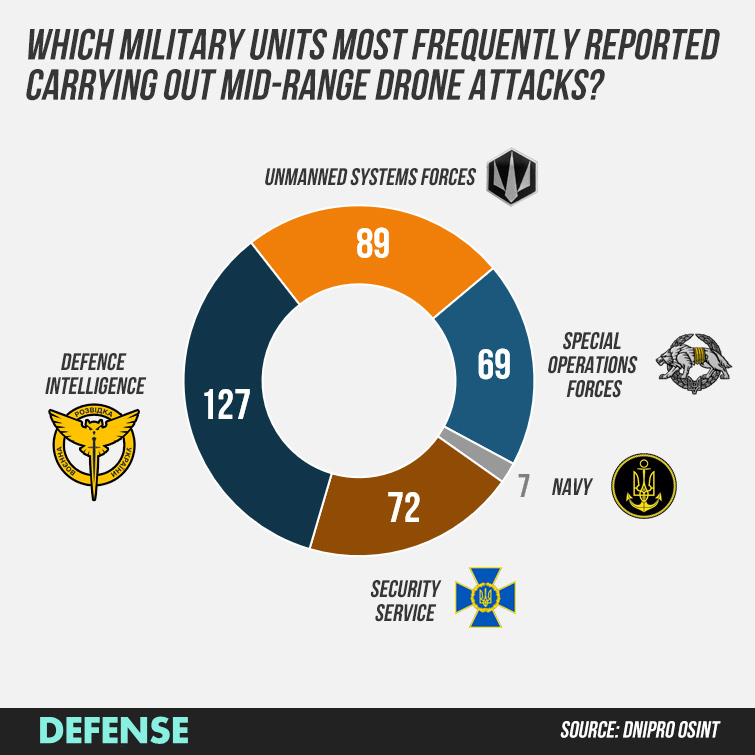
Other agencies are also stepping up their activity. The Security Service and the Navy, after putting the FP-2 into service, have also begun reporting strikes against Russian forces. The expanding engagement of defence forces units in mid-range strikes is naturally increasing the number of successful attacks reported.
Effects of mid-range strikes on Russia
Strikes against air defence systems are gradually having an effect. Russian forces are being forced to redeploy anti-aircraft missile systems and radars from other locations. This weakens their air defences and makes it easier for Ukrainian deep-strike drones and missiles to target major energy sites and facilities belonging to Russia's military-industrial complex.

The area roughly 50-250 km behind the front line is becoming increasingly dangerous for Russian forces. Air defence systems, logistics and other military infrastructure facilities are being persistently targeted and destroyed, making offensive operations significantly more difficult for the Russians. Still, it remains hard to assess with certainty how far these attacks have already shifted the operational and tactical situation at the front.
However, the effect on Russian air defence is already evident. Air defence systems and radars are being destroyed at a pace that Russia's defence industry cannot match through new production, leaving the rear unprotected.
Vasyl Maliuk, former head of the SSU, said Russia produces 30 Pantsir systems a year, but that the pace of their destruction far exceeds this figure.

Beyond rear-area operations, drones are also actively used at the front, striking infantry clusters, Russian forward positions and UAV operator sites. If costs keep falling, production scales up and operational expertise grows, it will become increasingly difficult for Russian forces to advance, as deploying and concentrating troops and equipment is just becoming harder and riskier.
Mid-range drones can also serve a strategic purpose. Strikes on high-value systems, particularly Iskander tactical ballistic missile systems, have intensified recently. In February and March 2026 alone, Ukrainian drones struck four launch sites – a record since the start of the full-scale war. Drone manufacturers and the defence forces are clearly not looking to slow down.
Efforts are underway to scale up production, improve weaponry, identify new applications and expand the use of mid-range drones across different units of the defence forces. Given the current pace of development, such strikes are expected to increase further.
Read more about "middle-strikes" in this Ukrainska Pravda article: Hitting the rear and easing the load on HIMARS: Ukraine's new mid-range drones
By Harbuz (Dnipro OSINT)
Translated by Artem Yakymyshyn
Edited by Susan McDonald