Zelenskyy presents 20-point "basic document" to end war for the first time
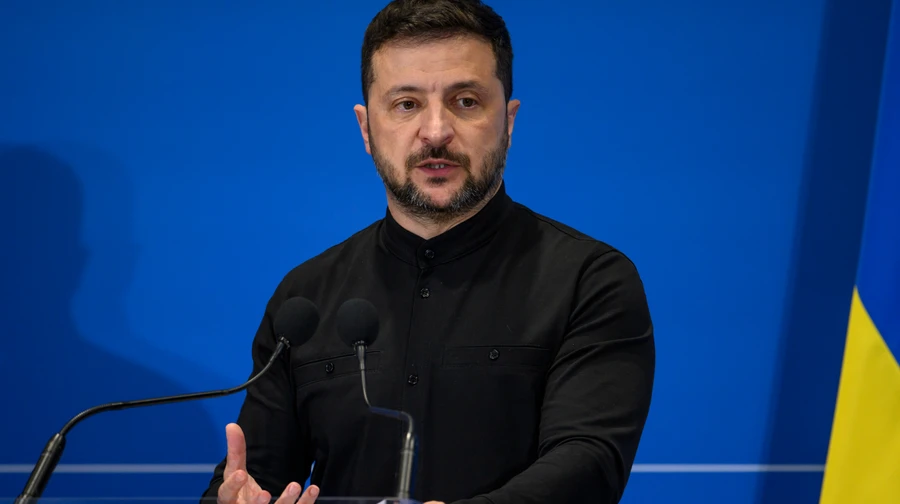
President Volodymyr Zelenskyy has for the first time publicly presented a draft 20-point document on ending the war, which he called a framework or "basic document" between Ukraine, the US, Europe and Russia.
Source: correspondents from Ukrainian public broadcaster Suspilne and Ukrinform, citing Zelenskyy during his conversation with journalists
Quote: "Now I am ready to talk through the draft 20-point document, and this is a document called a framework, a basic document on ending the war, a political document between us, America, Europe and the Russian Federation."
Details: The president noted that the draft reflects the shared vision of Ukraine and the United States in many areas. It reflects in part the approach of the US side and a number of points, he said, still require further work and agreement.
Zelenskyy also noted that there is still no common position with the US side on two issues: territories in Donetsk Oblast and the Zaporizhzhia Nuclear Power Plant. At the same time, he said that on most other points the sides have "significantly converged" and that overall consensus has now been reached.
Point 1: Ukraine's sovereignty will be reaffirmed. We affirm that Ukraine is a sovereign state and all signatories to the agreement confirm this with their signatures.
Point 2: This document constitutes a complete and unconditional non-aggression agreement between Russia and Ukraine. It states that, to sustain long-term peace, a monitoring mechanism will be established to oversee the line of contact using space-based unmanned surveillance, provide early warning of violations and resolve conflicts.
Point 3: Ukraine will receive robust security guarantees.
Point 4: The size of the Armed Forces of Ukraine will remain at 800,000 in peacetime.
Point 5: The US, NATO and European signatory states will provide Ukraine with security guarantees that mirror NATO's Article 5.
- If the Russian Federation attacks Ukraine again, in addition to a coordinated military response, all global sanctions against Russia will be reinstated.
- If Ukraine invades the territory of the Russian Federation or, without provocation, opens fire on Russian territory, the guarantees will be deemed null and void. If, however, the Russian Federation opens fire on Ukraine, the guarantees will take effect.
- The issue of US compensation for the guarantees provided was mentioned separately, but Zelenskyy said this subparagraph has been removed because the Ukrainian side does not understand what exactly is meant by it.
- The agreement does not cancel Ukraine's bilateral security arrangements with other states (this refers to possible agreements with countries who are part of the Coalition of the Willing and with partners outside Europe).
Point 6: Russia will enshrine a policy of non-aggression towards Europe and Ukraine in all necessary laws and ratification documents, including ratification by an overwhelming majority in the State Duma [the lower house of the Russian parliament – ed.]. (marked as a US proposal).
Point 7: The plan provides for Ukraine's accession to the EU within a defined timeframe and for temporary preferential access to the European market. However, specific dates for membership remain subject to separate discussions and, as noted, still require confirmation from the European side.
Point 8: A "development package" for Ukraine is to be agreed, to be formalised in a separate investment agreement on future prosperity. This includes:
- the creation of a development fund for investment in fast-growing sectors (technology, data centres, AI)
- cooperation between the US and American companies with Ukraine in the rebuilding, modernisation and operation of gas infrastructure
- the rebuilding and rehabilitation of affected territories, cities and residential neighbourhoods
- the development of infrastructure
- the extraction of minerals and natural resources
- the preparation by the World Bank of a special financing package
- the creation of a high-level working group and the appointment of a "prosperity" administrator/coordinator to implement the recovery plan.
Point 9: Several funds will be established to address the recovery of Ukraine's economy, the reconstruction of damaged districts and oblasts and humanitarian needs. The aim will be to raise US$800 billion through share capital, grants, bonds and private sector contributions.
- The US and European countries should establish a capital and grant fund of approximately US$200 billion for investment in Ukraine.
- A wide range of financial instruments is envisaged for post-war reconstruction; international institutions should strengthen these processes.
- Ukraine has declared its intention to introduce the best international standards for attracting direct foreign investment.
- Ukraine's right to compensation for damages is stipulated separately.
Point 10: After this agreement is concluded, Ukraine will accelerate the process of finalising a free trade agreement with the US.
Point 11: Ukraine reaffirms that it will remain a non-nuclear state in accordance with the Treaty on the Non-Proliferation of Nuclear Weapons.
Point 12: It is proposed that the Zaporizhzhia Nuclear Power Plant be operated jointly.
- The American proposal: equal distribution of control, with the US as the chief manager of the joint venture.
- The Ukrainian proposal: a 50/50 Ukraine-US joint venture, where half of the electricity produced goes to Ukraine and the other half to the US (which then determines its distribution).
Point 13: Both countries commit to implementing educational programmes in schools and across society as a whole that promote understanding and tolerance of different cultures and eliminate racism and prejudice. Ukraine will introduce EU rules on religious tolerance and the protection of minority languages.
Point 14: Territorial distribution.
The Russian Federation shall withdraw its troops from the Dnipropetrovsk, Mykolaiv, Sumy, and Kharkiv oblasts in order for this agreement to take effect.
- Option 1: "We stay where we are." In Donetsk, Luhansk, Zaporizhzhia and Kherson oblasts, the line of troop deployment as of the date of this agreement would be the de facto recognised line of contact and would be monitored by international forces.
- Option 2: The creation of a potential free economic zone in Donbas, involving the demilitarisation of this area. Ukraine is opposed to the withdrawal of its forces, but if this option were implemented, it would insist on a mirrored withdrawal of forces – meaning Russian forces would have to withdraw as well. This option would require a nationwide referendum in Ukraine to ratify the agreement.
This issue may ultimately be resolved at state-leader level.
Point 15: Following agreement on future territorial arrangements, both the Russian Federation and Ukraine commit not to alter these arrangements by force.
Point 16: Russia will not obstruct Ukraine's use of the Dnipro River and the Black Sea for commercial purposes. A separate maritime agreement and access agreement will be concluded, covering freedom of navigation and transport. Under this agreement, the Kinburn Spit will be demilitarised.
Point 17: A humanitarian committee will be established to resolve outstanding issues.
- All POWs, including those imprisoned under the Russian system since 2014, will be exchanged on an all-for-all basis.
- All civilian detainees and hostages, including children and political prisoners, will be returned.
- Measures will be taken to address the problems and suffering of war victims.
Point 18: Ukraine is to hold elections as soon as possible after the signing of the agreement. Firstly, the presidential elections: the Ukrainian parliament must work out and vote on a mechanism for holding elections before the martial law restrictions are lifted. Then, the parliamentary and local elections.
Point 19: This agreement will be legally binding. Its implementation will be monitored and guaranteed by a Peace Council chaired by US President Donald Trump. Ukraine, Europe, NATO, Russia and the US will be a part of this mechanism. Sanctions will be imposed for violations.
Point 20: Once all parties agree to this agreement, a full ceasefire will enter into force immediately.
The president also said that a response from the Russian side to this draft is expected on 24 December, after the US side holds talks with them.
"Then we will understand our next steps and the possible timeframes for certain decisions. We are ready for a leaders-level meeting with the United States to resolve sensitive issues. Matters such as territorial questions need to be discussed at the level of leaders," he said.
In addition to the "basic document", Zelenskyy said that other materials necessary to bring the war to an end have been prepared in parallel. These include a multilateral framework for security guarantees (Ukraine–United States–Europe) and a separate bilateral framework of guarantees from the United States.
The president added that the guarantees package includes a military annex outlining a detailed plan of security mechanisms and response measures in the event of renewed Russian aggression. Zelenskyy says this set of documents is intended to ensure a strong Ukraine with the support of partners, a mechanism for monitoring compliance with peace and clear provisions on actions to be taken in the event of violations.
He also noted that Ukraine and the United States have worked out a document on recovery and economic development – the so-called Roadmap for Ukraine's Prosperity.
Background:
- Information about a new US "peace plan" intended to settle Russia's war against Ukraine appeared in a number of US media outlets on 19 November.
- Those reports claimed that the plan envisaged handing over the whole of Donbas to Russia. According to the same outlets, Ukraine would also be required to limit its weapons arsenal, halve the size of its army and agree to recognise Russian as a second state language.
- On 21 November, media outlets published the text of a 28-point peace plan under which Ukraine would permanently relinquish its territories, while Russia would receive amnesty.
- On 23 November, the United Kingdom, Germany and France prepared counterproposals to the draft US 28-point "peace plan", aimed at making it more favourable to Ukraine.
- Also on 23 November, talks between Ukrainian and US delegations took place in Geneva, after which it became known that an "updated" peace document had been prepared.
- The Financial Times reported that following the Geneva talks, changes had been made to the original version of the Trump team's "peace plan", reducing the number of points to 19.
- On 2 December, Zelenskyy said that the updated version of the peace plan being discussed by Ukraine and the United States now contains 20 points instead of the original 28.
Support Ukrainska Pravda on Patreon!