"They'd make out that the 'Donetsk People's Republic' was the whole of Donetsk Oblast." How Russia is indoctrinating young people in Ukraine's occupied territories


There are young people now leaving school in the temporarily occupied territories of Crimea and Donetsk and Luhansk oblasts who have not spent a single day studying under the Ukrainian curriculum. They were only five years old in 2014, when these lands were occupied.
For eleven years now, Russia has been trying to shape their worldview by means of a policy of erasure, isolating them from any information from the rest of the world – except for the "Russian world".
During those years, children in the so-called "Donetsk People’s Republic", for example, have been raised in the "best" traditions of Soviet propaganda. To erase Ukrainian identity, a different identity has been imposed – that of the worker and miner. Young people have been pushed towards taking part in militarised activities, with "DPR" militants conducting training drills in schools. The "knowledge" instilled in children's minds by this propaganda has been deliberately aimed at distorting reality and historical truth.
What sort of textbooks are used by Ukrainian children in the temporarily occupied territories of Donetsk Oblast? Are there any opportunities they can access for learning the Ukrainian language and Ukrainian history? How does Russian propaganda explain the Russo-Ukrainian war to children, and can they openly identify as Ukrainians? This article sets out to explore these questions.
We’re not Russians or Ukrainians – we’re miners
Tiia, now 20, is from Makiivka. She was nine when the occupation began. She completed middle and high school under occupation and then enrolled at a university. Life with a Ukrainian identity was difficult: Tiia’s classmates threatened to report her to the authorities.
After Russia announced its annexation of the occupied Donetsk and Luhansk territories, Tiia decided to leave for Ukrainian-controlled territory. She managed to carry out her plan in 2023.
Up until 2020, Tiia did not hold explicitly pro-Ukrainian views. She says she was more sympathetic to the Russian opposition than to Ukrainian politicians. But her worldview changed when the protests in Belarus started. These events made her reconsider her attitude towards Russians and the Russian language and helped her rediscover her own identity. Two years before the full-scale invasion, Tiia began to pay attention to the Ukrainian language and Ukrainian culture and became interested in history.
"Our identity wasn’t about being citizens of the ‘DPR’. It would have been ridiculous to push anything like that even to the ‘militants’, because it’s just an artificial construct. Instead, both formal and informal education were built around a proletarian identity: the worker and the miner. That’s who they were raising us to be," says Tiia (name changed for the sake of her family’s safety), who was forced to attend school in the "DPR" from 5th to 11th grade [aged 10 to 17].
Mariia from Donetsk tells a similar story. The occupation began when she was finishing 5th grade. Her family decided to stay in the occupied city.
Mariia clearly remembers when she discovered her Ukrainian identity – as with Tiia, it happened in 2020 and was also triggered by the protests in Belarus. And like Tiia, in 2023, Mariia left for Ukrainian-controlled territory. Her route took her through the Russian cities of Voronezh and Belgorod to a checkpoint in Ukraine’s Sumy Oblast, which was still operational at the time.
"It was hard," says Mariia, now 21. "You speak Ukrainian at home, within four walls. You and your friends talk in Ukrainian online, too. But as soon as you step outside – to go to a shop, say – you’d be trembling, terrified of accidentally using a Ukrainian word. I knew it would be easy for someone to find me and throw me into a ‘basement’." [In the occupied territories, a basement is where collaborators and occupying forces detain individuals who resist the occupation. Numerous testimonies have described basements being used as sites of torture – ed.]

In autumn 2014, the schools in occupied Donetsk Oblast began teaching under a new curriculum that was different from the Ukrainian one. Tiia says that during her time at school in Makiivka, she used both Ukrainian and "DPR" textbooks.
"My parents had enrolled me in a Ukrainian kindergarten and later in a Ukrainian language class. Because although we continued to study Ukrainian language and literature even during the occupation, the number of hours would decrease each year. In the final years of school, we only had one lesson of Ukrainian language and literature every two weeks.
For most subjects we were given two textbooks at the same time, because the teachers used to complain that the ‘DPR’ ones were really poor quality. You know, if you lost a Russian textbook, it wasn’t a big deal. But if you happened to lose a Ukrainian one, there’d be a huge drama, because they were in short supply," Tiia says ironically.
But in Donetsk, Ukrainian textbooks were no longer used, Mariia recalls. In her class, the only teachers who kept on using the old textbooks were the maths teacher – because she considered the "DPR" ones to be of poor quality – and the Ukrainian language and literature teacher, simply because there were no Russian textbooks for those subjects. Ukrainian was retained in the Donetsk school curriculum as a "language of an ethnic community" and reduced to just one lesson per week.
The Russian occupation of part of Donetsk Oblast militarised education. Victory Day on 9 May became one of the main "holidays" for schoolchildren, a day they would prepare for months in advance. Helping World War II veterans became the primary form of school-organised volunteering: children were taken to veterans' homes on organised visits.
Interestingly, before 2022, DPR militants were not invited to events at Tiia’s school. The focus was on other wars: the "Great Patriotic War" and the Soviet invasion of Afghanistan. However, Mariia recalls regular military training exercises taking place in the grounds of her school in Donetsk.
"Twice a year, these strange men with assault rifles would come to our school and teach us how to shoot. It made us question why teenagers needed to know how to take a rifle apart, how to shoot, what all these rules were for, and why we had to pass certain standards," Mariia says. "The school echoed the official stance of the ‘head of the DPR’: 'We’re on our own, we’re a proud, independent republic that is definitely not Ukraine, but it’s not Russia either. But Russia is good: it helps us like an older brother.’
I had no connection to Russia apart from the media and the language. But I didn’t feel a connection to Ukraine either, because I had no idea what kind of people lived there or what they cared about. The only thing I knew for sure was that I was from Donetsk."
Young Republic, TeriCON and sci-fi festivals
"What did we study in Ukrainian literature? No, of course we weren’t taught about Stus, Dziuba or Drach, even though they came from the Donetsk region," Tiia recounts. [Vasyl Stus was a Ukrainian dissident poet whose works were banned by the Soviet regime; he spent 13 years in prison for his political views, dying in the Perm-36 labour camp. Ivan Dziuba was a Ukrainian literary critic and dissident known for his 1965 work Internationalism or Russification?, which criticised Soviet policy and led to his persecution. Ivan Drach was a Ukrainian poet, screenwriter, and co-founder of Rukh, the first major pro-independence movement after Ukraine gained independence– ed.] "We learned about Lesia Ukrainka, who always seemed to be sick, and about [Taras] Shevchenko, because he was freed from serfdom. We read [Ivan] Kotliarevsky’s Eneida and [Ivan] Nechuy-Levytsky’s The Kaidash Family – because it’s a funny text: ‘a bunch of khokhols [a derogatory word for Ukrainians] fighting over a pear tree’. But outside of school, there was basically no cultural life.
The theatres did retain some remnants of Ukrainian professionalism. There was a lot of talk about sport, especially about Sergei Bubka. By the time I started at university, the entirety of cultural life in the big city of Donetsk was essentially limited to three locations – the municipal libraries, and the only comic and geek merchandise shop in the ‘DPR’."

Alternative extracurricular activities were offered by a government-backed organisation called Young Republic (Moloda Respublika), which got teenagers involved in volunteer work. They’d take part in neighborhood clean-ups (subotnyky), help veterans, and deliver food to animal shelters. The organisation also hosted discussion and debating clubs and arranged film screenings. Its branches were based in schools, with teachers acting as the coordinators.
Tiia recalls: "There was nothing going on in Makiivka – except with them. They had all the activities. So if you wanted to go to a debating club or a film screening, you had to join Young Republic."
The Youth Parliament, affiliated with Young Republic, aimed to involve young people in governance within the so-called "DPR". Another project, InfoSchool, recruited teenagers with an interest in journalism. They were taught to film and edit videos and write articles – essentially to produce content about life in the occupied territories and thus, whether they knew it or not, to spread propaganda.
"Now their students feel pretty good, churning out tons of propaganda content," Tiia comments.
In 2022, a new organisation called the Movement of the First began operating in the occupied part of Donetsk Oblast. Unlike Young Republic, participation in this movement is not voluntary: in the 2023-2024 school years, the parents and guardians of students from all grades received messages from teachers requiring them to send in applications for their children to join the movement.
Outside of school, Mariia spent her time in a geek community in Donetsk that had formed around the city’s only comic book store. She was one of the local cosplayers: she and her friends would dress up as characters from comics, anime and video games. A major highlight for the community was TeriCON, a festival organised by the store. According to Mariia, it started as a small local event but eventually began attracting guests and creators from Russia.
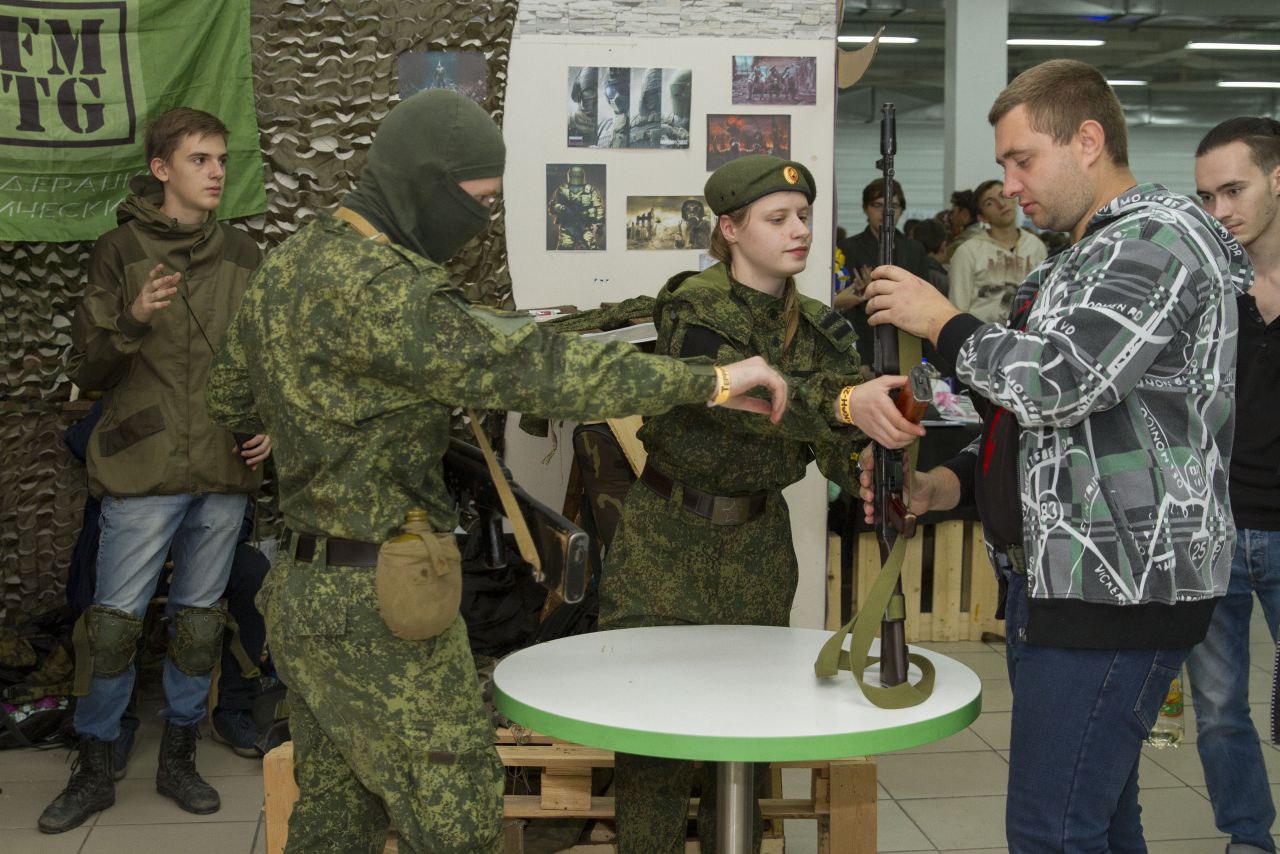
"There was simply nothing else happening in Donetsk. This festival was the only entertainment for teenagers and young people – a way to express yourself, be seen, and not be judged for your interests," Mariia recalls. "But unfortunately, even it couldn’t escape patriotic indoctrination. During the event there was a corner with military-themed merchandise, and at one of the venues you could do shooting with an assault rifle and go through an obstacle course."
"Donbas culture" – nothing but Russian epic poems and the legend of Shubin
"I never saw an actual map of the occupied territories until after I got to Ukrainian-controlled land," Tiia recalls. "They’d always show us a map of the whole of Donetsk Oblast. Some people might lightly draw a line by hand to mark the division, but we were taught about the whole oblast as if both the occupied and the Ukrainian-controlled areas were one. When I finally got to study the history of the Maidan and the war from 2014 to 2022, I realised that only a few cities in the oblast were actually occupied. Can you imagine how isolated we were from information?"
One of the new subjects introduced under the occupation was "Donbas Historical and Regional Studies". Textbooks published in 2019-2020 devoted considerable space to cities and cultural landmarks that at the time were still located in Ukrainian-controlled areas of the oblast.
For example, a 5th-grade textbook includes material about the Mariupol Museum and its collections. A section on heraldry features the coat of arms of Bakhmut (notably using the historical name rather than Artemivsk, the name preferred by the occupying authorities). Chapters on the Sviatohirsk Lavra (Monastery) appear in textbooks for nearly every grade.
Kateryna Zarembo, author of Ukrainian Sunrise, a book about the early 21st-century history of the Donetsk and Luhansk regions, describes these textbooks as a manifestation of Russian political fantasies.
"This approach to interpreting history is a vast layer of propaganda that’s being fed not only to people in the occupied territories, but to Russian society as a whole," Zarembo says. "It’s meant to normalise ideas of occupation, revisionism and historical injustice, including the notion of ‘great geopolitical catastrophes’ like the collapse of the Soviet Union.
If you look at Russia’s ultimatums, it becomes clear that they are imagining they possess Donetsk, Luhansk, Kherson and Zaporizhzhia Oblasts within their administrative borders – and that’s what they say in the textbooks."
Area studies textbooks about Donbas printed in Donetsk in 2020 describe the Holodomor of 1932-1933 as a natural famine caused by poor harvests. The Cossacks are portrayed as part of Russian history. These narratives are "balanced" by stories promoting the concept of Novorossiya from the time of Catherine the "Great".
The Ukrainian People's Republic is mentioned as a failed state. The textbooks describe miners’ protests in the 1990s without acknowledging their pro-Ukrainian nature, and the miners’ actions after 2004 are framed as the point where Kyiv and Donetsk began to diverge. Tiia says she only learned about the Ukrainian character of the miners' protests, the Holodomor, and the repression of Ukrainians on her own, after she had left Russian-occupied territory.

"The miners’ protests of the 1990s are considered one of the starting points of Ukraine’s civic movement – when people stood up and fought for the rights of their profession," says Kateryna Zarembo, commenting on the textbook material. "This was something that had been impossible in the Soviet Union, and it did indeed have a national character in terms of Ukrainian statehood. So it’s telling that once again, in the so-called ‘DNR’ textbooks, the miners’ protests are referenced only fragmentarily and through the lens of Russian propaganda."
One of the most absurd sections in the textbook is the chapter on the folklore of the Donetsk region. While Russian propaganda does not deny the region’s multiethnic history, it completely erases its heritage.
Tiia and Mariia say they were constantly being told at school that Donbas was a region where Russians, Ukrainians, Germans, Jews and others lived peacefully together. Yet the textbook reduces Donbas folklore to Russian ballads and epic poems (byliny), along with the legend of Shubin – a spirit who lives in the mines and controls the fate of the miners, who are supposed to offer him a share of their lunch.
"The way Russian propaganda erases the cultural heritage of Donbas, turning it into dry, soulless historical trivia, is a textbook example of the mutilation and violation of the Ukrainian history and legacy that’s rooted in this land," says Zarembo.
"According to the 1897 Russian Empire census, over 60% of the population in the Donetsk region was Ukrainian-speaking," she emphasises. "Photos taken in the Donetsk region in the 1920s show carol singers holding stars and people in Ukrainian folk dress. All over Donetsk and Luhansk Oblasts, you’ll find red-brick houses built by Western European colonists. These people, too, sang songs in their own languages and built their own cultures.
This heritage is an inconvenient truth that’s being hidden from children. Sadly, we are witnessing a live experiment in cutting people off from the truth. Only what is convenient for Russia remains."
***
For 11 years now, pro-Russian educators in the occupied territories of Donetsk and Luhansk oblasts have been trying to raise a generation ignorant of its roots and unable to freely choose its own identity. The cultural, political and social achievements of the people who lived in these territories are silenced, and the only past promoted with pride is that of militarism and the worker identity.
Raphael Lemkin, the lawyer who coined the term "genocide", said that genocide does not only mean physical destruction. It also refers to actions aimed at "the disintegration of the political and social institutions, of culture, language, national feelings, religion, and the economic existence of national groups".
The Russian authorities’ actions with regard to the education system in the temporarily occupied Ukrainian territories clearly bear the hallmarks of genocide – and they confirm that Russia’s war against Ukraine is existential in nature.
Author: Sofiia Cheliak
Editor: Rustem Khalilov
Translator: Elina Beketova
Editor: Teresa Pearce