

Pavlohrad, 14 August 2025
Fighting in eastern Ukraine is intensifying, and with it comes a new, large-scale wave of evacuations. In recent days, this wave has swept across Donetsk and Dnipropetrovsk regions. In just the past 24 hours alone, humanitarian missions, volunteers, and police have evacuated nearly 500 people from eastern Ukraine - mostly families with children. For comparison, the same number of people was evacuated this spring over the course of an entire month along the whole contact line.
Familiar roads are turning dangerous, quiet villages are becoming battle zones, and children are once again becoming displaced. Access to water, education and medical services is deteriorating. Drones and bombs are now reaching towns and villages that, just at the start of summer, were considered rear areas and relatively safe. A cloud of anxiety and tense waiting hangs over thousands of families in eastern Ukraine, suddenly finding themselves within 15 kilometres of the front line.
And they must make a heartbreaking choice.
"I have four children: my eldest is 11, and my youngest is just three months old. What are we leaving behind? We’re leaving everything," says 43-year-old Oleksii from the village of Zoryane in Dnipropetrovsk region, averting his gaze and trying hard to hold back tears.
Oleksii and his wife are leaving behind their house, their pets, and his elderly mother, who still refuses to leave.

"It’s very hard. I never wanted to go. But we’re leaving for one reason only - for the safety of the children," he says, helping his children onto a white evacuation bus, carefully handing baby Rodion to his wife, and saying goodbye to his mother as explosions echo in the distance. This time, the tears come.
On the borderline
White humanitarian evacuation buses travel along the boundary between Donetsk and Dnipropetrovsk regions, stopping in settlements where elderly people, families, children, and even pets are waiting. The route passes by lines of concrete tank traps and under protective mesh strung across the road to guard against drone attacks. Even so, drivers try not to linger — the threat of shelling remains.
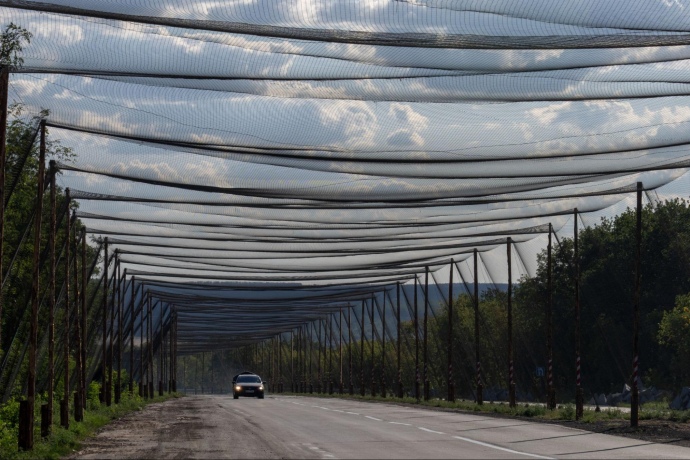
There are several buses today — the number of people needing to be rescued is high.
"Unfortunately, a new wave of evacuations has begun. Evacuation traffic has increased fifteenfold — it’s enormous. It started in July with Dobropillia, when the town came under airstrikes and drone attacks. The front has advanced, and small towns like Bilytske, Bilozerske, and Rodynske began suffering, followed by five communities in Dnipropetrovsk region along the Donetsk border. We prioritise families with children. Every day we get hundreds of evacuation requests," says Yevhen Kaplin, head of the humanitarian mission Proliska, who is also taking part in today’s evacuation convoy.
The absence of mobile phone service in some settlements makes evacuations even more difficult, but volunteers and police in armoured vehicles continue to search for people, even when they can’t call them.
"I advise families, especially with children, not to delay evacuation - leave while you can. In Mezhova, for example, there is no longer any phone service, guided aerial bombs are hitting the town, and yet children are still there. Right now, we’re trying to locate a mother with an 11-month-old baby who is hiding in a basement without communication. We keep looking for her," Yevhen says, checking the long list of evacuation requests on his phone.
Volunteers are still receiving many requests from the town of Bilozerske in Donetsk Oblast.
Now almost the whole town is packing their belongings. Bilozerske has been left without water, and guided aerial bombs (KABs) and drones are flying overhead.
Two buses and one armoured vehicle from another humanitarian mission, the Relief Coordination Centre, came under fire this morning while evacuating people from Bilozerske and Dobropillia. A KAB fell 100 metres from the evacuation convoy on the road near the village of Virivka. All passengers are unharmed but frightened.
They step out of the wrecked bus in Pavlohrad, carrying out cats wide-eyed with fear and their bags. They shake shards of glass and metal fragments from a shell out of their bags.
A blonde woman from Bilozerske hands the driver a piece of metal that flew past her and shattered a window: "It was only a few centimetres from my ear. I heard it whistle".
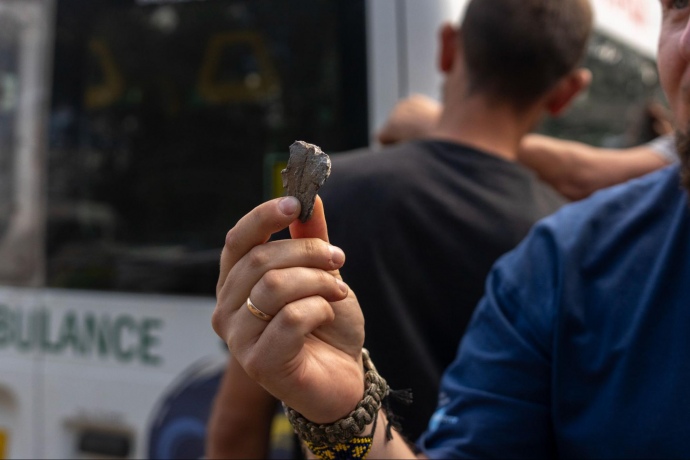

"Mum, when will we go back?"
"But who will feed my pets?" asks 10-year-old Dasha, holding back tears in her mother’s arms. She woke up at 6 a.m. today to slice cucumbers for her rabbits — one white and five black — before getting ready to leave. Into her pink school rucksack she packed pyjamas, a towel, coloured markers, a colouring book, and some treats. There was no room for her favourite toy.
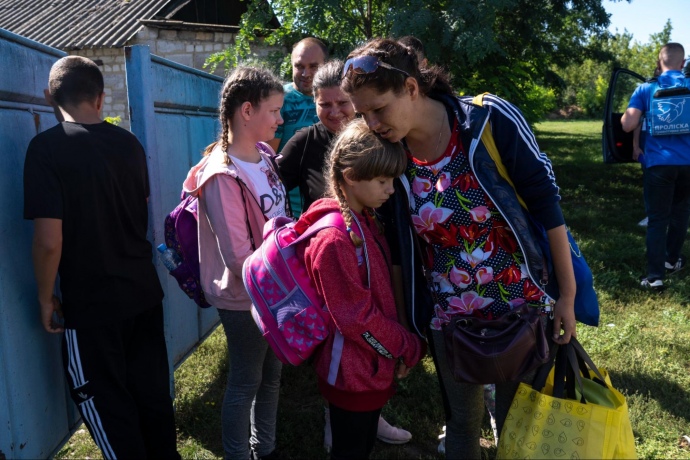
The bag still looks almost new — her school has been closed for years due to the war, and she’s been studying from home. But now that drones have reached her village of Slavianka in Dnipropetrovsk region, even home is no longer safe.
"I live with my mum, sister, grandmother, our rabbits, and kittens. We left today because it became dangerous. Sometimes there’s shooting. The scariest moment was when a drone fell right next to us — our windows almost shattered. Now we’re going to relatives, and my grandma stayed to feed our animals," Dasha says, as her mother loads their belongings onto the bus.
The family is heading to Vinnytsia. Along the way, Dasha asks her mother how far they still have to travel and when they’ll be able to come back for her rabbits, her grandmother, and her toy dog. But her mother, Iryna, has no answer to that last question.
"I want to go and see something new, but then I want to come back home," Dasha says, looking out the window at the sunflower fields rolling past.
"In a week, our town was burned to ashes"
Families evacuated from the east are taken to a transit centre in Pavlohrad, which operates as a humanitarian hub. Here they receive first aid, hot meals, psychosocial support, a place to sleep, and registration for relocation and financial assistance. UNICEF also provides financial support to families forced to flee.
Oleksii from Zoryane is registering for assistance while his wife breastfeeds their youngest son.
"First and foremost, families with children need financial help. Now we’ll look for housing where the children will be safe. When we get UNICEF’s assistance, we’ll use it to pay rent. The war has been going on for a long time, but this is the first time it has come so close to our home," says Oleksii, who lost his job as a teacher when the local school closed due to the fighting.
Next to him in line is 29-year-old Yulia, mother of four-year-old Yehor, who left the settlement of Biletske in Donetsk region.
"We’re originally from Myrnohrad. In just a week of shelling, our town was burned to ashes. I don’t even know what happened to our home. When the attacks began, we fled to my parents in Biletske. It was quiet there for a while, but then the war came there too. We didn’t want to wait for the airstrikes to destroy the houses one by one, so we came here. Now we’re looking for a place where Yehor can sleep peacefully," Yulia says, stroking her son’s head.
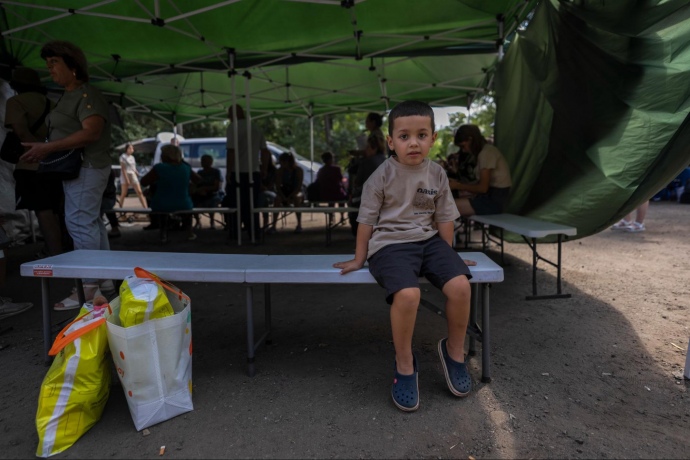
The boy sits on a bench in the transit centre, eating pasta his mother cooked for him that morning before they left their home for an unknown length of time.
One by one, more buses arrive at the centre, bringing families with children, pensioners, people with limited mobility, and evacuees carrying cats, dogs, guinea pigs, and parrots — all those whom the war has driven from their homes. Today, humanitarian workers are particularly awaiting the last bus from Mezhova. On it is the mother with the 11-month-old baby, found and rescued after a full day of searching.
UNICEF works with local authorities and partners to support displaced children and families, providing them with financial assistance, essential supplies, and access to healthcare, education, and social services, including psychosocial support.