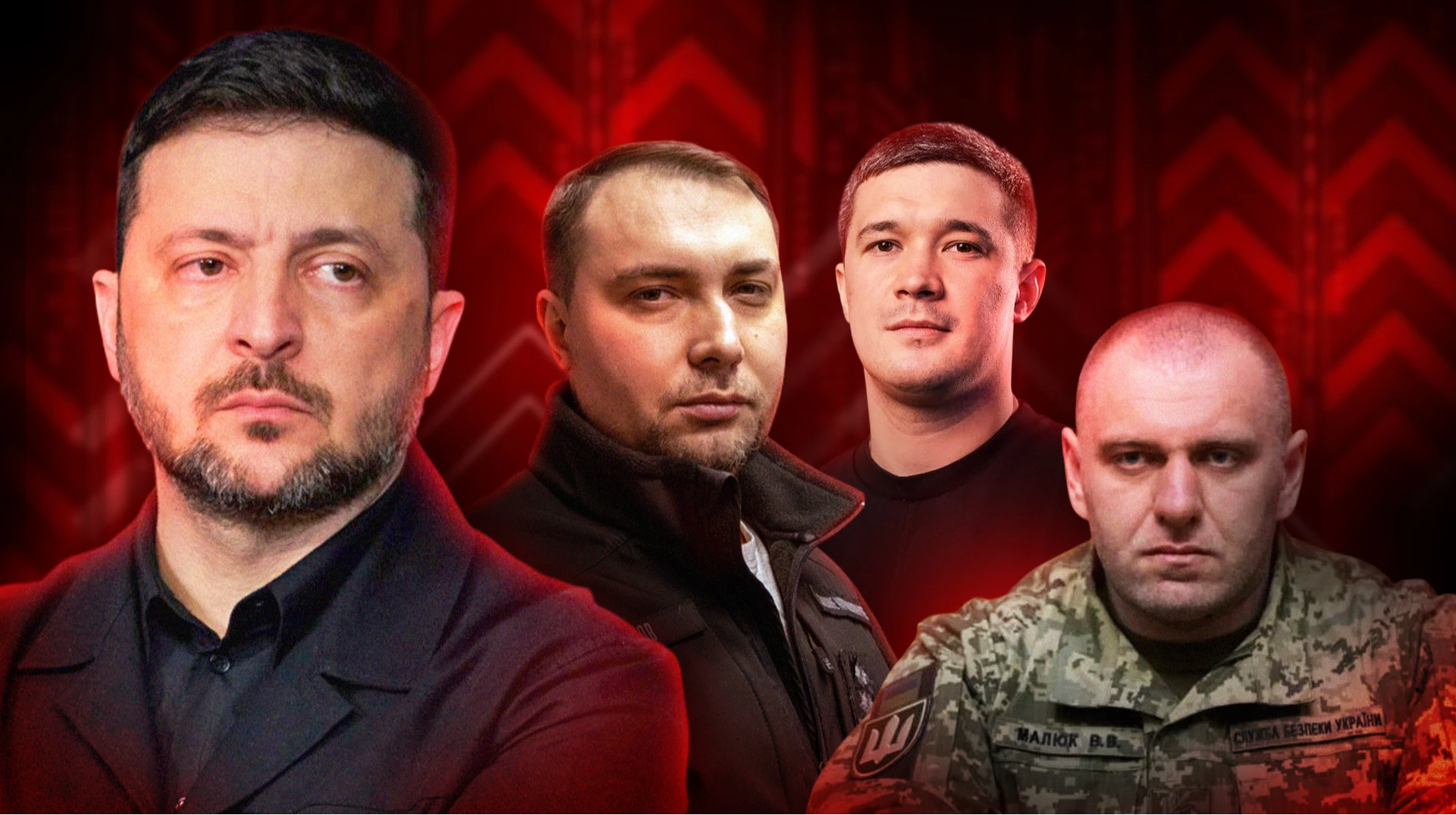
All change: why Zelenskyy needs to reshuffle Budanov, Fedorov, Shmyhal, Maliuk and other top officials

"Self-destruction will build me up again"
Stop Her ("Зупини Її") by Nikow
Ukrainian politics is not exactly dull, but truly epoch-defining moments don't come along all that often. The sweeping reshuffle of the first few days of January 2026 has a strong claim to be called such a moment.
That's especially true given that the "redeployment" of Kyrylo Budanov, Denys Shmyhal, Mykhailo Fedorov, Vasyl Maliuk and other top officials appears to be only the first wave of a wider series of anticipated hirings and firings in what could be described as Zelenskyy's upgrade to "version 3.0".
The first stage of Volodymyr Zelenskyy's presidency could be most accurately summed up by a line he used in an election campaign debate with Petro Poroshenko: "I am not your opponent; I'm your verdict." The second stage could be encapsulated in these words from his most famous wartime address: "The president is here" [i.e. in Kyiv].
The new version of Zelenskyy has yet to be given a name, but it can already be said to be preparing for both war and peace.
What triggered this transformation was the resignation of the omnipresent Andrii Yermak as head of the President's Office – Zelenskyy's chief of staff. For Zelenskyy, Yermak had functioned as chief cook and bottle-washer, covering government management, military matters and geopolitics all at once, meaning his sudden exit risked pushing the system close to paralysis.
Zelenskyy had two options: either find a way to preserve Yermak's influence covertly through various proxies operating in the shadows, or embark on a radical restructuring of the entire system, attempting to shore up his power with the last remaining members of his team who still had positive political significance.
After hesitating for more than a month, the president chose the second, far more difficult path. The current reshuffle does not yet amount to a complete excision of Yermak's tentacles from the system, but the overall mood suggests that this is only a matter of time.
A senior official who himself narrowly avoided being caught up in Yermak's desperate attempts to save himself told Ukrainska Pravda: "You know that in the last week before his dismissal, Yermak was sending emissaries to anti-corruption people and proposing a 'trade': if they left him alone, he would arrange for Maliuk, Budanov, Tatarov, Sukhachov and several others to be removed. After that, I don't think he has many friends left who are still willing to listen to him."
Ukrainska Pravda decided to find out why Zelenskyy needs spy chief Kyrylo Budanov as head of the President's Office; why the technocrat Mykhailo Fedorov is being dispatched to run the Ministry of Defence; why the president pushed through the resignation of wartime hero General Vasyl Maliuk; and, more broadly, what the high-profile reshuffles of recent days mean for the future of the government – and for the country itself.
Budanov at Bankova Street
Over the past year, Andrii Yermak (then head of the President's Office) made repeated attempts to have Kyrylo Budanov (then head of Ukraine's Defence Intelligence) removed from his post. As a result, Budanov was, entirely predictably, one of the first and most active participants in the "mutiny" against Yermak after the so-called Mindich tapes were released by the anti-corruption agencies.
As far as Ukrainska Pravda's sources among the "revolutionaries" are aware, there was no talk of Budanov being moved to the President's Office at that time. The early configuration of changes envisaged by members of the informal "revolutionary committee" saw Mykhailo Fedorov moving to the Defence Ministry, with Denys Shmyhal taking over the role vacated by Yermak at the President's Office.
But when Yermak was eventually dismissed and the president began actively searching for a replacement, it was not Denys Shmyhal who emerged as a leading contender, but Mykhailo Fedorov and Kyrylo Budanov.
Some media outlets reported that a figurehead – Vladyslav Vlasiuk, the President's Commissioner for Sanctions Policy – could be appointed to head the Office, effectively serving as a façade for Andrii Yermak's return to power. When this idea surfaced publicly, it provoked such a fierce backlash, both within the President's Office and across other camps of the ruling team, that it is hard to believe there were forces capable of pushing such an appointment through.
After returning from talks in Mar-a-Lago in the final days of 2025, Zelenskyy had further discussions with the two leading candidates and ultimately chose Budanov. The broader context of the negotiations with US President Donald Trump may well have been one of the decisive factors behind his choice.
One senior member of the president's team, sharing their impressions of the US trip a day or two before Budanov's official appointment, said: "Our people came back from America feeling that we'd been treated somewhat like fools. While Yermak was in office, he monopolised all the negotiations and didn't let anyone else talk to anyone, and we lost the chance to establish contact with Kushner and other key officials six months to a year ago. Now something needs to be done about this urgently."
Zelenskyy himself framed the choice of his new chief of staff in similar terms, explicitly linking it to the negotiations.
"I am strengthening the negotiating team. That's what I am doing," the president told journalists when he was asked about Budanov's appointment.
In his previous role, Budanov was one of the very few officials who dared – quietly and out of the public eye – to maintain parallel channels of communication with various camps within Trump's circle, from General Keith Kellogg to Vice President JD Vance's team. Yermak repeatedly tried, both directly and via the president, to block this contact.
In the eyes of the Americans, Budanov has two major advantages. First, he has a realistic understanding of the situation on the battlefield, which makes him a credible negotiator. Second, he has not been implicated in the recent high-profile corruption scandals, meaning there is no reputational risk in talking with him.
In addition, Budanov is arguably the only person in the country who has direct, working-level contact with the Russians. He has communicated with them on prisoner swaps, and he held separate face-to-face talks in the UAE during the latest round of diplomatic efforts by the new US team.
A stronger negotiating team and the "decentralisation" of contact with the United States are, in fact, expected to be the main changes brought about by Budanov's appointment.
Incidentally, the foreign policy aspect was one of the main reasons why Budanov agreed to take on the new role.
As head of the President's Office, Budanov will effectively lead the Ukrainian side in the negotiations on ending the war, securing guarantees from the United States and its partners, and addressing the broader range of security issues.
Sources within Zelenskyy's team told Ukrainska Pravda that over the past year, Budanov had repeatedly tried to get across to the president how Andrii Yermak was really perceived in Washington, how his negotiating style was viewed, and whether he was considered capable of handling such talks at all. Now Budanov will have a chance to show what he can do in this area himself.
Given Budanov's steadily rising approval ratings, this chance to become an architect of peace offers the new head of the President's Office a genuine opportunity to take the final step that separates him from top-level politics.
That's why many in the corridors of power have dubbed Budanov's arrival at Bankova Street (where the President's Office is located) as pretty much the start of Operation Successor. Since Zelenskyy realises how uncertain his own chances of re-election are, the logic goes, he has appointed someone he can trust – not only with the negotiations on ending the war, but also the talks on "security guarantees" for himself and his immediate circle in the event of a transition of power.
And it must be said that Budanov, who maintains working relationships with virtually all the major centres of influence in the country, is an exceptionally good fit for the role. Only under Budanov could people as different as seasoned politician Yevhen Chervonenko and blogger Kseniia Maneken have operated under the same roof. Only Budanov has managed to maintain equally functional relations with both Oleh Tatarov and the heads of the anti-corruption agencies. And only Budanov currently has direct lines of communication with both the Americans and the Russians.
Yet it would be naïve in the extreme to interpret Kyrylo Budanov's appointment as an attempt by Zelenskyy to step aside – at least for now.
If that were the case, why would the president have appointed someone long seen as a trigger for Budanov – Lieutenant General Oleh Ivashchenko from the Foreign Intelligence Service – to head Defence Intelligence of Ukraine, rather than loyal Budanov ally Major General Vadym Skibitskyi?
Not only has this effectively cut Budanov off from the powerful megastructure he spent years building, it also has a distinct whiff of Yermak about it, as this is precisely the kind of replacement Yermak himself had been pushing for all year.
In fairness, it should be noted that Ivashchenko himself has worked his way up through the ranks at Defence Intelligence of Ukraine. And in a lifelong career, a general will inevitably have worked alongside a long list of politicians, making it unwise to fixate solely on the most recent of them (Yermak). Still, if there is revealed to be any truth in reports that Yermak is effectively living in and working out of Foreign Intelligence Service facilities, alarm bells will definitely be ringing.
Be that as it may, for now it appears that Zelenskyy has deliberately prevented Budanov from combining his influence in the sphere where he built his authority with the powers that come with his new position. Instead, he has pulled him into an entirely new – and overtly political – reality.
In other words, the president is not opposed to his chief of staff becoming a serious political player – but only if he plays strictly within his own team.
"Power plays" within the system
All the other reshuffles announced in recent days only reinforce the impression that Zelenskyy is not looking for a successor, but trying to build a new system tailored to himself.
It is through this lens that the second most high-profile personnel move must be viewed: Mykhailo Fedorov is expected to replace Denys Shmyhal as minister of defence.
Shmyhal resisted any change to his position for as long as he could. He was one of the first to decline the offer of heading the President's Office – entirely understandably. After being appointed to lead the Defence Ministry, he spent half a year stabilising the institution so that it could recover from the effects of Rustem Umierov's "managerial genius".
At his first meeting with the president last week, Shmyhal again showed no enthusiasm for moving to another post. However, it soon became clear that Zelenskyy's interest was more than just casual, and that Shmyhal would indeed have to leave the Ministry of Defence.
The main reason for the president's persistence was simple: he had already promised the position to current First Deputy Prime Minister Mykhailo Fedorov.
If this appointment does go through – and securing the necessary votes in a demoralised parliament will not be easy – it will mark the end of the longest-running personnel saga of recent years. Fedorov's constant attempts to become defence minister have been going on for several years now.
As Minister of Digital Transformation, Fedorov has been one of the main drivers of technological change in the armed forces throughout the war. Multiple sources told Ukrainska Pravda that he constantly puts forward technical solutions at high-level military meetings, pushing through complex projects such as the Drone Line.
"Misha [Mykhailo – ed.] has an entire vision of a new kind of technological warfare. He's been trying to push it for a long time, often against fierce resistance from the system. If he does become defence minister, all of this will be unleashed at full throttle," one senior government official explained to Ukrainska Pravda.
In essence, Shmyhal was assigned the role of an emergency physician at the Ministry of Defence – tasked with stabilising a critically ill patient. The actual treatment and long-term recovery are to be handled by Fedorov.
That's how President Zelenskyy sees it, anyway.
As Zelenskyy has explained to journalists, Budanov's appointment and the move of Serhii Kyslytsia – a close associate of Yermak – from the Foreign Ministry to the President's Office are intended to get Ukraine ready for intensified international efforts and a possible end to the war through negotiations.
Fedorov's appointment, by contrast, is intended to speed up the modernisation of Ukraine's defence forces in case Russia derails the talks and Ukraine is forced to continue fighting at the same intensity as it is now.
The potential appointment of a new defence minister would pave the way for further, as yet unannounced but already clearly visible, personnel changes at the very top of the military command.
At least, as far back as last summer, when Prime Minister Yuliia Svyrydenko's government was being formed and Fedorov was once again one of the candidates being considered for defence minister, Fedorov suggested that Commander-in-Chief Oleksandr Syrskyi and his team should be replaced in order to give the defence forces "new momentum" and a different decision-making culture.
Whether he will be able to do this now is hard to say. What is certain is that Shmyhal has failed to break the generals' closed ranks – and this appears to be the main reason why Zelenskyy asked him to step down.
Ultimately, Shmyhal's move can only be to Ukraine's benefit: for the first time in years, the Energy Ministry will be headed by someone who actually understands the industry rather than a politician whose main skills are constructing schemes and funnelling money to handlers in Moscow. In case anyone has forgotten, before entering public service Shmyhal successfully ran one of Ukraine's largest power plants – the Burshtyn Thermal Power Plant.
At the same time as his defence ministry reshuffle, Zelenskyy is launching a sweeping reset of the key security agencies. Defence Intelligence of Ukraine has a new head. The Foreign Intelligence Service will be next. The long-serving head of the State Border Guard Service, Lieutenant General Serhii Deineko, has also been removed from his post, both to neutralise the reputational damage caused by corruption scandals involving fugitive officials and possibly to pre-empt further procurement scandals.
Vasyl Maliuk will also have to step down as head of the Security Service of Ukraine. When he met with the president on Saturday following a wave of public support from prominent civic figures and military personnel, Maliuk refused to resign and move to the Foreign Intelligence Service or the National Security and Defence Council.
As far as Ukrainska Pravda is aware, Maliuk justified his position by saying that several operations on a scale comparable to that of Operation Spider's Web are in the final stages and it would be irresponsible to abandon them now.
However, Maliuk reportedly added that if that was the president's wish, the issue should be referred to parliament to be decided there.
Maliuk's refusal to resign is said to have infuriated Zelenskyy. Communications advisers further fuelled the president's irritation by arguing that the public campaign in support of the general "had been orchestrated by the Security Service itself". A stressed-out Zelenskyy threatened to suspend Maliuk from office if he did not resign of his own accord. The power to do this was in fact granted to the president by Parliament at the start of the full-scale invasion with regard to officials appointed by the head of state.
Many MPs fear the public outcry that could ensue if this procedure were to be used against Maliuk, who is best known for being the brains behind sea drones, the attacks on the Crimean Bridge and Operation Spider's Web.
Within Zelenskyy's circle, however, Maliuk is seen firstly as one of the public faces of the Yermak-orchestrated attack on the National Anti-Corruption Bureau of Ukraine (NABU) and the Specialised Anti-Corruption Prosecutor's Office (SAPO), which the President's Office is now desperately trying to distance itself from. Secondly, Maliuk is accused of allowing the Security Service to engage in blatant "commercial activity" in the rear, selectively squeezing businesses at will.
Maliuk's own team, by contrast, believe that his removal is nothing more than revenge by Yermak – who remains in the president's orbit – for Maliuk's stance during Mindichgate and the searches at Yermak's home.
At a briefing on Saturday, Zelenskyy – visibly irritated, though he did not name the Security Service head – said he would go ahead with all the replacements he had planned. Ukrainska Pravda has learned that the President's Office had even begun looking for formal legal grounds to issue a decree suspending Maliuk.
By Sunday 4 January, the Security Service head was being pressured not only to resign, but also to publicly express gratitude for being dismissed.
Despite strong support from the military, international partners and MPs, and despite the slim chances of parliament approving his removal, according to Ukrainska Pravda's information Maliuk ultimately decided that escalating the conflict with the president would be harmful to the state and agreed to step down. The timing and procedure for his removal, which must be voted on in Parliament, are expected to be decided shortly.
Maliuk may be replaced on an interim basis by Major General Yevhen Khmara, head of the Security Service's Alpha special forces unit. However, Zelenskyy has not abandoned the idea of placing the Service in the hands of General Oleksandr Poklad – a candidate in whom Andrii Yermak had (and may still have) high hopes.
But the new head of the President's Office is unlikely to agree to that, given the fierce animosity between them that insiders have reported.
***
If and when the president manages to complete all the government and security reshuffles he has promised, another equally important phase will begin: changes within the army.
Taken as a whole, the reshuffles may appear unsettling. In one fell swoop, the president is clearing out the entire top tier of the security institutions that have racked up combat achievements and built up significant public goodwill year after year during the war.
Some see this as purely political, arguing that Zelenskyy is pre-emptively pushing influential security leaders away from the centres of power so they will be unable to leverage that influence during future elections.
In reality, the problem is far broader. As Ukraine approaches its fifth year of full-scale war, it has become clear that the existing system of governance and security institutions is in fact gradually deteriorating.
The heroic momentum of the early years still sustains the public standing of many agencies, but that impulse has weakened to the point where a single corruption scandal could bring down not only an individual institution, but – through a domino effect – the entire system.
At this stage, cosmetic adjustments will not save the situation. If anything is to be changed, it must be the system as a whole. Russia may not allow Ukraine another moment – or another chance – to do so.
And if in the course of these reshuffles Zelenskyy once again emerges as the only major player capable of forcing through change and recalibrating the balance of power in his favour, that would merely be a "nice bonus" for the president.
Author: Roman Romaniuk, Ukrainska Pravda
Translation: Myroslava Zavadska
Editing: Teresa Pearce