Fewer Ukrainians now willing to endure war for as long as it takes, survey shows

The number of people in Ukraine willing to endure the war for as long as it takes has declined over the past two months – as of early March, this figure stood at 54%, down 11 percentage points from January.
Source: a survey conducted by the Kyiv International Institute of Sociology (KIIS) on 1-8 March
Quote: "Between late January and mid-February 2026, there was a significant decrease in the share of those willing to endure the war for as long as it takes. At the end of January, the figure stood at 65%, but by mid-February it had fallen to 52%."
Details: KIIS asked the question again in March to see whether the trend would persist.
"The March survey confirms the previously identified negative trend, although without further deterioration, at least for now. It shows that 54% of Ukrainians are willing to endure the war for as long as it takes. Meanwhile, 28% say they would accept a shorter period of several months to half a year," the sociologists noted.
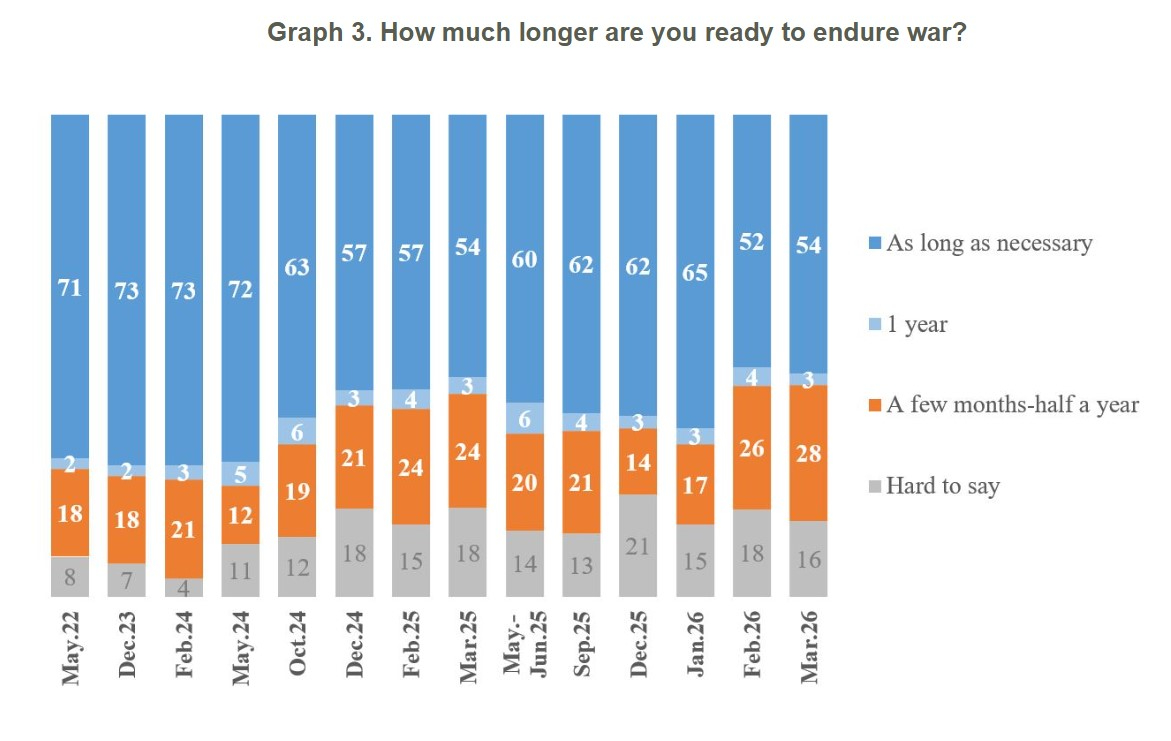
KIIS said the decline in willingness to endure the war was largely concentrated among those who were more willing to consider a difficult compromise that would see Donetsk Oblast ceded to Russia in exchange for security guarantees.
The sociologists suggest that towards the end of January, this group may have had higher expectations regarding the outcome of the peace talks, especially given that former Defence Intelligence chief Kyrylo Budanov had been included in the Ukrainian delegation. However, as it became increasingly clear in February that no real progress was being made in the talks, this had a demoralising effect on this segment of the population.
KIIS also points to other factors that may have influenced the survey results, such as the fact that February is typically seen as a "more depressing month" and there is a general sense of internal heightened alertness among Ukrainians due to the difficult energy situation during the winter. Against this backdrop, there is also faith that Western partners will provide more decisive support for Ukraine, and in the wider global context shaped by the US's new operation against Iran.
However, KIIS Executive Director Anton Hrushetskyi notes that the public mood among Ukrainians was similar at the start of 2025.
Quote: "However, a worrying trend is the decrease in the share of those who are willing to endure war as long as necessary. Perhaps this is a temporary decrease and the adaptation period is currently underway. A similar situation was in the first half of 2025, when both the willingness to endure the war and optimism about the country's future decreased, but then, in the second half of 2026, the indicators returned to higher levels."
More details: Hrushetskyi has not ruled out, however, that this may also be a longer-term trend, given the duration of the full-scale war and the worsening geopolitical situation around Ukraine and worldwide.
The study was conducted from 1 to 8 March. Using telephone interviews based on a random sample of mobile numbers, the sociologists surveyed 1,003 respondents aged 18 and over who, at the time of the survey, lived in territory of Ukraine controlled by the Ukrainian government.
Formally, under normal circumstances, the statistical error of such a sample (with a probability of 0.95 and taking into account the design effect of 1.3) did not exceed 4.1% for indicators close to 50%, 3.5% for indicators close to 25%, 2.5% for indicators close to 10%, 1.8% for indicators close to 5%.
In wartime conditions, in addition to the stated formal margin of error, there is also a certain systematic deviation, but the sociologists believe that the results are still highly representative and make it possible to analyse public sentiment quite reliably.
Background: In January, 65% of Ukrainians said that they were willing to endure the war for as long as it took.
Support Ukrainska Pravda on Patreon!