


On 24 February 2022, staff at the Chornobyl Nuclear Power Plant (NPP) and the National Guard troops assigned to protect it were among the first Ukrainians to encounter invading Russian forces.
The Chornobyl Nuclear Power Plant is only 16 km away from the border with Belarus, meaning that Russian troops were able to quickly enter the Chornobyl Exclusion Zone and occupy it.
The plant was liberated by Ukrainian forces in early April of that year. However, as they retreated, the Russians took 169 National Guard soldiers captive and stole over $100 million worth of equipment.
Up until 2022, visitors – even tourists – could enter the Chornobyl Exclusion Zone, and it was quite a popular destination. But after the invasion, access to the Chornobyl Nuclear Power Plant was closed, and entry is now impossible without a special permit.
However, shortly before the 40th anniversary of the Chernobyl disaster, Ukrainska Pravda, together with Greenpeace, managed to visit the plant and enter the infamous reactor number four.
Here's what we saw there.
The April sky is enshrouded in thick grey clouds. Darker and lighter layers of cloud overlap, scattering sleet onto the ground. The wind is biting, penetrating through several layers of clothing to sting any exposed skin. Empty space stretches out all around.
The abandoned, rusted-over fifth reactor of the Chornobyl Nuclear Power Plant looms on the horizon. It would have been put into operation at the end of 1986, but construction was halted after reactor 4 exploded. For 40 years it has stood there out in the open, surrounded by the skeletal remains of rust-coloured cranes.
Behind us is a memorial to those who died trying to extinguish the fire in the nuclear reactor nearly half a century ago. Ahead of us is the main building of the plant. The grey concrete against the grey sky is broken up by a huge mural depicting a human hand holding the "peaceful atom" in the foreground, with Przewalski's horses in the background.
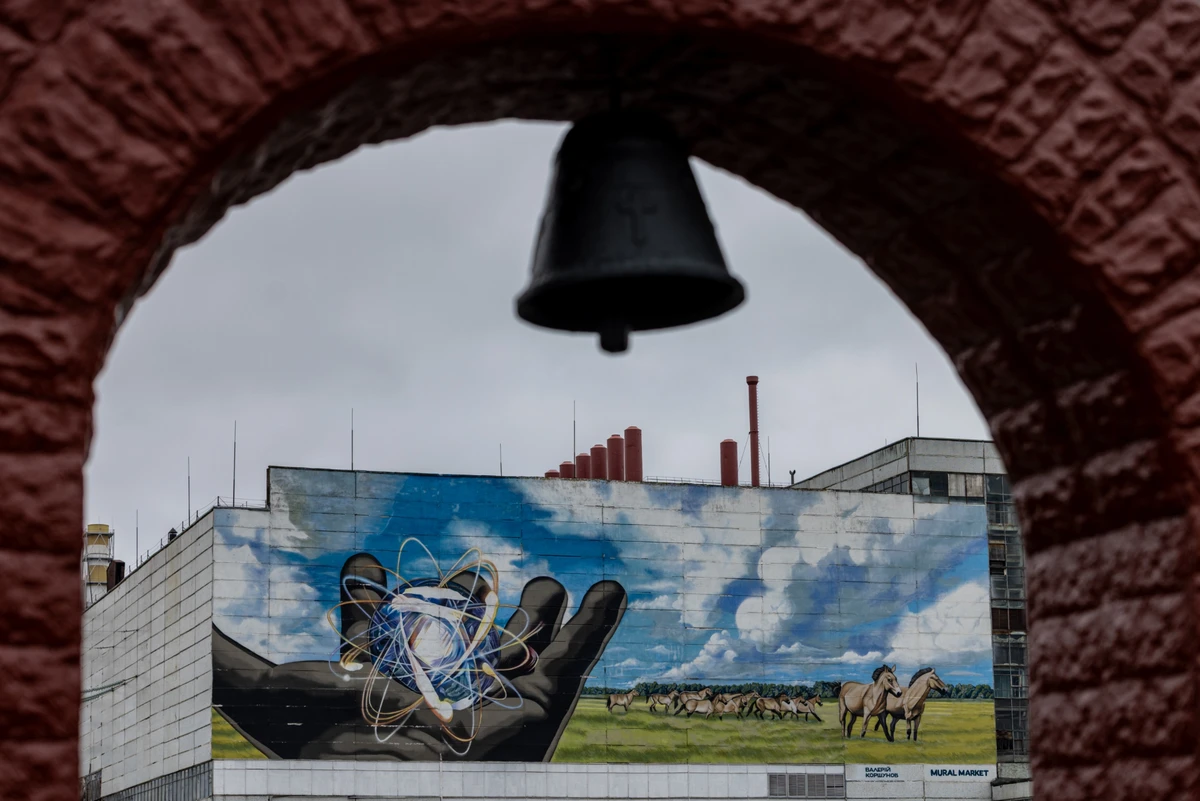
Forty years ago, as a result of Soviet policies, this was the site of one of the worst man-made disasters in the history of the planet. Russia (or rather the USSR) had concealed design flaws in the RBMK-1000 (high power channel-type) reactors and covered up earlier, smaller-scale incidents, and the experiment that led to the explosion of reactor number 4 had been poorly planned.
As the reactor effectively "breathed" radiation into the outside world, the Soviet authorities chose not to warn citizens about the possible risks, and the traditional May Day parade went ahead as normal in Kyiv, only about 100 km from the site of the explosion.
Later, during the investigation, the authorities shifted the blame entirely onto the plant's staff. The damage caused by the tragedy remains incalculable even to this day.

Yet even 40 years on from the tragedy, the Russians are giving Chornobyl no peace. As we queue for dosimeter checks, an air-raid siren begins to wail: drones are flying over Chernihiv Oblast, likely heading in our direction.
On 14 February 2025, a Russian Shahed drone struck the New Safe Confinement (NSC, also known as "the Arch"), tearing a 15-sq-m hole in it. The layer of materials beneath the metal shell – designed to shield the outside world from the sarcophagus and the sarcophagus from the outside world – began to smoulder. Firefighters had to cut into the structure to extinguish the blaze. As a result, what was originally one large hole became more than 300 smaller openings, through which snow and water are now seeping inside.
From a distance, however, the damage is not visible. The confinement structure looks like a giant arch covering the reactor. The original plan was that over the next hundred years, several generations of plant workers would use special cranes to dismantle the sarcophagus and the radioactive debris that part of reactor 4 has turned into.
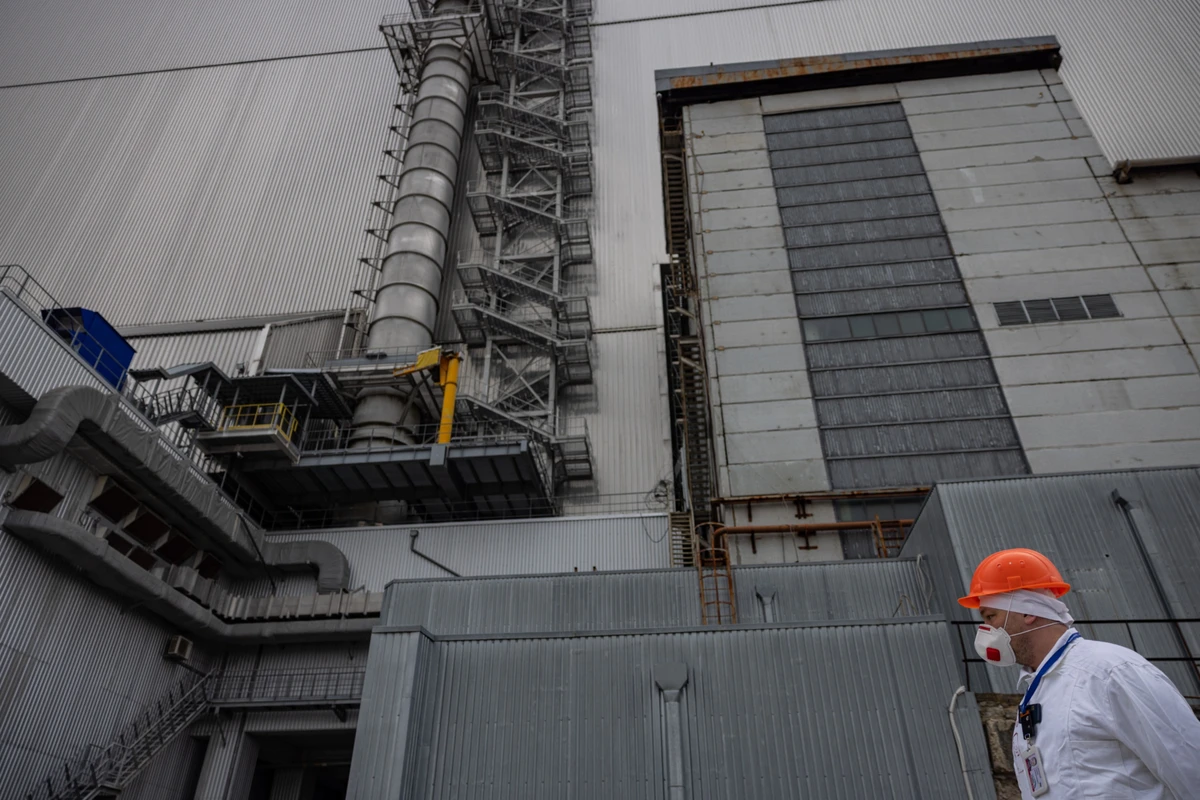
But now, engineers have to find a way to reseal the confinement structure in order to maintain a stable temperature and pressure inside. Experts and workers from other countries are unlikely to agree to work under the threat of Russian drones, which still fly over the Chornobyl Exclusion Zone occasionally.
According to the most optimistic estimates by the Chornobyl NPP's management, it could take several years to restore the hermetic seal of the confinement structure, as the work will have to be carried out at considerable height and with exposure to radiation.

Getting under the Arch to the sarcophagus itself is no easy task. You start by walking down the so-called "Golden Corridor" – a long passageway connecting all four of the Chornobyl Nuclear Power Plant's reactor buildings.
But before that, you have to get changed: the clothes you wear to enter the contaminated area must remain within the territory of the plant.
The changing room feels more like a hospital: bare walls, narrow metal lockers. The space is flooded with a pale white light that makes your eyes ache: you keep wanting to turn up the brightness.
First we change our shoes, leaving ours at the entrance and replacing them with slippers provided by the plant. Then we undress to our underwear at the lockers. In the next room, we are given two pairs of trousers and shirts each, jackets to go on top, and caps and helmets to cover our heads. Replacement socks and replacement shoes complete the outfit. Everything, apart from the blue jackets, is the same stark white as everything around us.

We walk down the dimly-lit corridors. The cold goes with us. It feels omnipresent. At least the wind can't reach us indoors. At times there are no windows in the corridor at all, and the darkness is broken only by yellow lamps that cast circles of light into the surrounding gloom.

The sound of dozens of footsteps echoes ahead of us and behind us. Apparently it's not often you see so many people here at once. A few minutes later, we notice that the walls are lined with gold-coloured metal panels – the reason this is called the "Golden Corridor". The panels are designed to shield against radiation, our guides explain.
Our escorts warn us that if anything falls onto the floor or the ground, it will stay there until staff have checked it for contamination. In the worst-case scenario, the item will have to be sent for decontamination.


Talking as we walk, we reach the Unit 3 control room, a small room containing several panels that once controlled the third reactor. Here we are given another dosimeter – one that will monitor the amount of radiation exposure we receive. We put respirators over our faces and gloves on our hands. From this point on, touching anything is strongly discouraged.
After another 20 minutes we find ourselves outside, right next to the confinement structure. Some twisted metal is lying there a few dozen metres from the main wall – the remains of the New Safe Confinement's outer cladding after it was hit by the Russian drone.
Up close, the Arch seems vast: it's over 90 metres high and 270 metres wide. It's tall enough to fit Kyiv's Motherland Monument inside and wide enough to fit the Sydney Opera House.
The New Safe Confinement control room is like a futuristic spacecraft, full of screens, computers and buttons. Monitors display pressure, temperature, humidity, radiation levels and countless other readings from inside the confinement structure. The handful of workers keep a close eye on the indicators.
They say radiation levels around the protective shield did not rise critically after the Russian attack, which is good news. But that doesn't mean it couldn't happen in the future, which is why the structure needs to be resealed within the next few years. Besides, radiation and exposure to the elements will cause the shield to age faster.


The sarcophagus, surrounded by engineering structures, looms over you like a concrete and metal monolith. You can't take your eyes off those rust-streaked walls. Half of the building that once housed reactor 4 is hidden in the gloom. Part of the "Golden Corridor" is somewhere there, too, but, as staff explain, entering the territory of reactor 4 is not advisable – radiation levels there are higher, so that section of the corridor is avoided unless absolutely necessary.

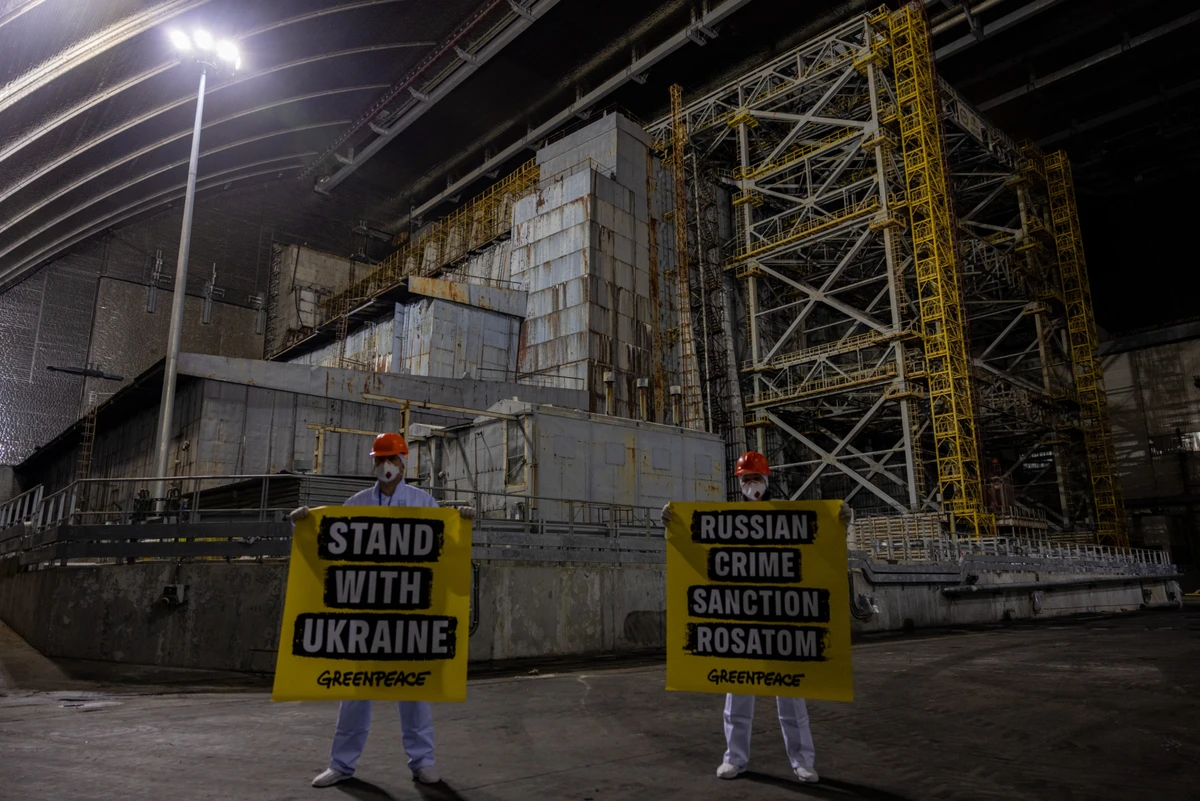
Suddenly you look down and notice water beneath your feet – a consequence of the Russian attack a year ago. Rain and snow seep through the holes in the Arch and drip onto the concrete floor, forming small puddles. We try to step over them to avoid getting our feet wet. The staff tell us to go back outside: it's not advisable to spend much time near the sarcophagus.


After passing through several more sanitary control points, we find ourselves in what is probably – however dramatic this may sound – one of the most significant rooms in modern history. We are in the control room of reactor 4 at the Chornobyl Nuclear Power Plant. The place where the infamous button was pressed, the one that set the apocalypse in motion. Incidentally, that button is no longer there on the control panel. Nor is most of the equipment that was once here.


The panels are covered in grey dust. The dosimeter shows 23 microsieverts per hour. For comparison, the normal background radiation level in Kyiv is around 0.1 microsieverts per hour. Twenty-four hours in this room would expose you to roughly six months' worth of radiation under normal conditions.


As we look around at the abandoned room in the freezing cold, the staff explain that the control room of Unit 4 looks like this because of its age, and because the room was never sealed off when the sarcophagus was built, so the wind and rain were left to do their work. Preserving the room did not become a consideration until much later, in the 2000s. It was only then that part of the control room was cordoned off and a separate passage was created to run alongside the Golden Corridor.

We make our way back to the changing rooms in silence. On the way, we hand in our dosimeters. In the hour and a half we've spent under the confinement structure and on the territory of reactor 4, each of us has received about 20% of the daily radiation exposure limit. In the changing room, we hand back our white protective clothing. An hour later, after additional checks, we step outside again under the grey April sky.

Yevhen Buderatskyi, Stas Kozliuk, Ukrainska Pravda
Translated by Vikroria Yurchenko
Edited by Teresa Pearce