

Ukraine has been steadily ramping up the pressure on Russia's oil and gas sector. Every day there are more – and ever more intense – strikes on oil refineries, oil depots and pipeline infrastructure targets.
When the campaign began in 2024, the main effect of the strikes was to generate publicity. But now their consequences are now being felt with increasing severity by both the Russian population and the Russian economy.
The Kremlin has been forced to respond to the production shutdowns by restricting fuel exports and introducing limits on petrol and diesel sales. Kilometre-long queues have been forming at Russian filling stations.
Could Ukraine's "long-range sanctions" turn localised disruptions into a full-blown fuel crisis, depriving one of the world's largest oil producers of its own resource?
The answer to this question doesn't just matter in terms of understanding the state of the Russian economy. Fuel is a critical resource for waging war. It powers military hardware, aircraft, logistics and the defence industry.
For this reason, further strikes on oil infrastructure may prove to have greater impact than attacks on ammunition depots or military airbases.
From dozens of strikes to hundreds
Ukraine has been striking Russian oil refineries for several years now. These strikes have repeatedly forced individual facilities to halt production and undergo "scheduled" repairs. But since the start of 2026 the campaign has reached a new level, increasing the intensity of attacks, their geographic spread, and the number of repeat hits on the same refineries.
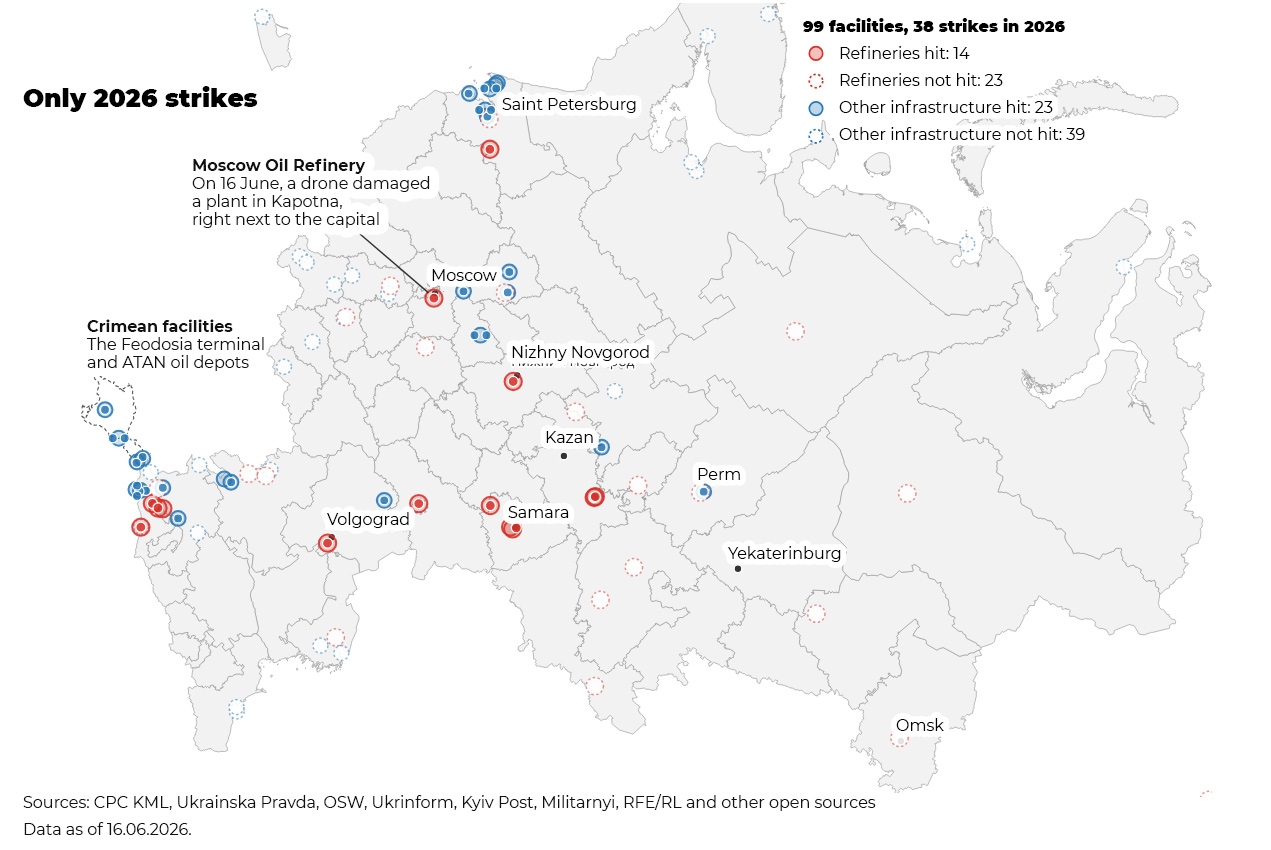
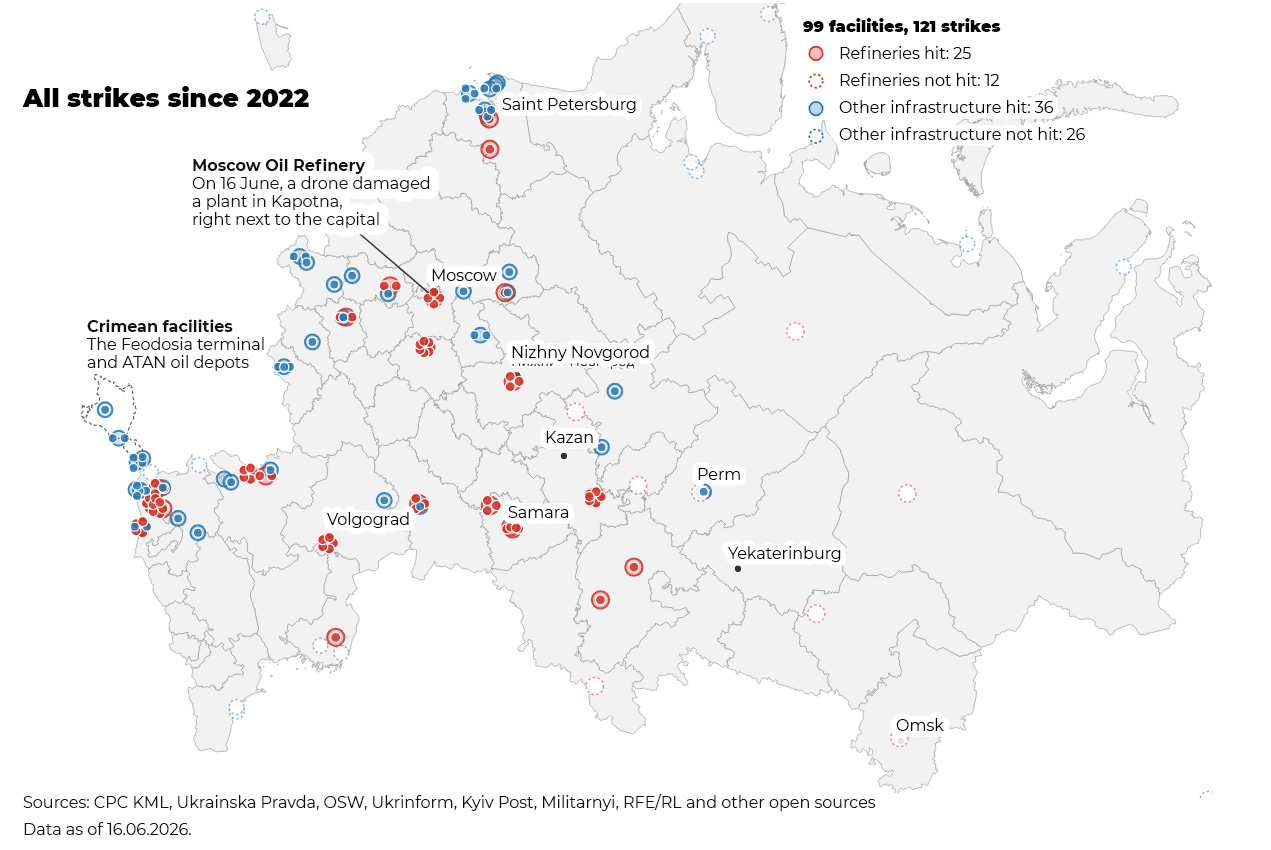
This map shows that the strikes on Russia's oil infrastructure are not isolated incidents, but deliver a broad geographical spread of pressure on the fuel system. Between 2022 and 16 June 2026, 121 strikes on 99 facilities have been recorded. Out of 37 refineries, 25 have been marked as hit, and out of 62 other oil infrastructure facilities, 36 have been hit.
In 2026 the intensity of these attacks is high: 38 recorded strikes fall within this period – nearly a third of the entire dataset. There are 39 incidents in the database for the past six months, showing that the campaign against Russia's oil infrastructure has not only continued, but was particularly intense in the first half of 2026.
As well as the rise in intensity, the 2026 strikes are also shifting focus from border regions and areas near Ukraine towards more remote logistical hubs and export infrastructure. This is reflected on the map in incidents around Ust-Luga, Primorsk, Novorossiysk, Taman, Crimea, the Volga region and individual pipeline stations. In other words, the campaign is increasingly looking like pressure not just on individual refineries, but on Russia's fuel system as a whole.
Virtually all the major refineries in European Russia have come under attack during this period. Two large refineries beyond the Urals remain untouched: Omsk and Angarsk. The same facilities are increasingly being hit over and over again, preventing the Russians from fully completing repairs and resuming production.
For example, the Ryazan and Saratov Refineries have each been struck over 15 times, while Syzran, Afipsky, Ilsky and Tuapse have each been hit more than 10 times.
And it isn't just oil refineries. Fuel depots, export terminals, fuel storage tanks and oil pumping stations are also being struck on a regular basis. Ukraine's defence forces are moving from inflicting localised damage towards the systematic destruction of the entire logistics chain of Russia's oil industry.
The objectives of the campaign are no secret: Zelenskyy has repeatedly dubbed the strikes "long-range sanctions". They serve two purposes. The first is to reduce the Kremlin's oil revenues – its principal source of funding for the war. The second is to create domestic economic problems and compel Moscow to agree to a halt in mutual energy infrastructure strikes ahead of the next heating season.
The Wall Street Journal has reported that Kyiv views its strikes on oil refineries as a lever of pressure on the Kremlin to achieve an energy ceasefire.
What are the consequences?
The consequences of the sustained attacks are becoming increasingly visible – not only in industry statistics, but in Russians' everyday lives. Motorists in various regions are now facing kilometre-long queues at filling stations, restrictions on fuel sales and rising prices.
Russia is going through the most extensive fuel crisis in its history, although there is still potential for it to deepen further. What are the signs of this crisis?
Russia has banned exports of petrol and jet fuel and is considering an embargo on diesel exports, which are already subject to export quotas.
In May, refinery throughput fell to its lowest level in 16 years, averaging 4.58 million barrels per day, with nearly one-third of the country's refining capacity lying idle. As a result, Moscow has been forced to export more crude oil instead of processing it domestically. Since the beginning of 2026, Russian crude exports have risen to 3.49 million barrels per day – the highest level since the start of the full-scale war.
Petrol shortages have spread to almost one-third of the country, affecting 25 regions, including Moscow and St Petersburg. Some filling stations have imposed a limit of just 20 litres per customer. Fuel supply disruptions have also affected farmers, and restrictions have been introduced on aircraft refuelling.
The price of petrol in Russia has risen by 28-34% since the beginning of 2026, while diesel has become 43% more expensive. Meanwhile the price of jet fuel has surged to a record high of RUB 110,000 (about US$1,500) per tonne. Against this backdrop, the Russian authorities have temporarily allowed refineries to produce lower-grade fuel in an attempt to make up the shortfall. Some refineries have been authorised to sell fuel labelled as meeting the Euro 5 standard even though its actual quality corresponds to Euro 3 specifications.
In particular, the permitted sulphur content in petrol has been raised to 15 times the Euro 5 limit, while the permitted level in diesel has been increased 35-fold. This lower-quality fuel may only be sold on the domestic market – exports are prohibited.
The situation is particularly acute in the Russian-occupied territories of Ukraine.
For reference: Ekonomichna Pravda has analysed online data from Crimea's two largest petrol station chains, ATAN and TES, which operate a combined total of 181 filling stations – 116 and 65 respectively. According to data collected on 15 June 2026, 26 filling stations, or 14.4% of the sample, had no AI-95 petrol available.
The shortage of diesel appears to be even more pronounced. Of the 181 filling stations surveyed, 44 (24.3%) had no standard diesel fuel available. Even when premium diesel is counted as an alternative, 22 filling stations – or 12.2% of the sample – had no diesel fuel of any kind.
The situation is different at each of the two chains. At ATAN, 11.2% of filling stations had no AI-95 petrol, while 27.6% were out of standard diesel. At TES, more filling stations had no AI-95 (20%), but fewer had no standard diesel (18.5%). In other words, it's not that fuel has disappeared entirely from the market, but the shortages are already clearly visible at the major filling station networks, with diesel particularly affected.
The picture becomes considerably gloomier once sales restrictions are taken into account. Although AI-95 was officially available at 155 filling stations, at 149 of them (96.1%) it could only be purchased using ration coupons or fuel cards. The situation is similar for diesel. Standard diesel was available at 137 of the 181 filling stations, but sales were restricted at 127 of them (92.7%). In practice, therefore, "available" does not mean freely available for most motorists.
The situation could deteriorate further, as the seasonal peak in fuel demand is still ahead.
Could Russia run out of fuel?
Serhii Kuiun, director of the A-95 Consulting Group, says Russia has traditionally experienced fuel supply problems towards the end of the summer, when consumption reaches its annual peak. In 2026, however, these difficulties began much earlier.
"We're only at the start of the peak demand season, yet they're already having serious problems. If the situation is this turbulent now, what will it be like in August and September?" he says.
Kuiun believes the current situation resembles Ukraine's fuel crisis in 2022, when shortages spread gradually but steadily across the country. He also warns that panic on the part of the public could make matters worse: "People will start buying up fuel wherever it's still available. Panic buying could rapidly aggravate the situation."
Oleksandr Sirenko, an analyst at the Naftorynok consulting company, argues that the crisis is being driven not only by reduced refining capacity, but also by mounting logistical problems: "This crisis has two defining features: refineries being shut down by strikes, and disrupted logistics."
He believes this is particularly evident in temporarily occupied Crimea, where fuel deliveries have become more challenging because of restrictions on both maritime and overland transport routes.
Energy expert Hennadii Riabtsev offers a similar assessment: "Logistical problems are often a direct consequence of the actions of Ukraine's defence forces. Once a refinery goes offline, fuel has to be brought in from other regions. It's more expensive, time-consuming and complicated."
In his view, logistics could become the catalyst for a much broader crisis: "This stopped being a market long ago. It's all being run on an ad hoc basis now: send one rail tanker here, dispatch one fuel truck there."
Despite these mounting difficulties, Russia still has a considerable safety margin.
"Its vast territory, excess refining capacity, state regulation and administrative allocation of resources enable the Kremlin to prevent a full-scale collapse. Even so, the problems are already obvious to everyone and building up by the day," a parliamentary source told Ekonomichna Pravda.
That, the sources say, is precisely why even the large-scale strikes have yet to trigger a full-blown crisis. "Russia is so vast that you can bite off half its backside and the signal still won't reach the brain straight away," says Riabtsev.
Nevertheless, he warns that the system may eventually reach breaking point.
"These have been the most effective strikes of the entire [full-scale] war. They're complicating logistics and draining enormous sums from the pockets of Russia's oil companies. The cost ratio is staggering: a handful of relatively cheap drones can disable installations worth hundreds of millions of dollars. The key is to keep striking consistently. Over time, that could bring about a systemic collapse."
"For now, Russia is putting out fires by taking ad hoc measures – redistributing fuel between regions and imposing restrictions," a Cabinet of Ministers source told Ekonomichna Pravda. "If the strikes continue, the localised disruptions we are seeing today could develop into a systemic crisis across Russia's entire fuel market by the end of 2026."
Mykola Topalov for Ukrainska Pravda
Translated by Anastasiia Yankina and Tetiana Buchkovska
Edited by Teresa Pearce