FPV drones are attacking civilians in Nikopol, Kherson and other frontline cities. Could electronic warfare protect them?


Ukrainians have grown used to the constant threat of Shahed attack drones. But there is another major threat that is less publicly discussed: the Russian FPV drones that constantly terrorise the local population in frontline cities.
The Russians killed a one-year-old child by dropping explosives from a drone in Kherson Oblast. A Russian drone hit a car with a family inside, including a four-year-old girl, in Nikopol, a city in Dnipropetrovsk Oblast. FPV drones flew into the city centre in Pokrovsk, Donetsk Oblast, and injured two elderly people.
These are far from isolated cases. Ukrainska Pravda has reported on a so-called "safari" that the Russians organised to target civilians in Kherson Oblast. Similar news continues to surface from time to time and is increasingly being perceived as "just the way things are".
It is no exaggeration to say that in frontline cities, the threat of FPV drones constantly hangs in the air. Local Telegram channels report drone attacks at least every half an hour.
There are two reasons for this. The first is that the Russians now have more drones. The second is that they have learned to fly them for dozens of kilometres using special equipment: repeaters. This means that many more cities, such as Sumy and Kharkiv, are about to come under attack.
Ukraine needs to start thinking now about how to protect its cities from the terror of FPV drones. The military, the defence industry, the state and local authorities need to have a serious conversation in order to find a comprehensive solution to the problem and roll it out to all populated areas.
Some work is already being done to protect the population, but so far it isn’t enough to make frontline cities even relatively safe.
The defence industry experts we interviewed agree that what’s needed is an automated system with a single control centre. This would enable city defenders to see a drone's direction of travel and remotely activate the suppression equipment in each specific area.
We asked Ukrainian electronic warfare manufacturers about how such a defence system would be set up, where to start, what tools to use, and how much it will cost the cities.
Yaroslav Kalinin, Infozakhyst

There are plenty of cheap "dome-type" electronic warfare devices on the market, but they provide about as much protection as the icons on a car dashboard. [This is a deeply rooted cultural practice among Slavic people: they place religious icons in their cars – often small images of Jesus, Mary, or patron saints – for protection and blessing while travelling – ed.] Covering all the roofs in the city with those devices is not an option. Such devices have a number of architectural problems, and this electronic warfare system isn’t ideal because it can’t be controlled as a single system – i.e. doing electronic reconnaissance to search for drones and combining that with electronic warfare jamming equipment.
Take the city of Nikopol. It covers an area of 10x10 km. We need to understand what we can do with a specific drone that’s flying over the city, delineate the areas of responsibility, not interfere with the electronic reconnaissance units, and only activate the electronic warfare systems when it will really help, rather than mindlessly activating various assets and revealing all the locations to the Russians.
If we have a smart system, we can set up directed antennas and thus increase the suppression radius. For example, instead of 300 metres, we can suppress an aerial asset in a specific direction at a distance of 3 km. But in order to do this, we do need to know which direction the drone is flying from, which is why I mentioned the importance of working as a team with the electronic reconnaissance.
Frontline cities already have electronic reconnaissance and electronic support units, operating with Ukrainian and imported equipment. They receive data daily on the frequencies and types of signals being used by enemy FPV drones and other UAVs.
However, the military usually only has enough resources to cover its own positions. With the best will in the world, there is often not enough equipment to fully protect civilian infrastructure.
So to protect our cities, we need to understand what piece of the jigsaw is missing in this military combination of electronic reconnaissance and electronic warfare in order to solve the problem of protecting the city as a whole, not just the military facilities.
For example, adding sensors that will cover central streets or residential areas. Adding suppression devices that can be remotely controlled and reprogrammed. These should be both dome-shaped and directional (depending on what is effective for protecting a specific area).
To achieve this, military administrations in various oblasts need to enter into dialogue with the Main Directorate of Electronic Security and Cybersecurity. Local officials should say, "We aren’t electronic warfare specialists, but we can find the money to cover civilian areas." And they should use their local budgets to purchase equipment that can be integrated into a unified countermeasure system, deploy it in the city, and transfer it to military control. The equipment exists, and there’s no need to build a system from scratch.
Some cities are already allocating money for self-protection, but they are more focused on Shahed drones. The same approach can be used against FPV drones.
But the local authorities will never be able to cope alone. The only solution is to ask the military to integrate into their system, purchase the necessary equipment and help maintain it.
Meanwhile, the military will build the detection border itself. This will trigger the suppression equipment that’s already programmed to the frequencies of Russian UAVs.
Securing effective protection of a 3-km area with a single station is entirely doable for UAH 2 million (about US$47,500). Such electronic warfare equipment consumes up to 2 kW of electricity (like an electric kettle), so all you need for it to work is a socket in the house next door.
To protect a city like Nikopol (up to 100,000 residents), we would need about 10 such stations. So to solve the problem of FPV drones in a city of this size, tens of millions of hryvnias will need to be spent, provided that these devices are integrated into the existing electronic reconnaissance system.
Combining the various electronic warfare and electronic protection devices is a technical challenge because right now we have a zoo of different systems and a zoo of subsystems. In order for them to work together, there needs to be a certain degree of standardisation between the assets, and this is currently being undertaken by the Ministry of Strategic Industries together with the 69th Electronic Support Centre. They are now thinking about how to create a "patchwork quilt" of the different models of electronic warfare and electronic support systems without any awkwardness. And that’s exactly the right thing to do.
Serhii Skoryk, Kvertus
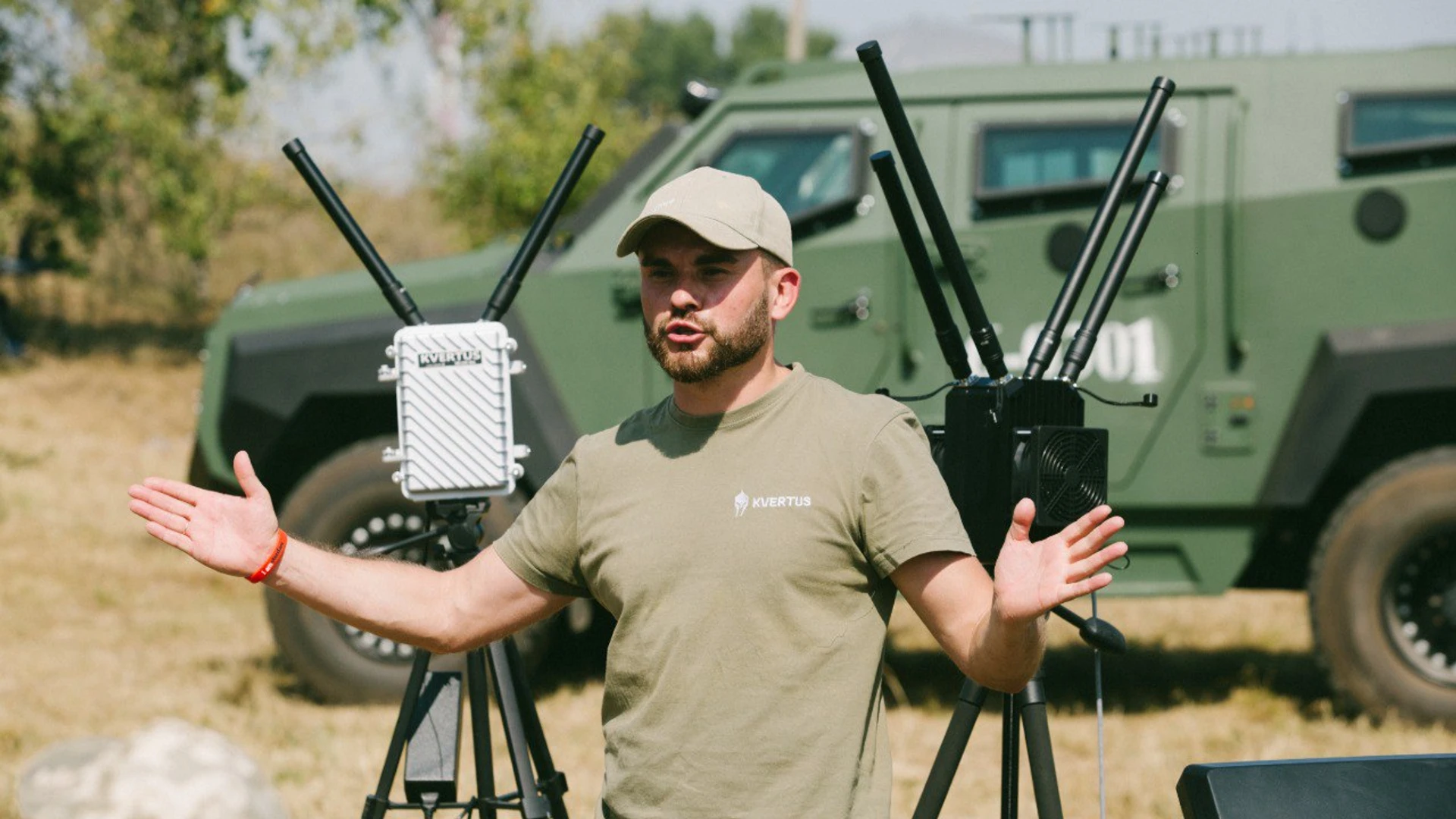
When it comes to protecting cities from FPV drones, we have the Atlas system. It consists of two units operating in tandem: an Azimut detection station and a Mirage suppression device.
The Azimut functions as a passive detection system. This means it operates continuously, receiving signals while remaining invisible to the Russians. With the Atlas, any number of detectors can be deployed in the area of coverage, all connected to suppression devices via the internet.
Imagine there’s a building in your city where an operator monitors everything and, at the push of a button, activates interference precisely where and when it's needed. That's what our solution does.
To make this work, Azimut detectors must first be installed at elevated positions along the expected FPV drone flight paths. Ideally, they should be placed 7-8 km from the contact line to remain out of sight.
Meanwhile, Mirage devices are installed, each providing a protection dome with a 2.5-km zone of effect. For a city of 100,000 people, around 100 to 150 units need to be placed at elevated positions so they don’t interfere with each other.
When the Azimut detects a drone, the operator gives a command that activates the appropriate suppression system from among the hundreds of integrated units to neutralise the threat. Some Russian drones use specialised firmware, flying across different frequency bands and switching frequencies. But the Mirage can counter them, thanks to multiple signal amplifiers and its ability to operate on several frequencies simultaneously.
This whole jamming system consumes only 150 W of power at peak, meaning it can operate for extended periods even when powered by a generator, if needed.
To cover a 30-km-wide strip, around 10 Azimut stations and 50 Mirage devices are needed. Each Azimut costs about UAH 2.1 million (approx. US$50,300), while each Mirage is priced at around UAH 640,000 (US$15,300). Altogether, covering the entire strip would cost roughly UAH 50 million (US$1.2 million).
A system for protecting cities from FPV drones does exist, though it’s impossible to say whether it’s good or bad. The thing is, the enemy is evolving. If their goal is to reach a specific point, they will find a way.
Electronic warfare cannot provide absolute protection, and a certain number will inevitably slip through, even with full coverage. Still, we can do everything possible to jam at least 80% of threats.
Anatolii Khrapchynskyi, Piranha Tech
There have been some attempts to address the issue of FPV drones in cities, but so far, these have mostly been isolated efforts: protection for individual sites, local initiatives, attempts to pool resources from businesses, farmers and volunteers. That's not a systematic approach.
There are companies in Ukraine that could create an effective multi-level system to protect cities from FPV drones if they joined forces rather than working individually.
Before embarking on setting up protection, it's essential to make a careful study of the city’s terrain and layout, building density and the location of key strategic sites, and to assess the main threats. Actually, it’s the same on the front line.
Arguably the most crucial element of countermeasures is the drone detection system. Here, active and passive radar systems, radio-electronic reconnaissance and a variety of acoustic, visual and thermal sensors come into play.
Next, we design the core drone suppression systems based on the terrain assessment data. This covers operational, operational-tactical and strategic systems that provide sector-by-sector coverage of the entire city.
I believe any city can be protected, but setting up defences needs to be approached carefully and with a real grasp of how deep the threat goes, rather than just "Give us one system that covers the whole city."
There must be a control centre. It shouldn't look like a checkpoint with binoculars, but more like a metro control room, a traffic light control centre or, say, a Smart City platform.
The centre monitors the power supply for system components across the city, their operational state, detection signals, decision logic, and responses. Most importantly, it must be a permanent facility. The operators could be members of the municipal security service, the police, or the National Guard, depending on the city and the resources available.
In terms of technical infrastructure, I would deploy such systems based on existing mobile communication towers.
Why am I comparing this to civilian infrastructure centres? Because the threat is no longer "temporary", and it's not going away.
It's more difficult to shield a city from drones than it is on the front lines. In frontline conditions, the system operates in the field with minimal infrastructure, a clear threat line, and the ability to take crude yet effective action. In a city, there’s a different defence strategy, different threat scenarios, and different restrictions on the methods that can be used.
You’re not just jamming or shooting something down here. You have to consider the building density, the presence of civilian traffic, medical facilities, emergency services and electronic communications. Integration into the urban environment is crucial – through rooftop structures, communication towers, backup power sources and control centres. And most importantly, everything needs to work effectively amid persistent background signal noise.
With regard to prices, there's no fixed cost as it really depends on the objective. If the city just wants to protect certain areas like critical facilities, government buildings or infrastructure nodes, that's one thing. But if they want broader coverage, integration with cameras, thermal sensors and automated controls, the cost will be quite different. And a comprehensive multi-level system – covering detection, identification and response – means a whole different budget, including engineering design and ongoing maintenance.
The cost of full city coverage, if we're talking about real protection with all the nodes, reserves and dispatching, not just a show of it, could reach US$15-20 million. And that's without factoring in maintenance, staff training or upgrades.
This is a rough estimate for a medium-sized city – somewhere like Sumy, Nikopol, Kramatorsk or Kherson – with a population of 100,000 to 200,000, moderate building density, a mixed layout of residential areas, infrastructure and industrial zones, and no excessively tall buildings.
In a city like this, the territory can be relatively clearly divided into sectors, and a multi-layered protection system with detection, response and dispatch logic can be gradually rolled out. The cost will be scaled up depending on the extent of coverage.
If we're talking about megacities like Kyiv or Kharkiv, the scale and budgets are on an entirely different level. Even partial coverage there could cost tens of millions of dollars. The costs may be lower in smaller cities, but the core requirements remain the same: precision, speed and reliability.
Coming back to the question of cost, there's one more point I'd like to make. We have a real opportunity to test and refine a reliable model of urban drone defence, one that could later be offered as a ready-made, exportable solution to our Western partners. So investing in these systems isn't just about security; it's also about creating new opportunities for our defence industry and technological sovereignty.
Author: Bohdan Miroshnychenko
Translation: Myroslava Zavadska and Artem Yakymyshyn
Editing: Teresa Pearce