"I tell my relatives we're being shot at and killed. And they say: it's your own fault!" Life on the border with Russia in Sumy Oblast


Someone who has lived through their own war might tell others that war is the same everywhere.
And sometimes it might seem that way to us, the Ukrainian journalists covering this war.
The front line creeps up to each settlement in much the same way: first, the quality of the mobile connection drops, then one of the Russian strikes cuts off the power, then the power is repaired a dozen times while the public utilities in the city are still operating. Over time, the hot dog stands close down, the last branch of the Nova Poshta courier service closes its doors, the taped-over windows shatter into glass, and the brick buildings crumble into sand.
But in reality, war comes to every city differently. Partly because the war itself is constantly changing, but more so because each hromada (community) – and each person – has their own history with it.
In late February to early March 2025, fighting returned to Sumy Oblast for the second time since the start of Russia's full-scale war. In May and early June, it became widely known that Ukraine had lost control over 200 sq km of territory north of the city of Sumy.
On 1 July, after the issue was highlighted by Ukrainska Pravda, the General Staff finally acknowledged this fact and began marking the Russian advance in Sumy Oblast on its maps.
Two weeks ago, after interviewing soldiers from a wide range of ranks, we reported on how the Kursk front suddenly turned into the Sumy front (although as far as the military was concerned, the change was far from sudden).
This new report from Sumy Oblast focuses on the moods, thoughts and feelings of the people who are defending the oblast and who live near its border. It is written from up close – we spent two weeks here, seeing firsthand how homes that were once lived in and cared for have become targets for Russian drones. Now pitted with craters from Shahed strikes, they remain under the control of Ukraine and the Ukrainian forces.
The Hunt 2025
"Quiet! Quiet," signals Dmytro Suslovets, commander of the Volunteer Territorial Hromada Battalion (DFTG) in Khotin, urging us to stop talking.
We have just stepped out of his car in the centre of Khotin – a settlement 5 km from the front line that the Russians are trying to take. Outside, there isn’t a soul in sight. Most of the residents have evacuated, which is very unusual for frontline settlements.
Dmytro listens intently to the sky. He hears a "bird" [drone – ed.] and orders us to move closer to the fence. The rain we’d been hoping for hasn’t come to cover us. We dash across the road, press ourselves against an old wooden picket fence, and hide in the greenery behind it.
Dmytro lingers near the roadside. He raises his rifle and signals to a vehicle carrying his brothers-in-arms – which is heading straight towards the drone – to turn around.
The drone keeps buzzing, as if observing our every move, leading us to conclude that it is definitely not one of ours.
"Chaika, Chaika, this is Bayraktar, I can hear an FPV drone heading towards the lake," Dmytro reports over the radio.
Immediately a powerful explosion rings out nearby. Boom. But the drone keeps buzzing, so we assume it’s not an FPV, but a reconnaissance drone. Our first thought is that we need to get out before it leads an FPV to us.
This is one of the things about the Russo-Ukrainian war in 2024-2025 – drones enter villages and towns before anything else. Having driven out most of the civilian population, they occupy the streets and hunt down any vehicle that moves.
But Dmytro and his men are clearly not the kind to accept this. Khotin is their territory.
On Tsentralna Street, where we are running from the drone, are their Nova Poshta branch No. 1 and their library, now damaged. On Soborna Street, which crosses Tsentralna, are their Church of the Holy Dormition, pockmarked with shrapnel holes, and their destroyed hospital. Just three months ago, Dmytro was still visiting that hospital to get his teeth treated.
And this is one of the things about Sumy Oblast: everyone is prepared to defend their own yard – especially if that yard is in Khotin, a prosperous model hromada where the flowerbeds are planted with precision, and where windows are re-glazed after strikes instead of being boarded up with chipboard. Because everything has to be pretty.
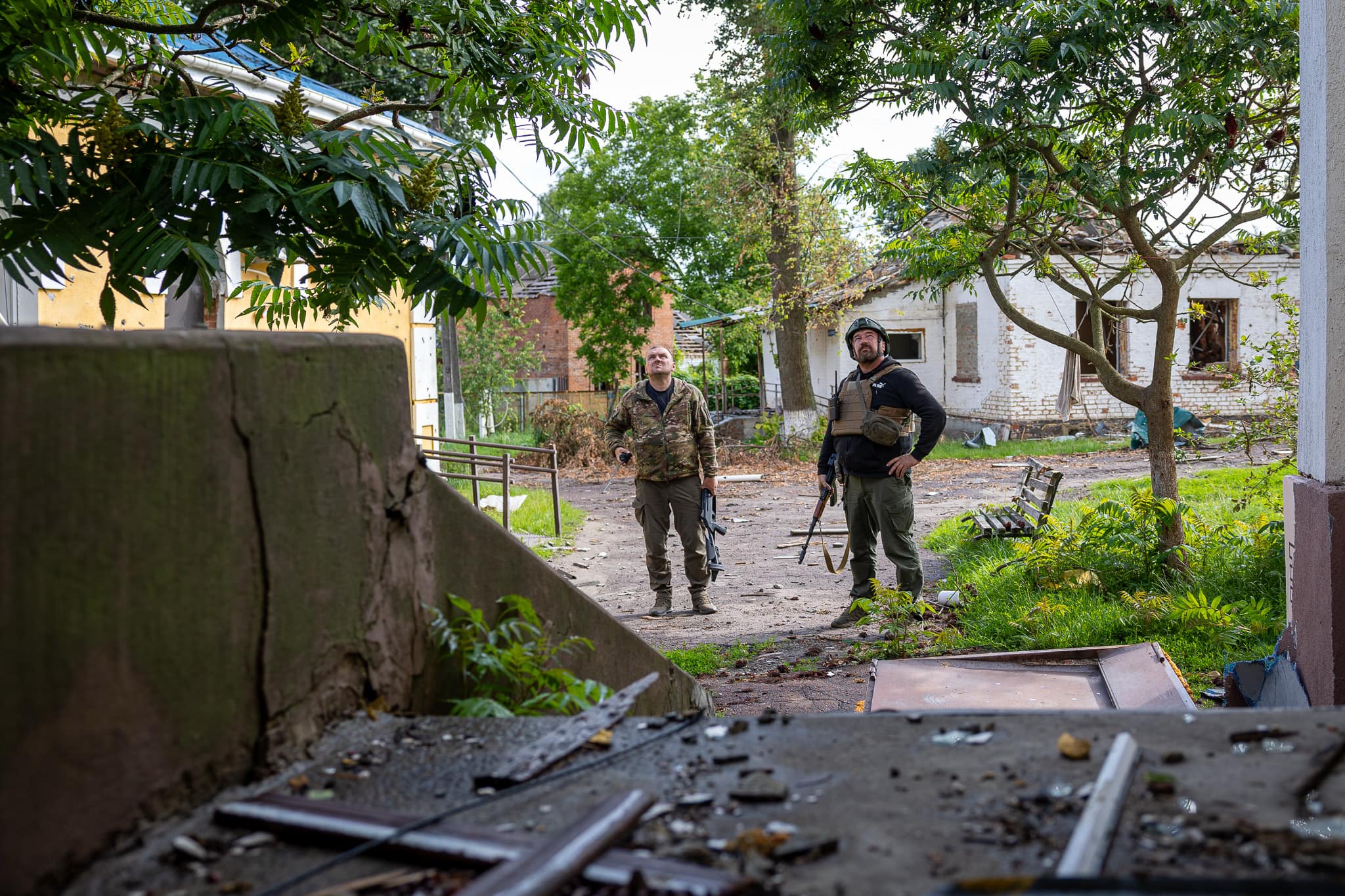
Fighters from the Khotin Volunteer Territorial Hromada Battalion standing in the courtyard of the damaged hospital in Khotin, watching the sky for an enemy drone. Sumy Oblast, June 2025
After getting to know the Khotin Volunteer Territorial Hromada Battalion, we were genuinely surprised to learn that the DFTG still exists as a phenomenon in Ukraine. In Sumy Oblast, they are treated with particular reverence. After all, when there were no regular troops in the oblast in February 2022, fighters from these volunteer units were among the first to go into battle.
These days the DFTG units are subordinate to the local Territorial Defence Brigade – the 117th. They down Shahed drones, build fortifications and guard property in frontline areas. Officially they are not considered military personnel and do not receive a salary. However, the local authorities provide them with financial assistance of UAH 6,000-8,000 (approx. US$150-200) per month. Some of them also have civilian jobs.
Three of Dmytro’s fighters eventually joined the Defence Forces; two of them have been killed in action.
"One of them called me. He was badly wounded," Dmytro recalls on the road from Khotin to Sumy. "It was morning. He listed what needed to be done, who to say goodbye to, and sent me his location, the coordinates of where he was. I got in the car and drove to his family’s house – I had just reached the house and called for his brother, when the connection was lost."
Fortunately, the Russian reconnaissance drone that had been tracking us doesn’t manage to bring an FPV drone in its wake, and we leave the settlement without incident.
When we ask Dmytro why the Russians were able to advance from the border deeper into the oblast, he replies, slightly embarrassed: "Perhaps our Armed Forces were not fully prepared for this kind of development."
"And what do the Russians want now, do you think?" we ask him.
"To take the high ground around and in front of Khotin. If they succeed, it will be critical for Sumy," the DFTG commander answers.
Corridors made of nets, Russian propaganda, and 28 bagfuls of belongings
Among the strangest things one might hear on the way to the frontline settlement of Khotin are silence, and the morning international news on the radio. The first is frightening – because you never know what will come after it. The second occasionally triggers hysterical laughter.
"Trump’s election as president this year has made Europe realise it must act immediately."
"Russia has joined forces with Iran."
"One of the most interesting proposals is to create a drone wall along Europe’s eastern border."
While the world is still pondering "the urgency of its actions", we are with an evacuation team from the Ukrainian Red Cross Society (URCS), racing towards a settlement that’s being pounded daily by Russian air-dropped bombs weighing several hundred kilograms. A single FAB-500, for example, weighs about the same as a third of a car.
Due to the unique features of the terrain, nearly every aerial bomb can be heard in Sumy itself.
Every sound of war in Sumy Oblast – bombs, missiles, night-time shooting at Shahed drones, or the ultra-low flight of a Ukrainian fighter jet – resonates as if amplified to the max.
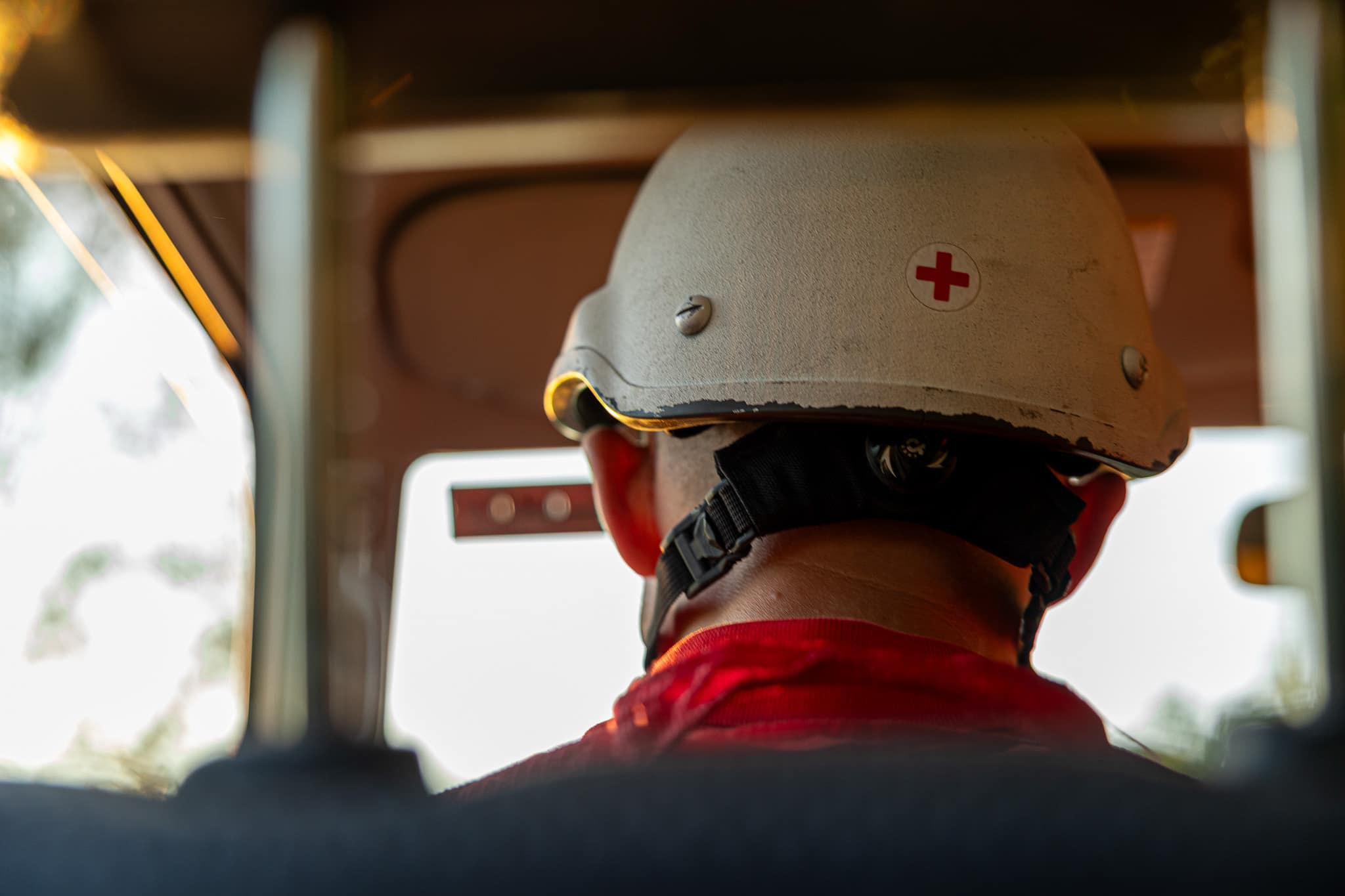
Morning light floods the evacuation vehicle of the Ukrainian Red Cross Society
Instead of the "wall of drones" Europe is contemplating, a fresh corridor of anti-drone nets stretches above us. Wooden posts driven into the ground on either side of the road hold up miles of transparent fishing net that block Russian FPV drones, particularly the increasingly dangerous fibre-optic models.
A few days later, we happen to be sharing a car to Khotin with Volodymyr Babych, deputy head of the Sumy Oblast Military Administration. "Isn’t it a bit late to start installing these nets here?" we ask.
"Everything to do with security is done when a threat emerges. But if they’d been set up in 2014, it wouldn’t have hurt. Maybe people would have ridiculed us for ten years, but they’d have thanked us later. They’re only being hung up now, in 2025," Babych replies, as if acknowledging it’s too late.
To be fair, we should note that the Oblast Military Administration primarily carries out fortification and netting tasks as assigned by the military – in Sumy Oblast, that’s the Siversk Operational Tactical Group and the Kursk group of forces.
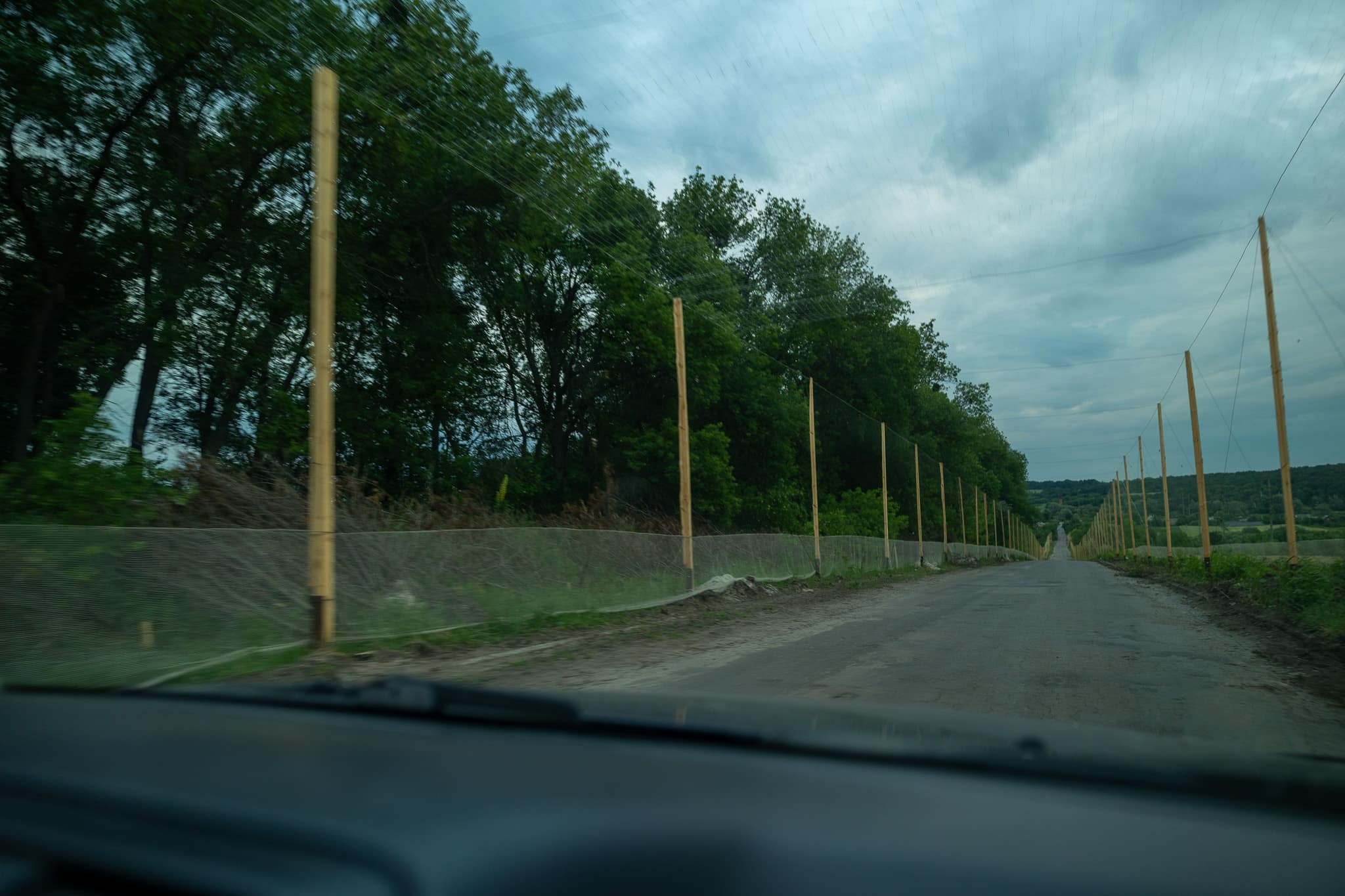
The Ukrainian Red Cross vehicle reaches Khotin before 05:00 to avoid the morning "batch" of Russian guided aerial bombs (KABs).
Ihor Shapoval, known locally as the "chief" and head of the regional Ukrainian Red Cross Society, bangs on a corrugated metal fence for a few seconds, assuming that the evacuee is still asleep, before climbing over the fence into the yard and knocking on the door with the same urgency.
Slipping through the morning batch of KABs has proven impossible: two aerial bombs land somewhere near the village. Boom, boom.
A thin man wearing a cap emerges from a neighbouring house and says the code word, "Svitlana" – the name of his daughter, who requested his evacuation. He’s the person we’ve come for, but we missed his house.
The man’s name is Ivan. He’s 77 and moved to Khotin from Kazakhstan, where his father served in the military, 30 years ago.
"Russian propaganda claims we’re not allowed to speak Russian here, but when I arrived, everything was in Russian! Everyone speaks Russian. The factories here were Russian-owned, and they still are – they won’t be taken away. But I think they should be nationalised!" Ivan declares, outlining his political views.

Ivan’s possessions are few – 28 bags full. Plus a plasma TV he was given by his children, who have already left Khotin, some chairs, and a fly swatter. He decides that he’ll come back later for his cat and his welding helmet.
"Come back later? Quite the desperado!" a Ukrainian Red Cross volunteer in a bulletproof vest and helmet remarks with admiration as he loads the bags.
On the way to Sumy, where his daughter Svitlana is, Ivan tells us how Russian propaganda has strained his relationships with his relatives.
"They call me, and we argue. They say, ‘What’s it like over there?’ I tell them, ‘They’re shooting at us, they’re killing us.’ They don’t care. ‘It’s your fault, it’s the Americans’ fault!’ But it’s Russia’s fault. How can you get their critical thinking back?"
Ivan believes Russia is a threat to everyone, Kazakhstan included, but there may be external forces holding Russia back. "They attacked Ukraine like it’s their fiefdom," he muses.
"If I can, I’ll go to war. My relatives ask, ‘Will you shoot them?’ I say, ‘Yes I will!’ They came here to shoot at me," Ivan adds.
At Ivan’s new home – a grey high-rise in Sumy’s city centre – one of the Ukrainian Red Cross workers hands us a piece of colourless wire resembling a fishing line.
"Here’s a souvenir for you – some optical fibre from Khotin," the worker explains. "We’ve got plenty of it now."
We ask Ivan if he’ll miss Khotin, his Ukrainian home for 30 years. He replies, "What’s to miss? I’ll be popping back. I’ve got potatoes, sweetcorn and onions growing there. There’s a minibus that runs three times a day – morning, noon and evening. If it doesn’t, I have a bicycle!"
The last time we heard such resolve was from the residents of Krasnohorivka in Donetsk Oblast in April 2024. The difference is that unlike the people of Krasnohorivka, which has been under Russian occupation for over a year, Ivan can still return home – for now.
"The defensive line could have been made ready during the Kursk offensive. All the villages were safe"
"No territory lost in Kharkiv Oblast, local authorities say."
"Fighting for grey zone settlements continues in Kharkiv Oblast."
"Russians occupy six villages in Kharkiv Oblast."
"Where are the fortifications?"
These are some of last year’s headlines about Russia’s repeat offensive on the oblast next to Sumy – Kharkiv Oblast.
That offensive was completely different – sudden, focused on two specific fronts, and involving heavy artillery and infantry assaults. Yet all the questions that were raised then, and that should have informed the military and civilian leadership, apply to the situation in Sumy Oblast today. One key question persists: "Where are the fortifications?"
Another parallel is the retreat of Ukrainian defence units from the border. Ukrainska Pravda has information that on the North Slobozhanshchyna (Sumy) front, some Territorial Defence units, border guards and newly formed brigades have abandoned positions in villages that have now been captured by the Russians. Now they are being reclaimed with significant effort by units such as the 95th Air Assault Brigade, the 225th Assault Battalion, and units of Ukraine’s Defence Intelligence.
Below we present a commentary on the situation from a defence forces soldier who has been working in the Kursk-Sumy area since early 2025. At his request, we are not disclosing his name or unit.
"The front line moved from Kursk Oblast to Sumy Oblast sometime in late winter and early spring. Before that, the Russians had suddenly launched an offensive on their territory and narrowed our positions to the entry-exit checkpoint beyond Sudzha. That lasted three or four days – it was pretty fast. Then for a long time there was fighting at the entry-exit checkpoint and below it, in and around Guyevo [10 km south of Sudzha – ed.].
Then they began to enter the border villages: Novenke, Zhuravka, Basivka. Sabotage and reconnaissance groups went in first. We were told about them by locals, DFTG members and border guards. They said not to wander around the border area because it was dangerous.
Now, many villages are already under enemy control. Presumably they [the Russians] are moving towards Khotin. That’s their main objective, because it would cut off all the logistics [for Ukraine].
We have less manpower than the Russians. If you have five people at your position and it’s assaulted by 20 Russians, you won't be fighting for long. Plus, the defence of the border area wasn’t equipped; there were no proper fortifications, trenches or dugouts. There was no solid line of defence as such. Could it have been prepared while the Kursk operation was going on? Yes, definitely.
When we went into Kursk, all these occupied villages were safe – we operated there without any electronic warfare equipment. FPV hits were rare. The focus was all on Kursk Oblast: we controlled it just as much as they did.
So everything could have been done if we’d got started [building fortifications – ed.] as soon as the Kursk operation began failing, at least. If those responsible [for preparing Sumy Oblast for defence] had reacted faster, I think we would have lost a smaller part of Sumy Oblast than we’ve lost now.
Is it feasible for them to reach Khotin and Pysarivka now? Their great assault potential seems to be running out. Plus a lot of our units are there. We’ve made some progress: two settlements have been liberated, but I won’t name them. The initiative is still on our side.
Russian political leaders say they want to create a buffer zone, and to do that, they need to drive us away from the border. Sumy is very close – 30-40 km from the border. So they need to draw our forces away.
Sumy itself is very difficult to capture. It’s in a good position for defensive actions: it has a river, a lot of bridges, lots of residential areas and high-rise buildings, and it’s also in a bad position for an assault. It would be like Bakhmut – actually, even tougher. It would be harder for them to advance.
The Russians didn’t enter Sumy at the start of the full-scale invasion; they just bypassed it and advanced towards Kyiv. Sumy is important to them for the narrative – ‘Look, we’ve captured this big city!’ – but I doubt it’s that easy."
One less street in the village
Velykyi Bobryk is a tiny village of around two dozen streets, just 10 km away from Sumy. On the night of 23-24 June, one of those streets was destroyed.
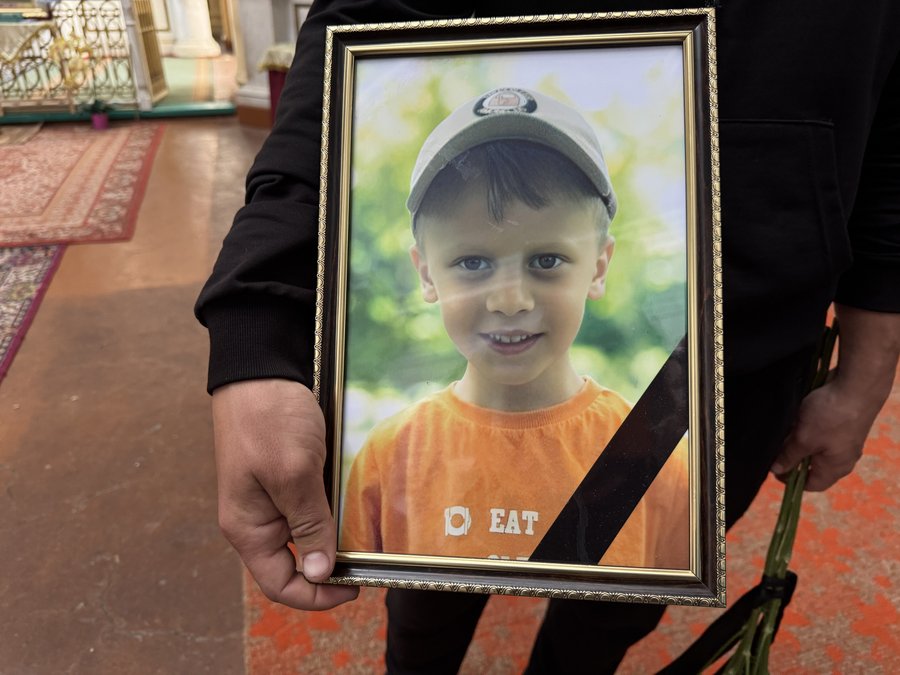
Using eight drones, the Russians razed seven houses to the ground and damaged about 20 others. A large fire broke out following the heavy strike. Three people from different families, including a 5-year-old boy, were killed.
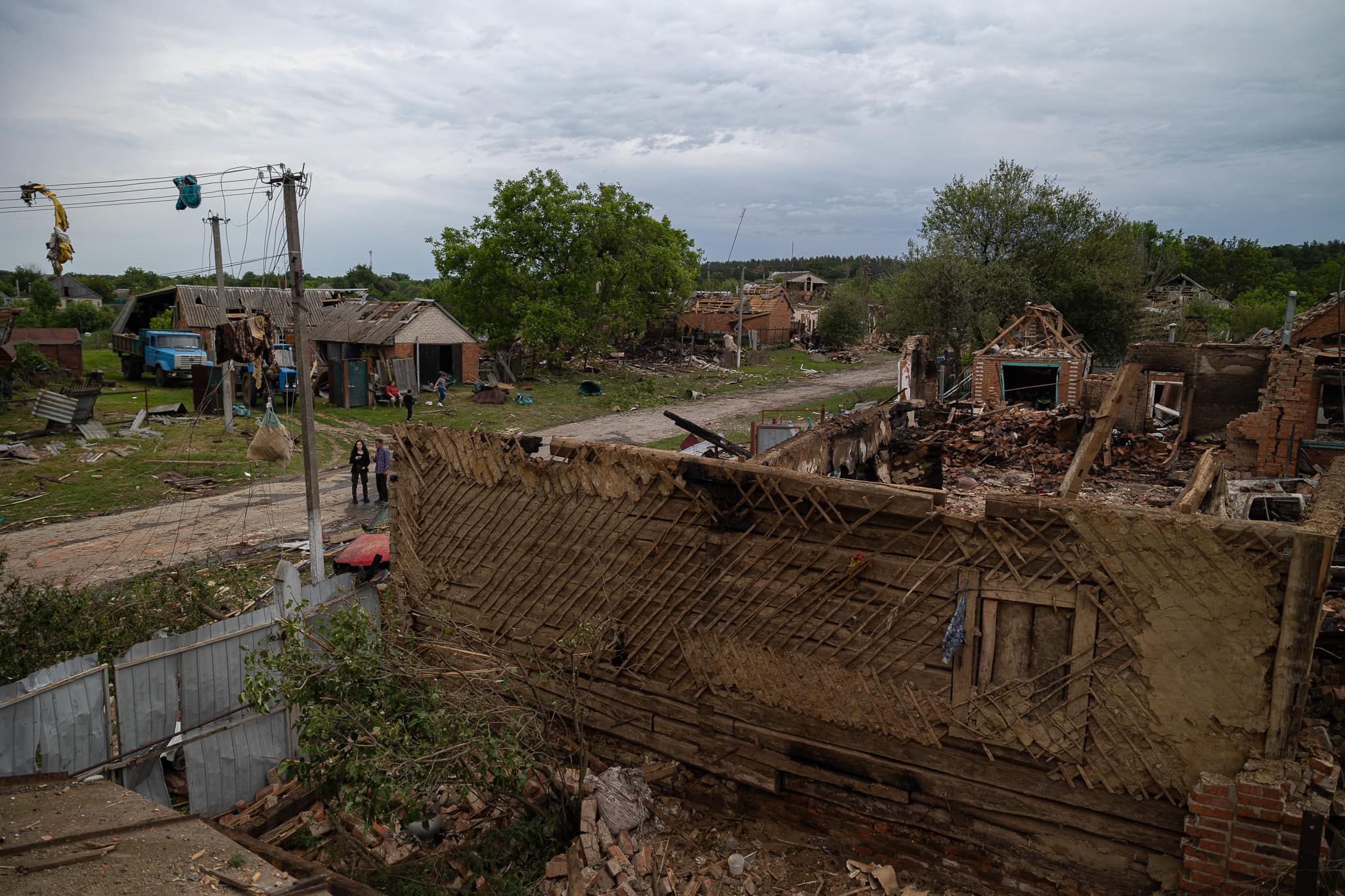
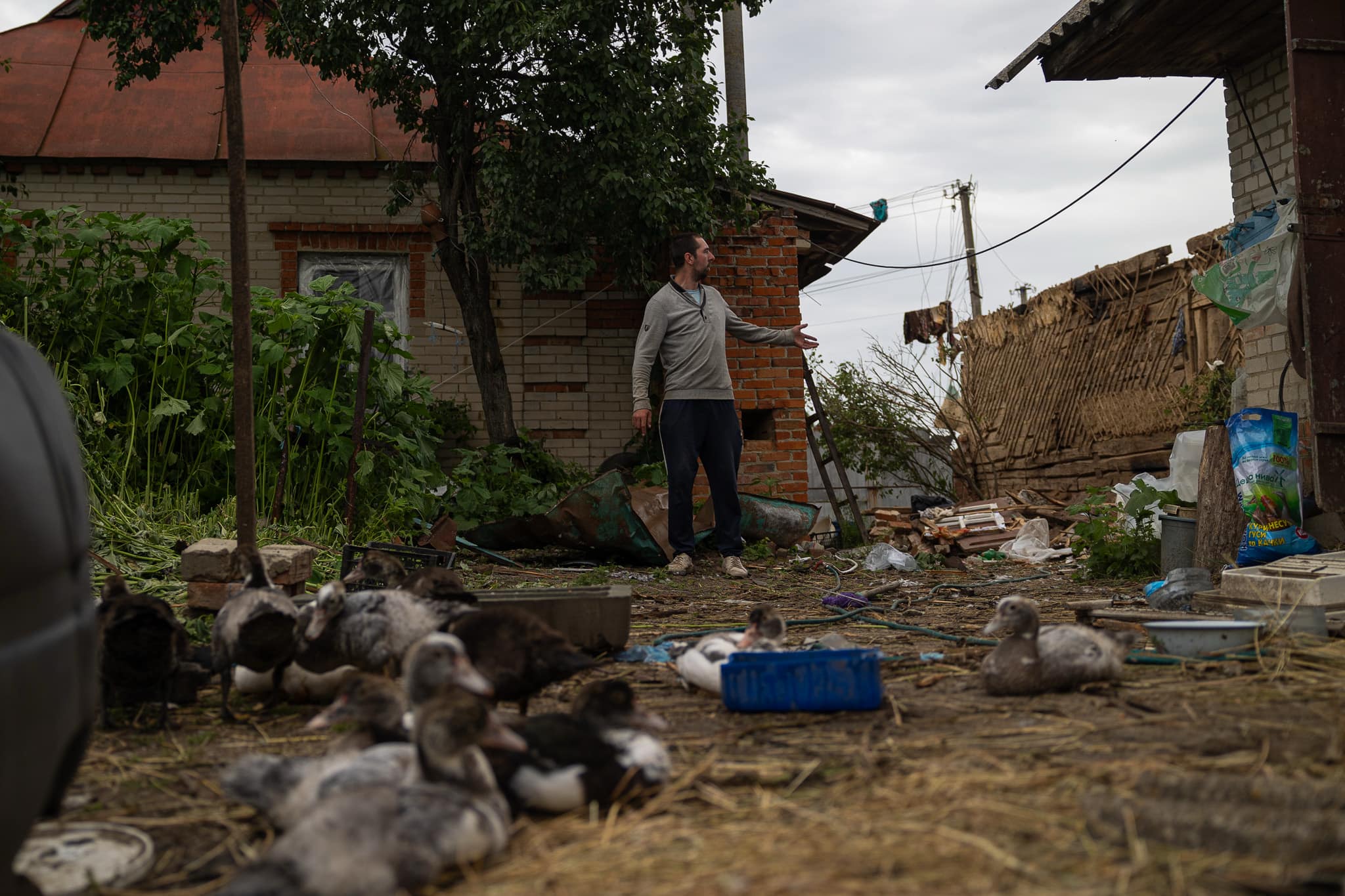

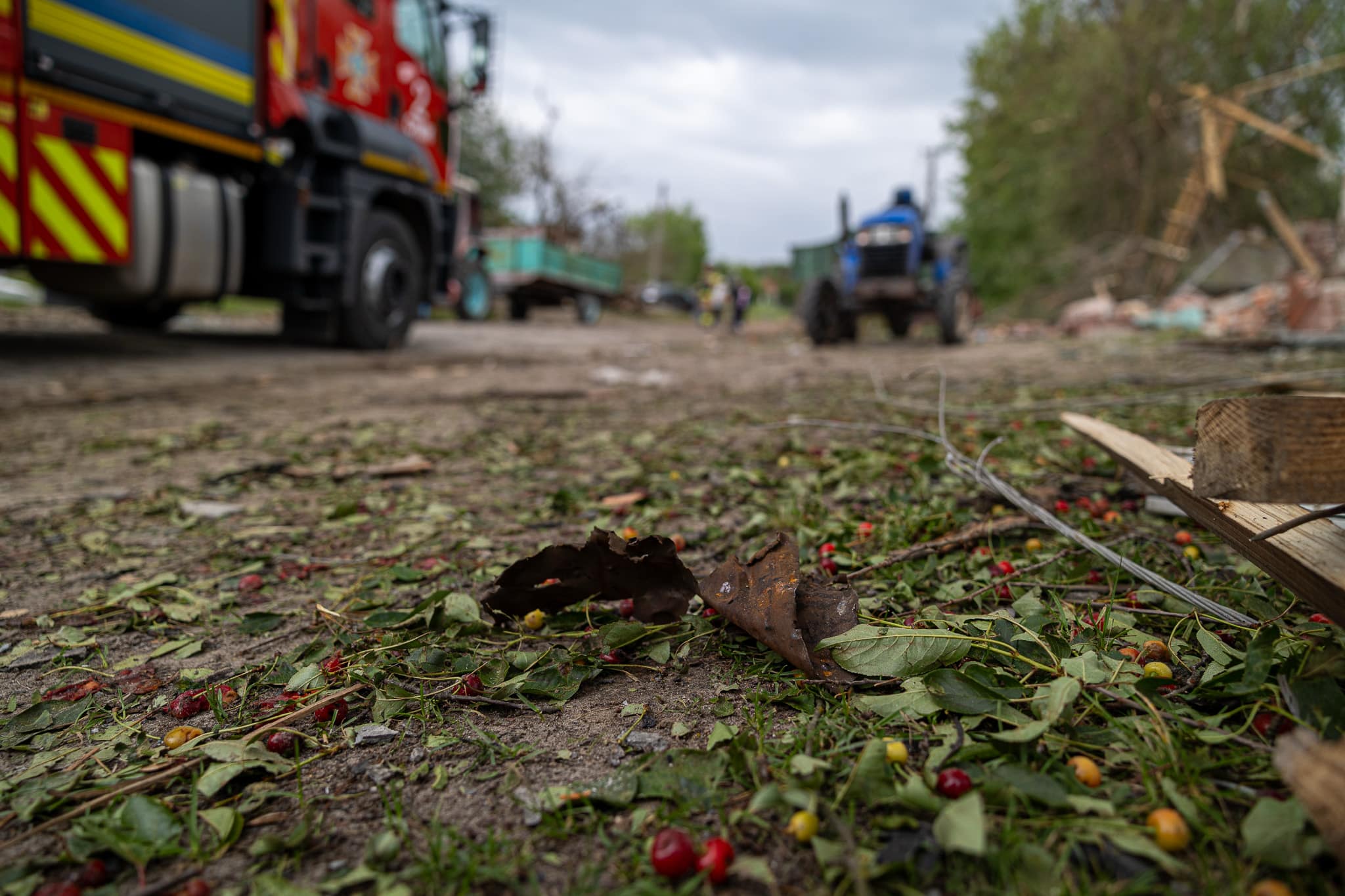
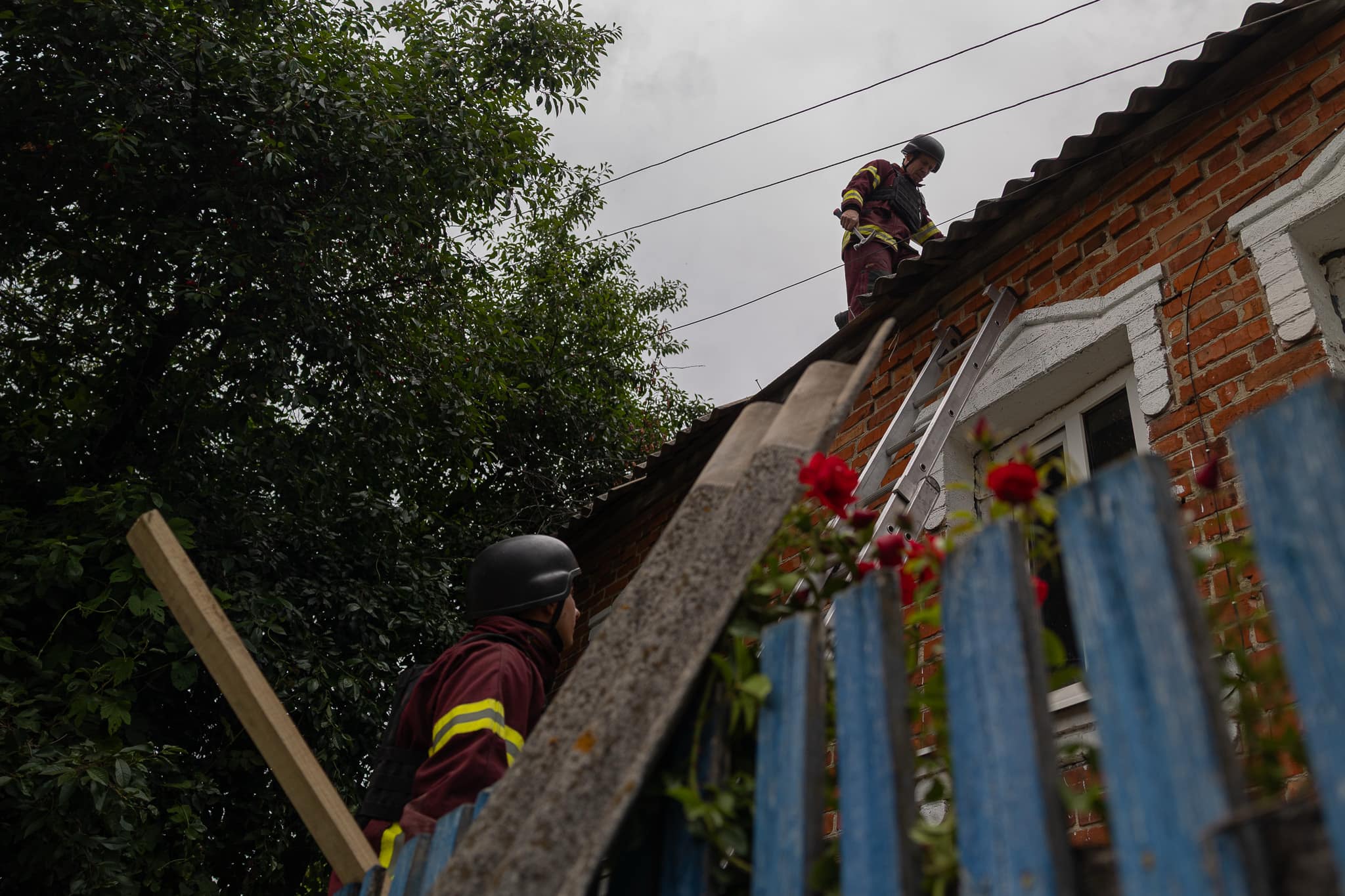
The next day, Velykyi Bobryk was so silent that the village seemed numb with grief. Without a word, amid the rumble of tractors and generators, the villagers cleared away the rubble and, together with the emergency workers, covered the roofs of the remaining houses.
Unripe cherries fell from the trees that had become entangled in the debris. Someone's feather pillow was stuck on an electric pole. The grass was littered with scraps of bloodstained bandages that someone had tried to use to bind up a wound during the night.
At the beginning of the street, one of the roofs that the emergency workers were covering belonged to Viktor's family. Viktor, a young man of 25-27, was almost the only person who agreed to talk to us. He had lived in Velykyi Bobryk for 21 years, five of them on the same street.
"It was around midnight when the Shaheds came. There were nine or ten of them," Viktor remembers. "My wife and I stayed in the house almost the whole night, and I covered the children with my body. When there were about 30 seconds between each Shahed, we ran outside, picked up the children, and fled to the end of the garden. Our house began to fall apart… to collapse. The roof fell in. We had to run.
The boy who was killed was only little. He lived four houses away," Viktor adds, pointing further down the street. "His mother was taken to hospital, and they were looking for his grandma. I don't know whether they took her [to hospital as well]. And his dad’s a soldier; he's missing in action."
The little boy's name was Dmytro Bezverkhyi. Dmyrto was buried in Velykyi Bobryk, the last person to be killed that night.
Is this enough for Europe to realise that they must "act immediately"? Is Sumy Oblast included in the concept of the "eastern border" of Europe? Will there be a "wall of drones" here?
Or at least some kind of wall?
These are the questions that swirl around your head as you watch the people of Velykyi Bobryk sort out what remains of their street.
***
At the end of June, four months after the Russian offensive in Sumy Oblast began and after 200 sq km of territory had been lost, the defence forces managed to stop the Russians and stabilise the situation.
The front line – at least for now – has stopped 20 km from Sumy.
Ukrainska Pravda sources among the military report that the Russians did not reach Khotin and Pysarivka, but they have captured most of Yunakivka. The Ukrainian army has recaptured Andriivka and advanced toward Oleksiivka and Kindrativka. The situation in Sadky is still difficult.
Russian assaults continue, especially on the Yunakivka front.
The Russian army shows no signs of stopping.
Author: Olha Kyrylenko, Ukrainska Pravda
Translation: Anastasiia Yankina, Theodore Holmes, Yuliia Kravchenko
Editing: Teresa Pearce