Aftermath of Russian tanker accident: birds covered in oily liquid spotted in Odesa Oblast – photos

Birds covered in oily liquid have been found in the Tuzly Lagoons National Park in Odesa Oblast. They are likely to have flown in after two Russian tankers sank, spilling oil products into the Black Sea.
Source: Tuzly Lagoons National Park; the Crimean Tatar Resource Centre, a non-governmental organisation
Details: The latest case occurred on 9 January, when a great crested grebe was found in the Tuzly Lagoons with its feathers coated in fuel oil, the National Park said.
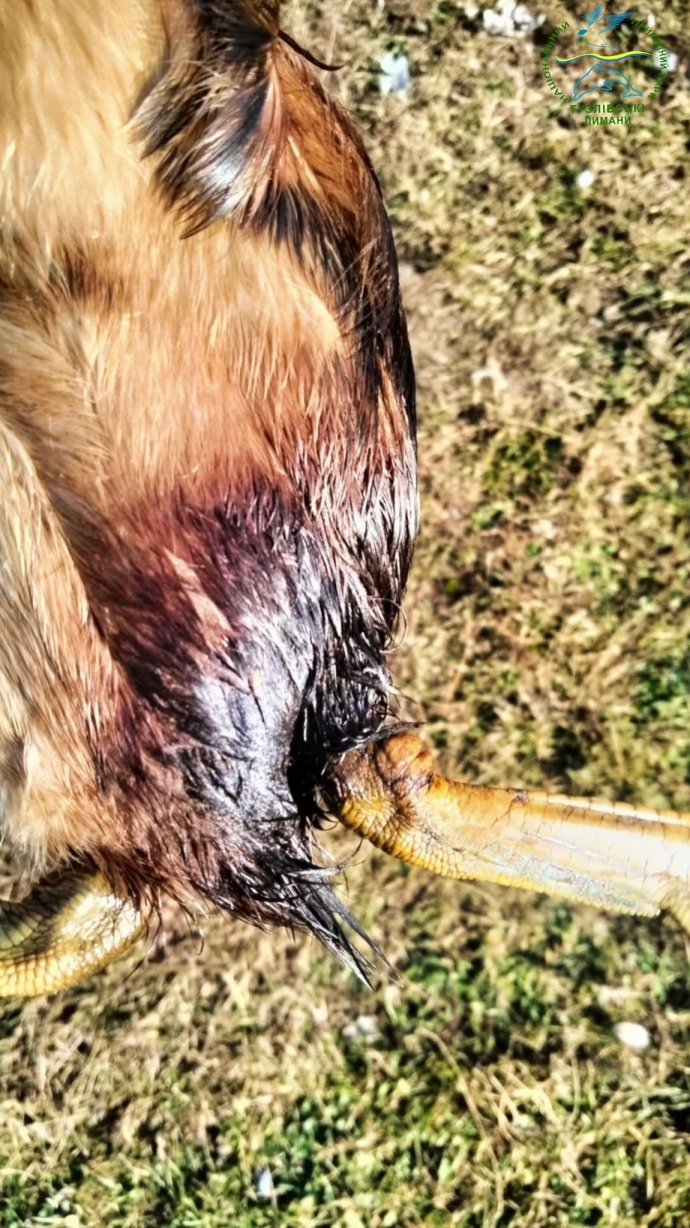
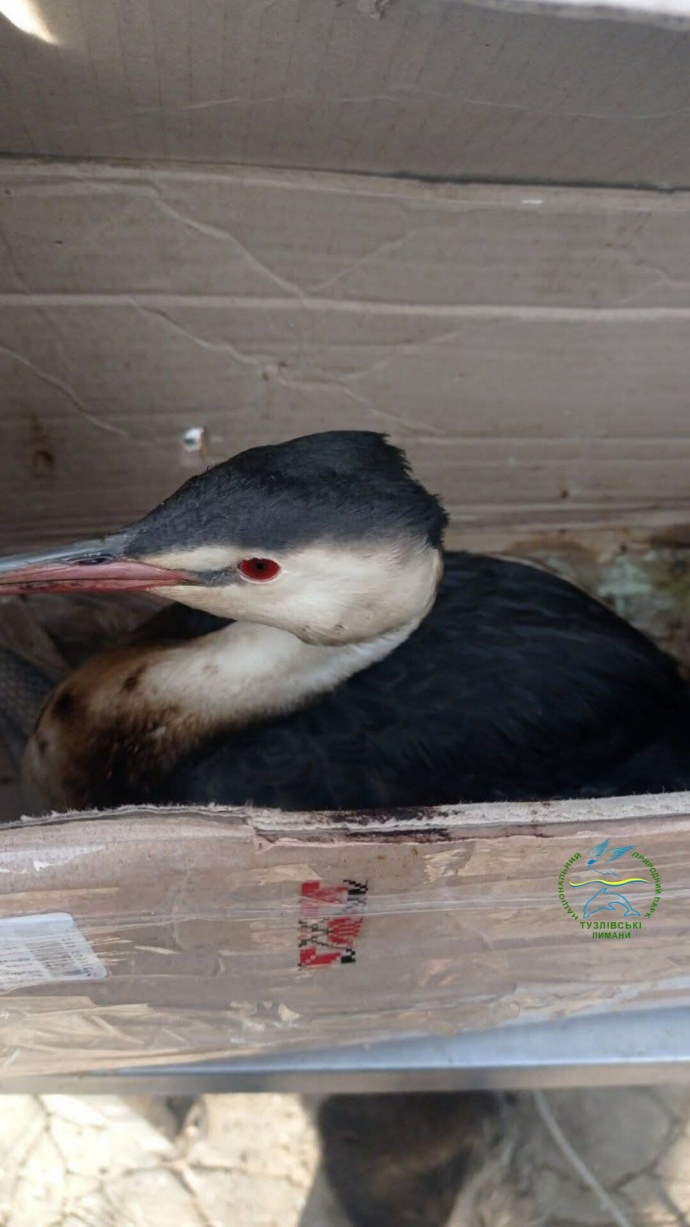
The bird is believed to have flown from the wreck of the Russian tankers that had been carrying tonnes of fuel oil, since great crested grebes can fly fast and cover long distances.
Earlier, a great cormorant was spotted in the park which seemed to be in a similar situation. However, the bird could not be rescued from the water.
One of the birds did not survive. Tuzly Lagoons staff will send it to the Ukrainian Scientific Center of Ecology of the Sea to be examined. Experts there should be able to conduct laboratory tests to identify the oil products and establish their connection with the Russian tanker accident.
Dr Pavlo Holdin, a researcher at the I.I. Schmalhausen Institute of Zoology at the National Academy of Sciences of Ukraine, told the Crimean Tatar Resource Centre that the impact of fuel oil pollution in the Black Sea will be felt for at least 20 years.
Quote from Holdin: "We see this based on the example of previous major fuel oil accidents, both in the Black Sea and beyond. For example, the consequences of the accident dated 2007 in the Kerch Strait are still being observed."
More details: Dr Holdin added that fuel oil from the Russian tanker accident is already reaching the western coast of Crimea and could spread further west to Odesa Oblast.
At the same time, an increase in the mortality rate of dolphins, the causes of which are not yet known, has been recorded in the northeastern waters. Dr Holdin suggests that the mammals may be dying not only because of fuel oil in the Black Sea, but also due to the toxic effects of ships, missile attacks, or outbreaks of infections that occur from time to time.
Quote from Holdin: "It is not certain that the dolphins are dying due to acute fuel oil poisoning, but it cannot be ruled out. Laboratory testing is required to determine the causes, which can take months."
More details: Dr Holdin says oil pollution could reach the coasts of Türkiye, Georgia and Romania, and the consequences could affect fauna and the economy, particularly through a decline in fishing. Holdin noted that sea fish and shellfish may contain toxic substances as a result of the accident.
The zoologist argues that an environmental disaster of this magnitude is unprecedented for the Black Sea.
"I'd like to emphasise that this is a record-breaking case in the history of the Black Sea in terms of the number of fuel oil leaks, meaning that the Black Sea has never experienced a disaster of this magnitude, either in terms of the number or the area of spread. And it's hard for me to predict exactly how the clean-up will be handled," he said.
Background: On 15 December 2024, two Russian tankers began sinking in the Kerch Strait. They broke in half, causing fuel oil to leak into the water.
The ships were carrying around 4,300 tonnes of oil, most of which leaked out of their tanks, creating a vast black stain in the water.
Greenpeace Ukraine said an oil spill in these waters could have serious consequences.
Read more: Source of pollution of Seim and Desna rivers found, restoration to take 2-3 years
"If it is driven ashore, then it will cause fouling of the shoreline which will be extremely difficult to clean up," said Dr Paul Johnston, Head of the Greenpeace Research Laboratories, based at the University of Exeter in the UK. "Any environmental impact will depend on the type of oil spilled. Heavy residual fuel oils will tend to cause more visible damage than refined fractions and marine gas oil which will tend to disperse and break up quite rapidly.
Given the potential for significant environmental impacts the focus should, after rescuing crew, be to try and minimise any further spillage if possible. If the ships sink, then there is the potential for releases of oil and petrochemicals over a longer time span."
In January 2025, the oil products that spilled into the sea following the accident reached the southern coast of Crimea, with patches of fuel oil extending up to 15 km near the city of Sevastopol and the settlement of Kacha.
Read more: Russia has destroyed over 60,000 hectares of Ukrainian forest worth almost US$360 million
Ukraine's Ministry of Environment and Natural Resources estimates that the full-scale Russian invasion has resulted in nearly 6,500 cases of ecosystem destruction and caused over €65 billion worth of damage.
Support UP or become our patron!