Most Ukrainians reject idea of troop withdrawal from Donetsk Oblast for security guarantees – poll

The share of Ukrainians who radically oppose Donetsk Oblast being ceded to Russia in exchange for security guarantees has slightly decreased compared to early spring, although a majority of respondents still firmly oppose the withdrawal of Ukrainian forces from the region.
Source: survey by the Kyiv International Institute of Sociology (KIIS), conducted on 20-27 April
Quote: "A total of 57% of respondents consider it categorically unacceptable for entire Donetsk Oblast to be transferred under Russian control in exchange for security guarantees. Meanwhile, 36% are willing to make this concession (although most admit it is a difficult condition). Another 7% are undecided."
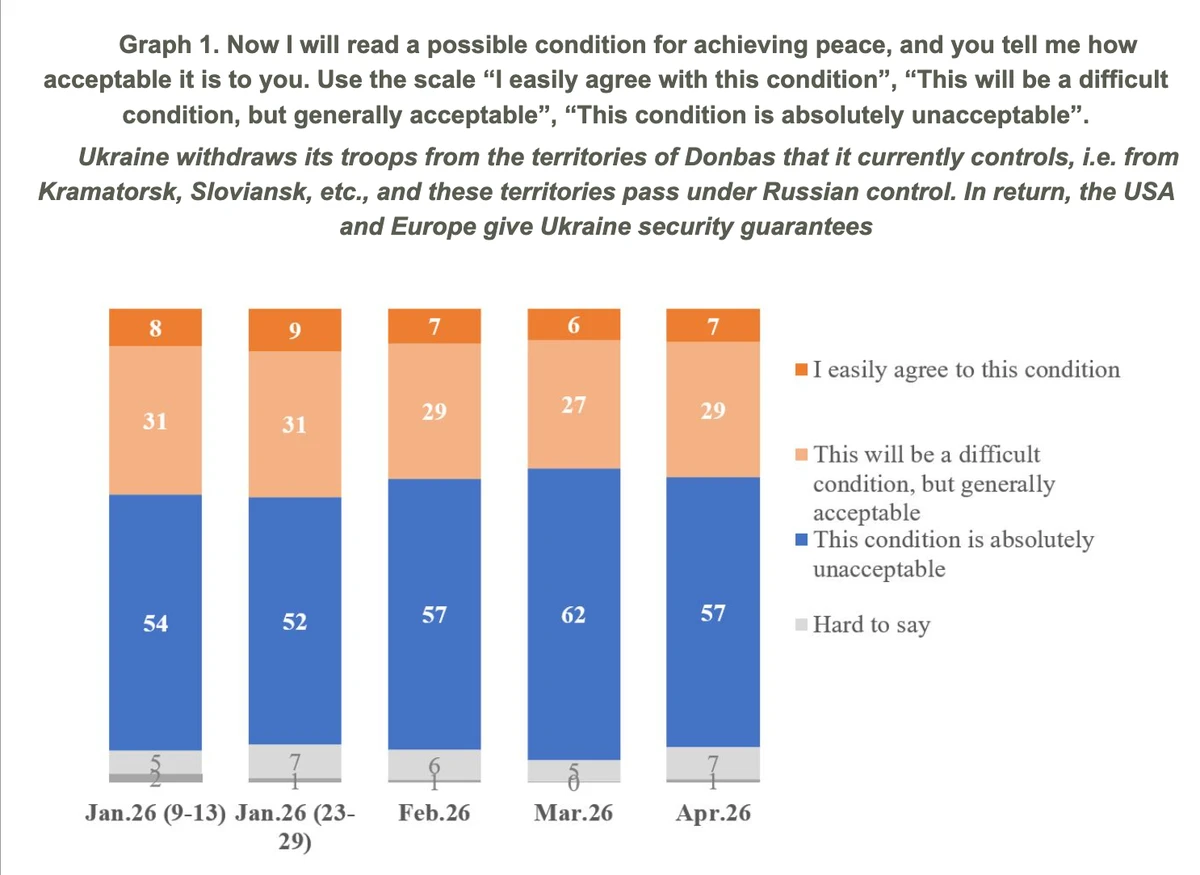
Details: According to KIIS, compared with early March, the share of those who strongly oppose the idea has fallen by 5 percentage points (57% compared with 62% in March). The proportion of those willing to accept the withdrawal of Ukrainian troops has also slightly increased (36% compared with 33% in March).
The sociologists note that the current figures have returned to February levels. KIIS also stresses that, overall, public opinion on the issue has not changed significantly, with a stable majority of Ukrainians continuing to be opposed to the idea.
For reference: The survey was conducted on 20-27 April using telephone interviews based on a random sample of mobile numbers. A total of 1,005 respondents aged 18 and over were surveyed across all regions of Ukraine under government control. Residents of temporarily occupied territories were not included (although some respondents are internally displaced persons who moved from occupied areas), and Ukrainians who left the country after 24 February 2022 were also not surveyed.
Under normal circumstances, the statistical margin of error (with a probability of 0.95 and taking into account a design effect of 1.3) did not exceed 4.1% for indicators close to 50%, 3.5% for those close to 25%, 2.5% for those close to 10%, and 1.8% for those close to 5%.
In wartime conditions, in addition to the stated formal margin of error, a certain systematic bias is possible; however, the sociologists believe the results remain highly representative and allow for a reasonably reliable analysis of public sentiment.
Support Ukrainska Pravda on Patreon!