

In mid-August 2025, US President Donald Trump made his first tangible attempt to organise negotiations to end Russia’s war against Ukraine.
During his campaign trail, Trump once promised to "end the war in 24 hours". Yet more than 24 weeks into his second term, he has failed to move closer to that goal.
Instead, during his first seven months in office, he has publicly clashed with Ukrainian President Volodymyr Zelenskyy, branded him a dictator with "4% support", blocked Ukraine’s access to intelligence and weapons supplies and repeatedly pressured the victim of aggression rather than the aggressor.
It was hardly surprising that Ukrainians have reacted with great coldness – if not outright outrage – to the US president’s idea of welcoming to Alaska the globally isolated mass murderer and ruler of Russia, Vladimir Putin.
Despite much scepticism, on 15 August Trump rolled out the red carpet for the Russian leader, which turned into another "red line" for Ukrainians and European leaders that the American leader must not be allowed to cross.
That is why a hastily assembled coalition of Zelenskyy and European leaders was in Washington on 18 August, trying to prevent Trump from going over to the "dark side".
Following this summit, the White House announced that a bilateral meeting of the leaders of Ukraine and the Russian Federation was being prepared, followed by a trilateral forum with the participation of the US president.
Western diplomats were quoted in the press as saying that "a diplomatic solution is closer than ever". Meanwhile, American and European media made even greater attempts to manipulate various kinds of data about the mood of the Ukrainian public, the "desire for peace," and "war fatigue".
In the end, it was as a result of such manipulation that a journalist in the White House asked Zelenskyy whether he intended to "keep sending soldiers to their deaths" while the people supposedly "want peace negotiations".
Such blatant manipulation of many statements, given the sensitivity of the issue, prompted Ukrainska Pravda to investigate whether Ukrainians actually do support negotiations, whether society trusts those participating in them, and whether President Zelenskyy still retains sufficient support for any potential outcomes of talks to be accepted in Ukraine.
Do Ukrainians want peace talks?
On 7 August, a week before the Trump-Putin meeting in Alaska, the influential American Gallup Institute published a fairly extensive sociological study on public sentiment in Ukraine.
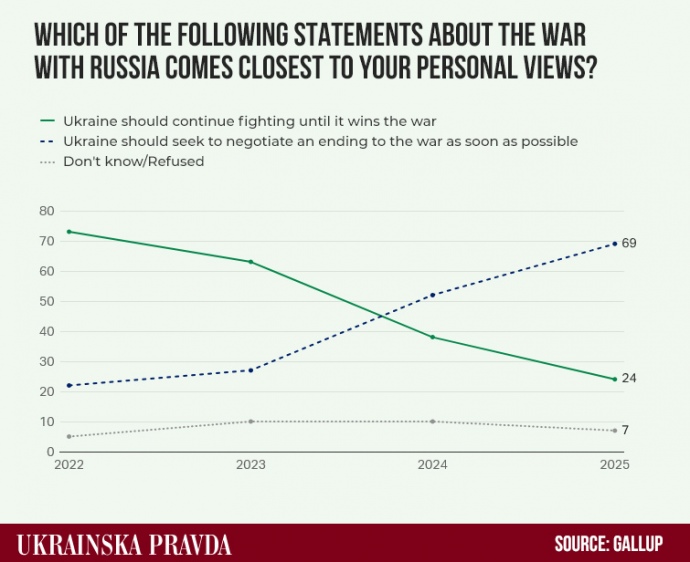
Among other things, it highlighted a "major shift": at the outset of Russia’s full-scale invasion in 2022, more than 70% of Ukrainians preferred to fight until complete victory, whereas by August 2025 nearly 70% leaned toward ending the war as quickly as possible through negotiations.
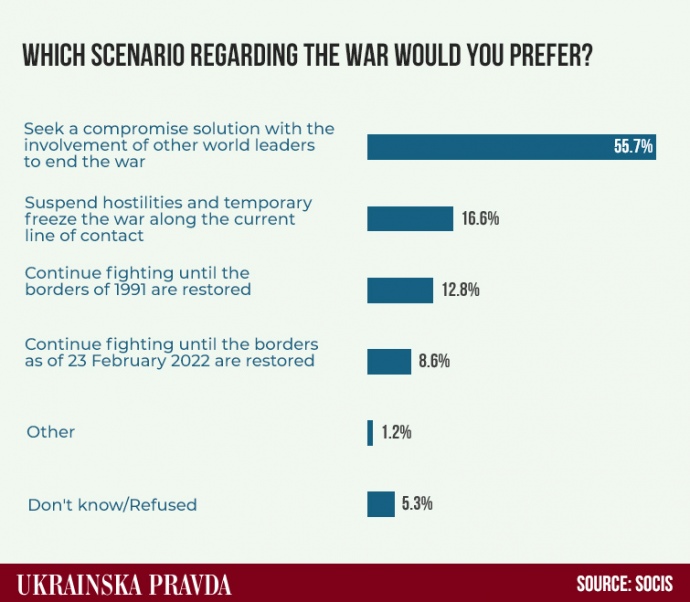
In June, similar data was published in Ukraine by the SOCIS sociological centre. According to its survey, just over 20% supported continuing the war until certain goals were achieved (the 2022 borders or even those of 1991), while roughly 70% favoured a freeze or the start of international negotiations.
However, the interpretation of these results by the American pollsters – and even more so by the media and politicians – was not very accurate. As Anton Hrushetskyi, executive director of the Kyiv International Institute of Sociology (KIIS), explained to Ukrainska Pravda, the answer to the question about wanting negotiations cannot be considered separately from several other questions.
"I personally saw Gallup’s data being presented as if Ukrainians were ready for peace on any terms. But the situation is much more complex. Of course, if you ask any normal person how best to end the war, they will say through negotiations. That is normal.
But the correct question is: what concessions are Ukrainians ready to make? And here the picture is completely different," the sociologist explained.
Hrushetskyi said that since 2023 – after the less-than-successful conclusion of Ukraine’s counteroffensive phase – public sentiment has shifted somewhat towards accepting the new realities.
"But without moving into a scenario where we are ready for any terms just to end the war. In 2023, only 10% were prepared to make territorial concessions. Now around 40% of Ukrainians are considering such an option. But even here, the situation is more complicated," Hrushetskyi said.
"What kinds of concessions are we talking about? If it concerns handing over territories currently controlled by Ukraine, or officially recognising the occupied territories as part of Russia, then an absolute majority – 70–80% of Ukrainians – oppose such options," the sociologist stressed.
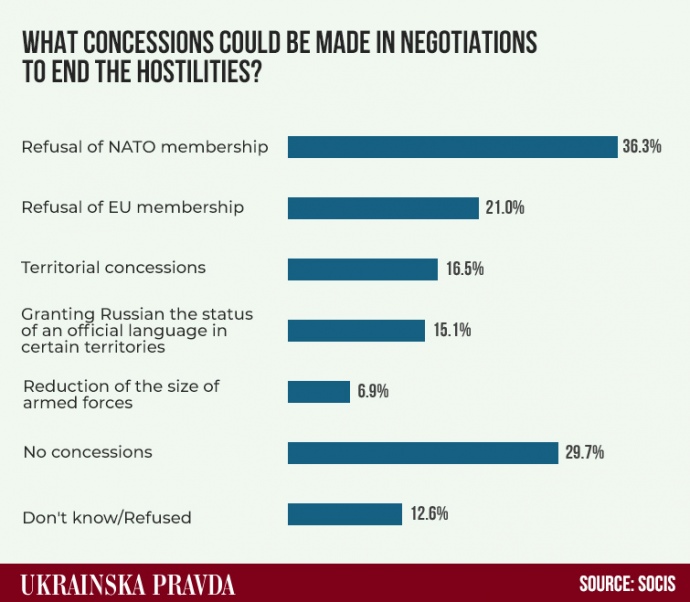
In the SOCIS poll, there was also a question about possible concessions. In an open question with multiple-choice answers, about 30% of respondents opposed any concessions to Russia.
Nearly 7% were willing to reduce the army, 16.5% to make territorial concessions, and 21% to give up joining the EU.
Most of the respondents were ready to give up the prospect of joining NATO – more than 36%.
However, this figure also requires proper interpretation: the Ukrainians were "sacrificing" what they believe in the least. The Gallup survey mentioned previously showed that in Ukraine, the number of those who believe in the possibility of joining NATO within the next ten years has dropped to a record low in recent years – now only 32%. Meanwhile, 33% do not believe in the possibility of joining NATO at all.
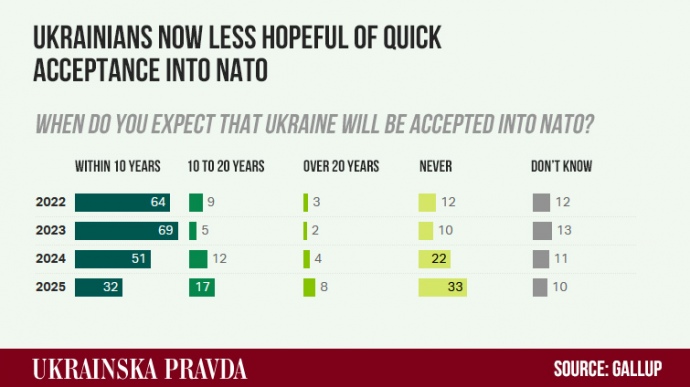
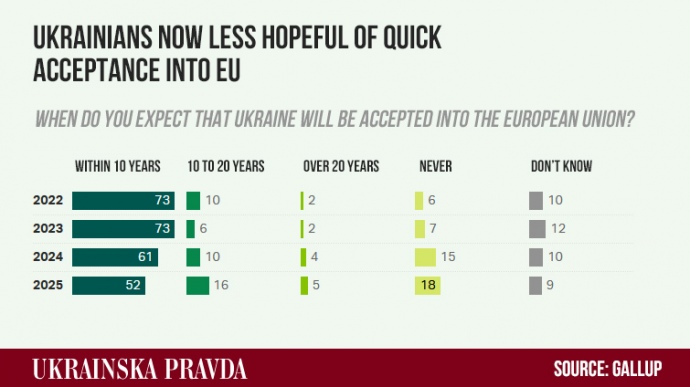
By comparison, the Ukrainians do believe in the prospect of rapid EU accession – 52% see it as possible within the next ten years, and another 16% think it will take between 10 and 20 years.
The issue of concessions is closely linked to another aspect of negotiations – security guarantees.
"If someone wants to gain support for a peace plan with various points along the lines of temporary occupation of territories, then anything like that is possible only if reliable security guarantees are provided in return," Anton Hrushetskyi told UP. "Only under such a scenario can more than 50% of respondents accept a certain ‘peace plan’. If there are no reliable security guarantees in such a plan, then the majority of respondents immediately reject any such document."
In summary, it can be said that Western sociologists have correctly observed the Ukrainian society’s readiness for a diplomatic format to end the war. But this is only possible if there are no unreasonable concessions to the aggressor and if reliable security guarantees from partners are in place.
Who are Ukraine's allies in peace?
Three and a half years of the full-scale war have left no doubt as to who the enemy is for Ukraine. But the question of allies, whose security guarantees could become one of the key factors in ending this war and preventing a new one, is less clear.
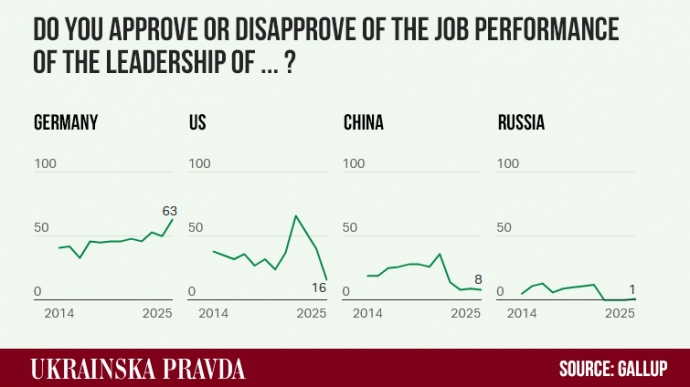
The Gallup survey clearly showed that the most dramatic change has been in the Ukrainians’ attitudes towards the United States.
At the beginning of the invasion in 2022, the approval rating of Washington’s actions in Ukraine reached 66%, but under Donald Trump’s presidency it plummeted to 16%. Seventy-three per cent of Ukrainians now disapprove of the course chosen by the new US leadership.
This distrust is largely behind the Ukrainians’ scepticism about Trump’s ability to achieve lasting peace in Ukraine through negotiations with Putin.
For example, according to a Gradus survey conducted on the eve of the Alaska meeting, only 25% of respondents believed it could bring lasting peace. Half of them believed at least a short-term ceasefire was possible.
However, after a downturn in Kyiv-Washington relations and the row in the Oval Office, a gradual trend towards the restoration of positive attitudes towards the United States can nevertheless be observed.
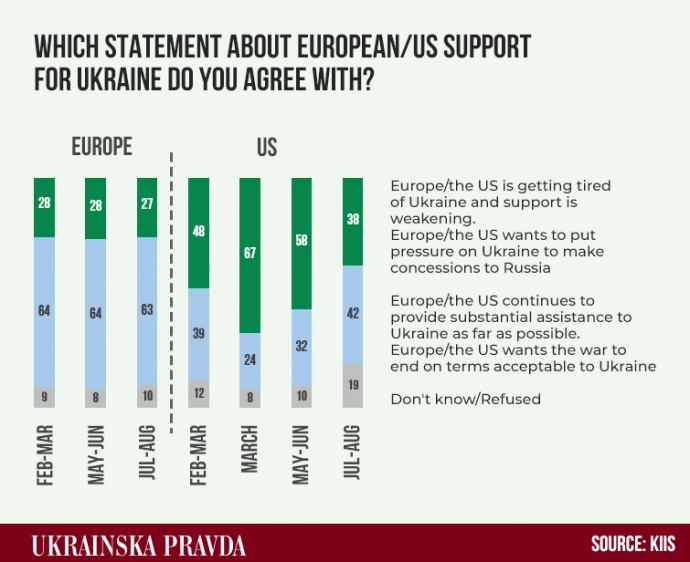
As shown in the August survey by Kyiv International Institute of Sociology, more and more Ukrainians are beginning to return to the view that the US is working to ensure the war ends on terms acceptable to Ukraine.
Firstly, despite hundreds of scandalous insider reports in the Western media and the red-carpet treatment for Putin, Trump has not sold out Ukraine on fundamental issues.
Secondly, most Ukrainians are aware that it is precisely the US and Trump’s team that have the main role to play in seeking a solution to end the war.
Gallup data shows that despite sharp disapproval of the US leader, 70% of Ukrainians believe Washington should play a significant role in resolving the war.
Meanwhile, Ukrainians would also like EU countries (75%) and the United Kingdom (71%) to be engaged on their side in the negotiation process.
That is why the Washington meeting with a Trump – Zelenskyy – EU leaders – Starmer format can be considered the most desirable for the Ukrainians. This is the set of countries and institutions the Ukrainians trust the most and whose security guarantees they would like to have.
The last unspoken factor that is critically important for legitimising the results of any negotiations in Ukraine remains the support of the Ukrainian president within the country.
At the beginning of the year, after the spat in the White House, Zelenskyy’s public approval rating rose sharply. In the months that followed, sociologists observed that the decline in this indicator was just slow and steady until 22 July, when the authorities carried out an ill-considered attack on anti-corruption bodies.
After a wave of protests and a major international scandal, Zelenskyy’s domestic support has been badly shaken. Yet this should not prevent him from representing Ukraine at peace talks, should they take place.
"There is a stable trend that when the president’s activity is assessed in the context of international politics, he is perceived more positively than in the context of domestic politics," Anton Hrushetskyi explained in a conversation with UP.
"In July, we saw that a formal majority of the population trusts the president. And it can be said that the president’s rhetoric is in sync with the poll results [regarding the ‘red lines’ – UP]. This is creating a positive perception among the public."
"In addition, the very presence of European partners adds credibility to the negotiations. Therefore there is trust in the president, but with the expectation that there are also ‘red lines’ that will not be crossed," Hrushetskyi added.
Author: Roman Romaniuk, Ukrainska Pravda
Translation: Myroslava Zavadska, Anna Kybukevych
Editing: Susan McDonald