Over 60% Ukrainians strongly opposed to withdrawal of Ukrainian troops from Donbas – survey

Over 60% of Ukrainians strictly disagree with the withdrawal of the defence forces from Donbas in exchange for security guarantees from the US and Europe. Only 7% easily agree to such a condition.
Source: a survey by the Kyiv International Institute of Sociology (KIIS) conducted on 8-16 October
Quote from KIIS: "Thus, 61% of respondents consider it categorically unacceptable to transfer the entire Donbas under Russian control in exchange for security guarantees. At the same time, 35% are ready for such a concession (although most of them admit that this is a difficult condition). Another 4% could not express an opinion."
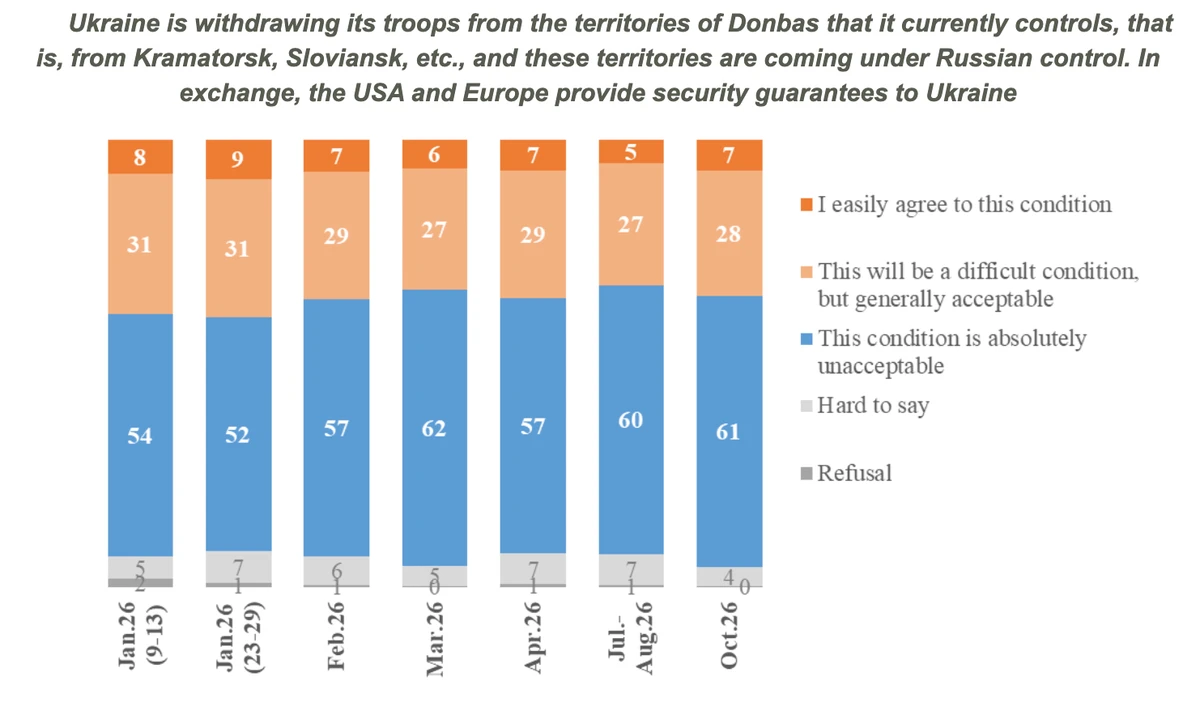
Details: The KIIS notes that compared to late July and early August, no statistically significant changes occurred.
Meanwhile, sociologists emphasise that among respondents surveyed on 8-9 October, prior to the announcement of the "diesel deal" and subsequent pressure on Ukraine, 57% were strongly opposed. Among respondents surveyed on 10-16 October, this figure rose to 62%.
Quote from KIIS: "Formally, the difference is within the margin of error, but we see that [at least] for now, the pressure campaign on Ukraine has not led to any greater readiness to accept this proposal."
Details: This situation applies across all regions – half or a majority reject the proposal to withdraw Ukrainian troops in exchange for security guarantees.
For reference: The study took place on 8-16 October. Using the telephone interview method based on a random sample of mobile numbers across all regions of Ukraine (territory controlled by Ukraine), 1,031 respondents aged 18 and older were surveyed. The sample did not include residents of territories temporarily not controlled by the Ukrainian authorities (at the same time, some respondents are internally displaced persons who moved from occupied territories), nor was the survey conducted among citizens who went abroad after 24 February 2022.
Under normal circumstances, the formal statistical margin of error for such a sample (with a probability of 0.95 and taking into account a design effect of 1.3) did not exceed 4.0% for indicators close to 50%, 3.4% for indicators close to 25%, 2.4% for indicators close to 10% and 1.7% for indicators close to 5%.
Under wartime conditions, in addition to the specified formal error, a certain systematic deviation is added. However, sociologists believe that the obtained results still retain high representativeness and allow for a fairly reliable analysis of public sentiment.
Your support on Patreon helps us keep the news free and accessible.