The devil in disguise: the Ukrainian Orthodox priests who work with Russian secret services and justify the war


On the afternoon of 15 August 2025, a meeting between US President Donald Trump and Kremlin leader Vladimir Putin at a military base in Anchorage, Alaska, came to a close.
The New York Times reported that one of the demands Putin made at the meeting was that his US counterpart provide security guarantees for Russian Orthodox churches in Ukraine. This is a clear reference to the Ukrainian Orthodox Church of the Moscow Patriarchate (UOC-MP), which, despite an "administrative separation" in 2022, remains part of the Russian Orthodox Church (ROC). The Orthodox Church of Ukraine, in contrast, is independent and has no ties to Russia whatsoever.
The request was perfectly targeted, as Trump is well known for having waged war on "anti-Christian bias". US Vice President JD Vance, while still a nominee, criticised the Ukrainian government for what he called an "attack on traditional Christian communities".
Some Western lobbyists are also working publicly to defend the UOC-ROC. American lawyer Robert Amsterdam receives funding from pro-Russian oligarch and deacon Vadym Novynskyi to represent the rights of the Ukrainian Orthodox Church.
In spring 2024, Amsterdam reportedly threatened Ukrainian MPs with sanctions if they voted for a law banning Russia-linked religious organisations. He now regularly parrots Russian propaganda narratives in interviews with foreign media outlets, claiming that Christians in Ukraine are being "persecuted" and churches in general are being "banned".
The press service of the Security Service of Ukraine (SSU) commented: "The Russians have been using the church for many years as a tool of hybrid warfare in Ukraine to expand the ‘Russian World’ [the general idea of the superiority of Russian Orthodoxy, culture, language, etc. – ed.]. The Security Service of Ukraine is not fighting against the church. But if a person wearing a cassock and carrying a censer commits crimes against the foundations of national security, such as adjusting enemy fire, then there will be no indulgence for them."
The SSU told Ukrainska Pravda that 180 criminal cases into unlawful activities by UOC priests have been opened since the full-scale war began. Among the suspects are 23 bishops.
The offences committed range from treason and justification of Russian aggression against Ukraine to child abuse and smuggling citizens across the border.

So far, 38 UOC priests have been convicted by Ukrainian courts.
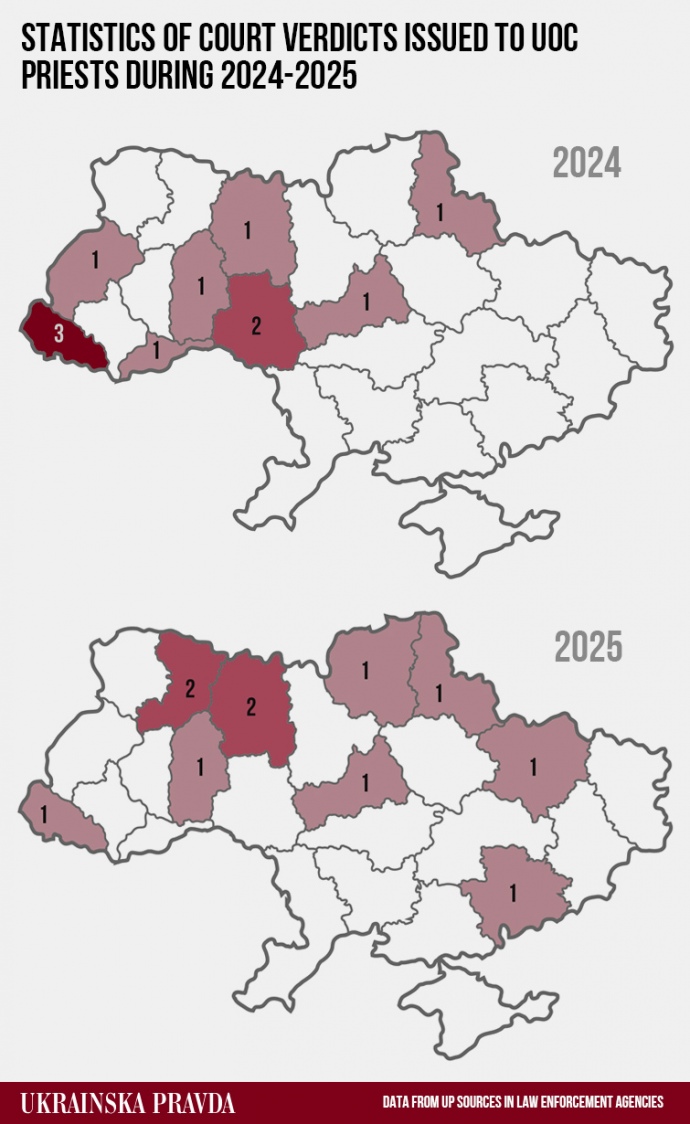
Ukrainska Pravda requested a comment from Metropolitan Klyment, spokesman for the Ukrainian Orthodox Church. We specifically asked whether the UOC condemns the crimes committed against the state by their priests and proven in court. At the time of publication, no response had been received.
We spoke with security officers, law enforcement officials and religion experts and studied criminal case materials and court verdicts in order to understand why the UOC became a breeding ground for networks of Russian agents, what Ukraine is doing to combat "collaborators in cassocks", and why the SSU’s "pilgrimages" – raids on churches belonging to the ROC’s branch in Ukraine – do not constitute "persecution of Christians".
We’ll explain this through examples of specific criminal cases.
Disclaimer: In this article we describe crimes against national security committed only by priests of the Ukrainian Orthodox Church. While working on this piece, Ukrainska Pravda asked representatives of the security sector whether any criminal proceedings concerning collaboration with Russia are underway with respect to clergy from other religious organisations registered in Ukraine. The answer was no.
Thou shalt not kill: collaboration with the Russian secret services
During the Soviet era, the Russian Orthodox Church operated under the close supervision of the Committee for State Security (KGB). The secret services controlled the seminaries, filtered candidates for church positions, and forced bishops to break the seal of confession.
The clergy in Ukraine were no exception. For instance, Filaret, now 96, who was the ROC Metropolitan of Kyiv and Galicia before the Ukrainian Orthodox Church of the Kyiv Patriarchate was created in 1992, had the agent codename Antonov and has made no secret of his long-standing ties with the Russian secret service. In 1997, the ROC declared Filaret a "schismatic" and anathematised him. He is now the honorary patriarch of the Orthodox Church of Ukraine (OCU).
Russia’s Federal Security Service (FSB), as the successor of the Soviet KGB, continues to use the church for its own purposes even today.
Prior to Russia’s full-scale invasion, Ukrainian law enforcement officers used to be reluctant to accuse clergy of crimes. Some of those who spoke to Ukrainska Pravda on condition of anonymity said they would wait for political will from the leadership (former SSU head Ivan Bakanov was a member of a UOC-MP parish). Others admit: "We were afraid of being anathematised and cursed."
The situation changed during the full-scale war. "We don’t monitor the religious environment 24/7. But if there’s a threat to national security, we are obliged to neutralise it," one influential security officer told Ukrainska Pravda.
Operations to "neutralise national security threats" have taken place in various regions of Ukraine.
In the spring of 2023, SSU officers served Mykola Zakroiets, the parish priest of St George’s Church in Yampil, a village in Sumy Oblast, with a notice of suspicion of treason. During searches, the SSU had found Russian literature about "our dear father the tsar" and the "united people" [Russian propaganda likes to claim that Ukrainians and Russians are one nation – ed.] and mobile phones containing correspondence with FSB representatives.
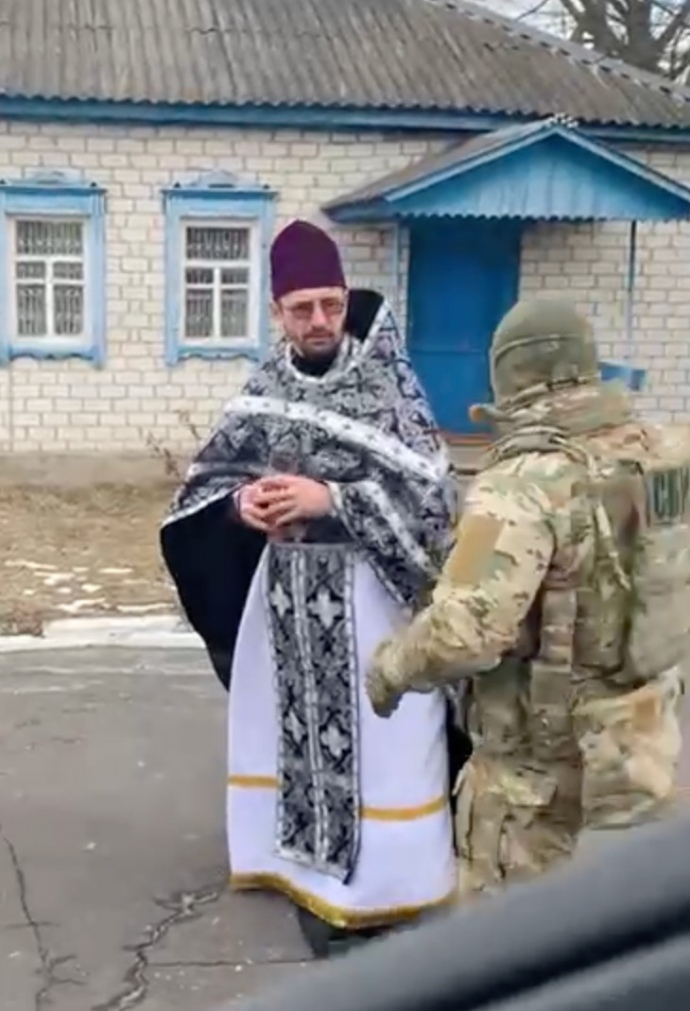
The investigation established that the archpriest had been recruited by FSB officers from Russia’s Bryansk Oblast in August 2022. Zakroiets would cycle around border settlements in Sumy Oblast photographing Ukrainian soldiers’ locations, combat positions and observation posts. The case materials state that he passed the information on to his Russian handler to assist in preparing for a series of missile strikes on the region.
A source among the investigators told Ukrainska Pravda that Zakroiets also informed his FSB handler about local citizens with pro-Ukraine views who might resist in the event of an occupation.
In October 2023, the court found the archpriest guilty of treason and sentenced him to 15 years in prison with confiscation of his assets.
Ukraine handed Zakroiets over to Russia in a prisoner swap in early July 2024. Shortly before that, he admitted that he had cooperated with the FSB not for money, but out of ideological conviction. "I’m serving a sentence for the Russian Idea. Of course I wanted Russia to win. No point hiding it," he said.
One of the most recent high-profile arrests of a priest took place in Zaporizhzhia when in August 2025, Archpriest Kostiantyn Kolodka, parish priest of the Church of the Holy Spirit, was detained. The SSU found a Russian passport, Kalashnikov ammunition and bladed weapons in his possession.
Kolodka is accused of treason, encroachment on the territorial integrity of Ukraine, aiding in the seizure of power, justifying Russia’s armed aggression, and violating citizens’ equality.
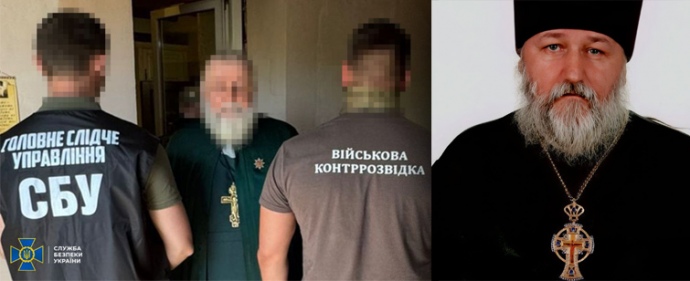
According to the SSU’s information, the archpriest handled a Russian military intelligence network in the city of Zaporizhzhia. He allegedly identified pro-Russian residents of the city during confessions and recruited them to work for the Russian Federation.
When pro-Russian president Viktor Yanukovych was in power, Kolodka was chaplain to the Zaporizhzhia-based Berkut security organisation. He was also one of the founders of Radomyr, a militant organisation which guarded the UOC’s Zaporizhzhia diocese. According to religion expert Andrii Smyrnov, it was members of Radomyr who organised and took part in the attempt to seize the Zaporizhzhia Oblast State Administration and Zaporizhzhia Oblast Council on 13 April 2014.
The Security Service of Ukraine first learned that Kolodka could be a Russian agent when a spotter of Russian strikes was detained in Zaporizhzhia and gave evidence against the priest. The security service then began monitoring the archpriest’s activities.
The case materials state that Kolodka recruited a mobilised serviceman who passed on information about the deployment, numbers and weaponry of Ukrainian forces on the Zaporizhzhia front. The investigators established that the clergyman and the agent coordinated their actions with a representative of the 316th intelligence centre of Russia’s Main Intelligence Directorate (GRU).
The pre-trial investigation is ongoing. Kolodka remains in custody. If his guilt is proven, he faces life imprisonment.
"Lord, preserve peace in our country, preserve our president and commander-in-chief Vladimir Vladimirovich [Putin], our military leader, and our Christ-loving army." This is a prayer said by Archpriest Andrii Pavlenko, parish priest of St Tikhvin’s Church in Lysychansk, Luhansk Oblast, in March 2023.
That same day, Pavlenko delivered thermal imagers and humanitarian aid to Russian occupation forces in temporarily occupied territory of Ukraine. And just a few months before, he had been held in custody in Ukraine.
An investigation found that at the beginning of the full-scale war, Pavlenko passed on information about the numbers and equipment of Ukrainian Armed Forces units stationed in Siverskodonetsk to police representatives of the so-called "LPR" [the Luhansk People’s Republic, a self-proclaimed Russia-backed quasi-state formation in Luhansk Oblast – ed.].
"Under the guise of providing spiritual support, Pavlenko would visit hospitals and extract information from wounded Ukrainian soldiers about the locations of their positions," a law enforcement source told Ukrainska Pravda off the record. "He also told the Russians which of his parishioners held patriotic views so that they would be killed in the event of occupation."
On 5 December 2022, the archpriest was sentenced to 12 years’ imprisonment for collaborationist activity. Shortly after the verdict was handed down, Pavlenko was exchanged for 28 Ukrainian prisoners of war. Among them was US citizen Suedi Murekezi.
Andrii Pavlenko was met in Russia personally by Wagner Group leader Yevgeny Prigozhin
After the exchange, Pavlenko began supporting the Russian occupation forces – with prayers and money. And on 22 August 2025, the International Day Commemorating the Victims of Acts of Violence Based on Religion or Belief, he made a statement to Russian propagandists in which he insisted that "the international community should be concerned about ending the persecution of believers in Ukraine".
"The enemy values its agents in cassocks," SSU head Vasyl Maliuk said in an interview.
Ukrainska Pravda tried to find out how many POWs have been freed in exchange for UOC priests, but both the SSU and the Coordination Headquarters for the Treatment of Prisoners of War refused to provide us with this statistic.
A source at the Coordination Headquarters explained: "There is no established practice whereby UOC priests can be exchanged for a specific category of POWs or civilian hostages. The individuals vary, and Russia’s level of interest in them varies. What we can say is that UOC representatives express the desire to be handed over to Russia far more frequently than the aggressor country expresses a desire to take them."
Another security source added, speaking on condition of anonymity: "Usually we are given more than a dozen POWs for one UOC priest. Sometimes such exchanges enable us to bring back not only soldiers and civilian hostages, but also top agents of the Ukrainian security services."
Sources in law enforcement told Ukrainska Pravda that Metropolitan Pavlo of Vyshhorod and Chornobyl (Pavlo Lebid, nicknamed Pasha Mercedes), who has been charged with justifying Russian aggression and violating citizens’ equality, was asked whether he wanted to be included in the exchange lists, but he replied: "No. I love Ukraine."
Pavlo demonstrates his "love for Ukraine" in these phone conversations, released by the SSU
Thou shalt not bear false witness: justifying the war
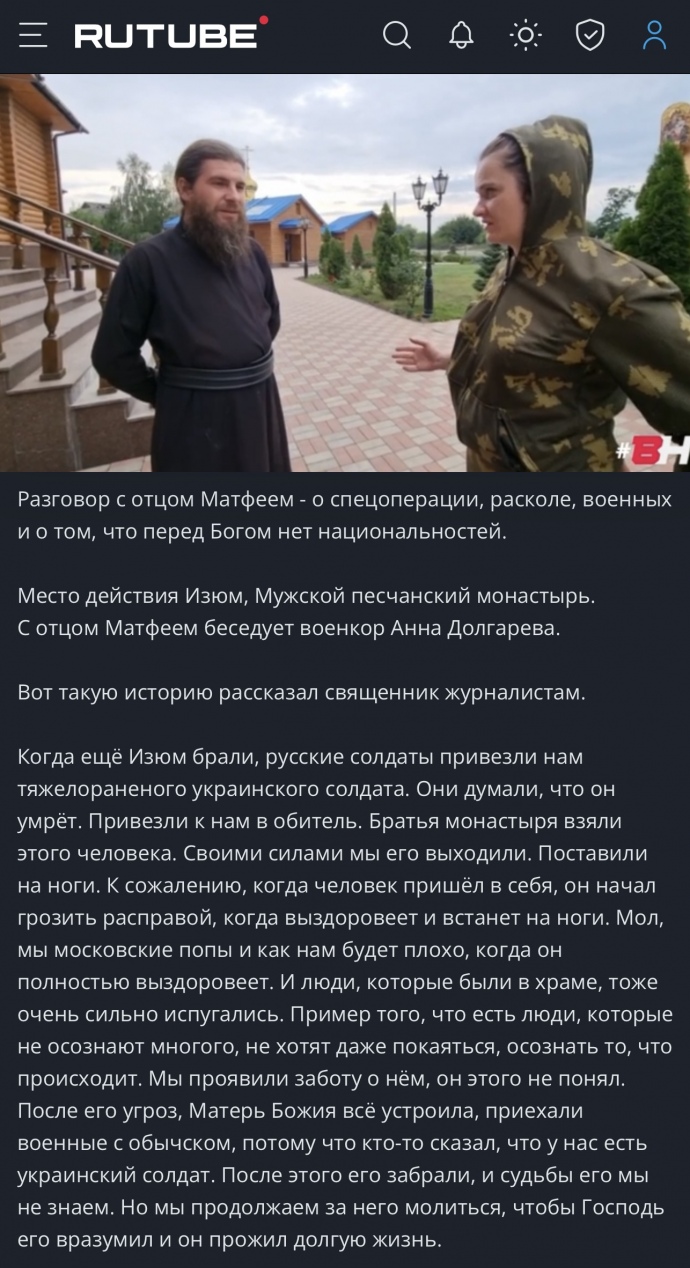
"We are the Moscow Patriarchate. We take a negative view of this [the possible ban on the UOC in Ukraine – ed.]. It’s all a political movement," Archimandrite Mykhailo Pimashyn, abbot of the Monastery of the Pishchansky Icon of the Mother of God in Izium, Kharkiv Oblast, emphasised in an interview with Russian propagandists published in August 2022.
Izium was still under occupation at the time. An investigation established that Pimashyn had blessed Russian soldiers, justified the Russian Federation’s aggression against Ukraine, and urged local residents to support the Russians.
The priest wrote to an aide of Patriarch Kirill, head of the ROC, whom he had known since his seminary days, asking him to send food and medicine to Izium. "Thank you, Lord and master!" was how Pimashyn expressed his gratitude for the humanitarian aid from Russia. The SSU maintains that Pimashyn used the Russian aid to "ensure the ‘loyalty’ of the local population towards the invaders".
On 30 May 2025, Pimashyn received a prison sentence for justifying the armed aggression of the Russian Federation. He will spend five years behind bars.
Mykola Zirka, priest of the parish of the Kazan icon of the Mother of God in the UOC’s Horlivka diocese in Yarova, Donetsk Oblast, chose life in Russia over seven years in a Ukrainian prison. A court found him guilty of collaborationism in February 2023. Later, with his personal consent and at Russia’s request, Zirka was handed over to the Russian Federation during a prisoner swap in which one hundred Ukrainian soldiers and a civilian hostage were freed.
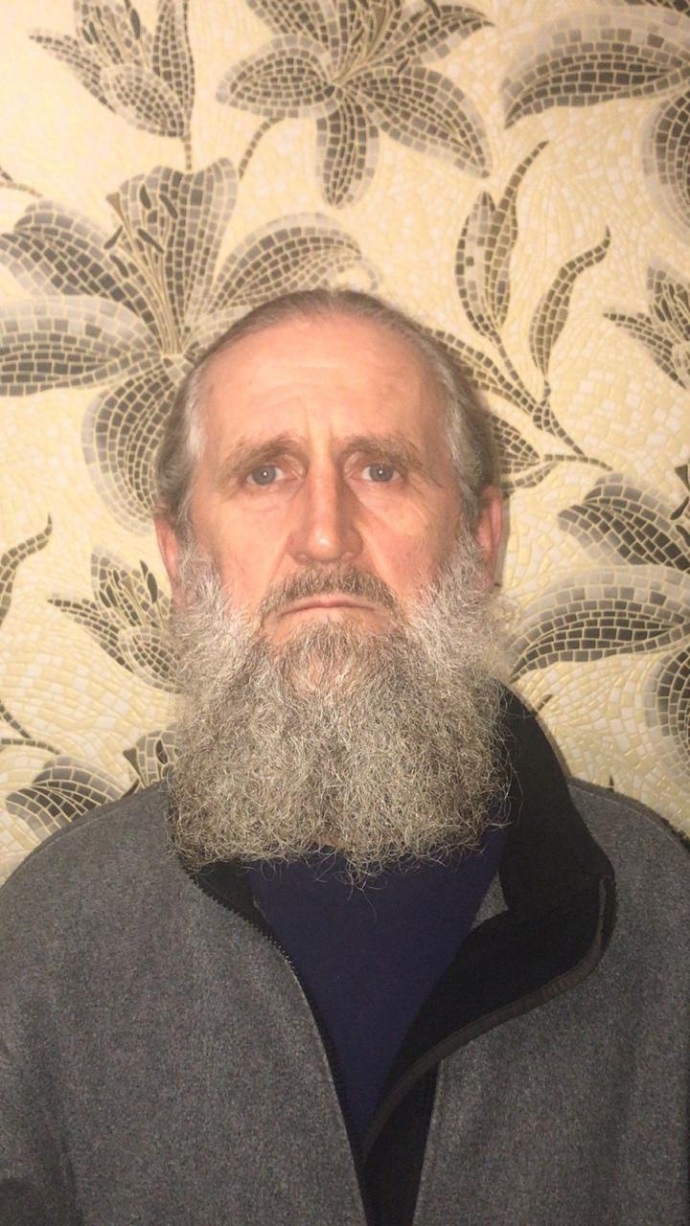
The priest colluded with Russian soldiers in May 2022 when they were advancing on Yarova. As soon as the Russians managed to capture the village, it was Zirka who informed the locals of that fact.
According to the case materials, during the temporary occupation of Yarova he openly denied that the Russian Federation had launched an armed attack on Ukraine. He also urged parishioners to vote for the "accession" of Donetsk Oblast to Russia in the sham referendum. After Yarova was liberated, Zirka was arrested.
These crimes were committed by priests during the Russian occupation, but our next anti-hero spread the ideas of the "Russian world" in Vinnytsia Oblast, which has certainly never been occupied.
The SSU opened a case against Metropolitan Ionafan (Anatolii Yeletskykh) of Tulchyn and Bratslav right at the start of the full-scale Russo-Ukrainian war – on 5 March 2022. The security service concluded that posts on the church leader’s personal website, Vladyka Ionafan, "contained calls for incitement of inter-confessional hatred".
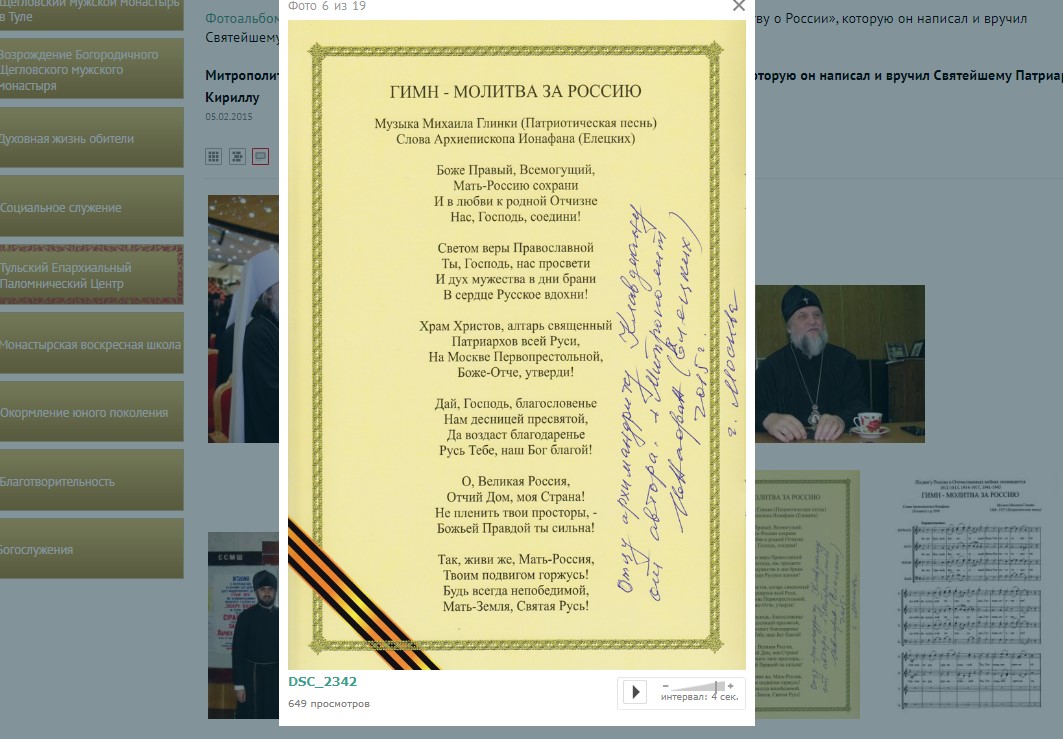
During searches at the metropolitan’s premises, operatives seized propaganda leaflets featuring the slogan "Donbas is Russian" and printouts of Putin’s "decree" annexing Crimea to the Russian Federation, including a map of Ukraine on which Crimea was marked as Russian territory. They also found a "Hymn-Prayer for Russia" which the metropolitan had published in 2015. These materials had been distributed by the cleric among his parishioners.
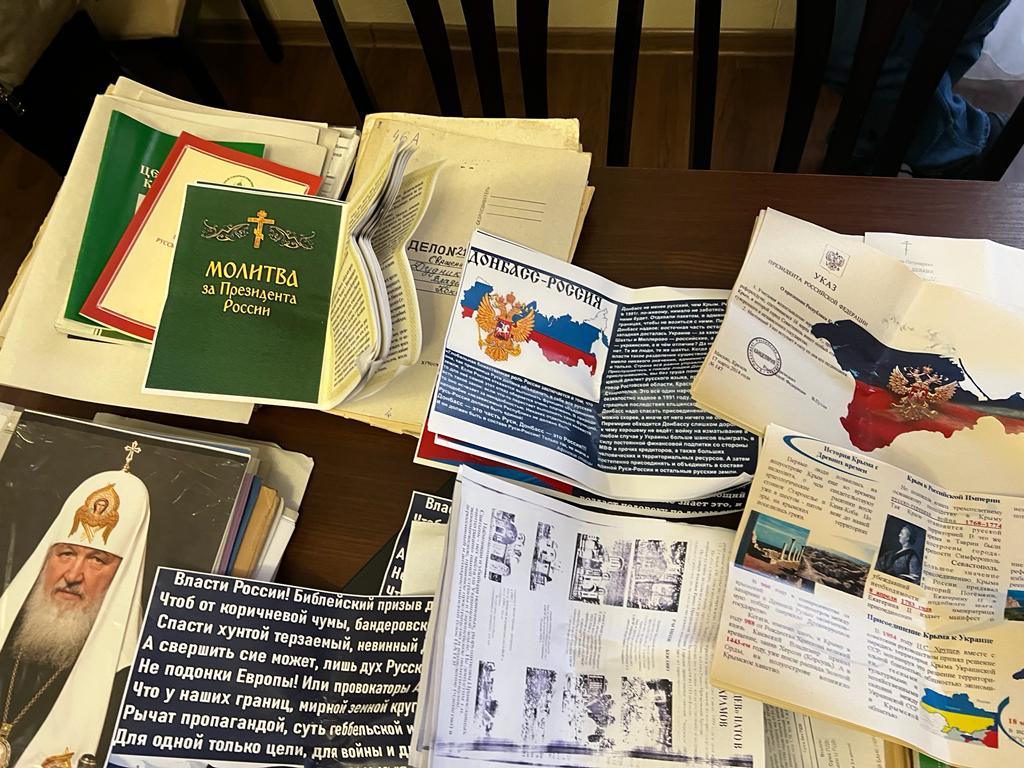
In a verdict announced on 7 August 2023, Ionafan was found guilty of attempting to overthrow the constitutional order in Ukraine, inciting inter-faith hatred, and justifying the Russian Federation’s armed aggression against Ukraine. He was sentenced to five years’ imprisonment.
Just a few days later, on 9 August, Yeletskykh submitted a request to be exchanged for Ukrainian prisoners of war, and in June 2024 he was handed over to the Russian side. Immediately upon his arrival in "Mother Russia", Ionafan was greeted by Moscow’s Patriarch Kirill with hugs and kisses and presented with the Order of St Sergius of Radonezh, 1st class.
The meeting of ROC Patriarch Kirill with UOC Metropolitan Ionafan
***
"The UOC is a breeding ground for agent networks. All pro-Russia and Russian parties and public organisations are banned in Ukraine. But you can’t just ban a church, and that’s why it continues to be used for intelligence activity," says Andrii Smyrnov, who sits on the advisory board of Ukraine’s State Service for Ethnic Policy and Freedom of Conscience.
Experts from the Service discovered signs that the UOC’s Kyiv Metropolis was affiliated with the Russian Orthodox Church and ordered the organisation to sever all ties with the ROC by 18 August 2025.
However, the Kyiv Metropolis refused to comply with the order, claiming that some points in the order were fictitious and nothing to do with the UOC. The Service responded by filing a lawsuit seeking to terminate the state registration of the UOC’s Kyiv Metropolis.
Smyrnov says that if the State Service for Ethnic Policy wins the court case, the Kyiv Metropolis will lose its status as a legal entity and the associated privileges, although it won’t go anywhere. However, the 154 religious organisations affiliated with the Kyiv Metropolis will lose the right to use any assets that are state-owned or in communal ownership.
A sunny morning, 28 August 2025. According to the Julian calendar, it’s the Feast of the Dormition of the Mother of God.
Worshippers are gathering in Odesa’s Transfiguration Cathedral, which has still not been fully rebuilt after being hit in a Russian strike in July 2023.
On a wall beneath the damaged roof is a depiction of St Xenia of Petersburg – a saint of the Russian Orthodox Church. An image of one of the ROC’s most precious relics – the Kazan icon of the Mother of God – stands in the centre of the church.
Chants of "Lord have mercy!" in Russian can be heard echoing from the service.
And yet not long before this, in this very city of Odesa, the SSU had detained two UOC priests from different churches for spreading Russian propaganda, justifying the war and glorifying the occupation forces.
Author: Anhelina Strashkulych, Ukrainska Pravda
Translation: Myroslava Zavadska
Editing: Teresa Pearce