"Are you advancing on Tyotkino? We're running into the same brick wall again and again." What is happening in Sumy Oblast where Russian troops are moving forward


In recent weeks, Sumy Oblast – which had not seen heavy fighting for a long time – has been appearing almost daily on updated maps of DeepState, a Ukrainian group of military analysts.
"The Russians have occupied Andriivka and Vodolahy."
"The enemy continues to advance in Sumy Oblast."
"The Russians have taken control of Loknia."
Ukraine’s withdrawal from Russia's Kursk Oblast resulted in the loss of not only Russian territory but also parts of Ukrainian land.
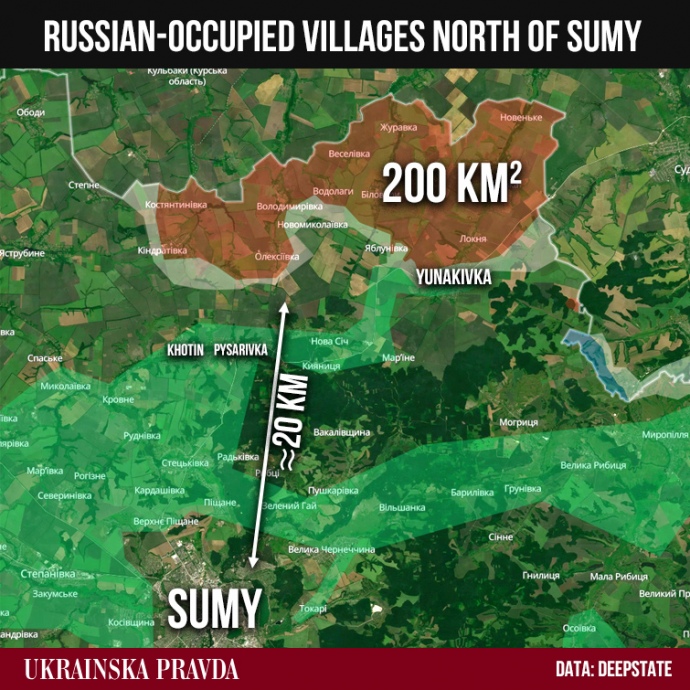
Over the past few months, Russia has occupied around a dozen small border villages in Sumy Oblast and is now pushing further towards three settlements that are crucial for the logistics of Ukraine's defence forces: Yunakivka, Pysarivka and Khotin.
Alongside its advance along the border, Russia has been regularly and indiscriminately firing on the city of Sumy, killing civilians. It targeted the city with a long-range multiple-launch rocket system for the first time on 3 June, likely having moved it right up to the border.
There is very little public information about the actual situation in Sumy Oblast – particularly from the military. The General Staff, regional command in Kursk and Siversk Operational Tactical Group have released little of substance.
Firstly, the General Staff still refers to this front as the "Kursk front", even though it has ultimately become the Sumy front over the past couple of months. Ukraine is not advancing on Kursk; rather, as painful as it is to admit, Russia is advancing on Sumy Oblast (it is currently unclear whether the city of Sumy itself is the main target).
Secondly, the General Staff has still not marked any of the villages in Sumy Oblast that have fallen under the control of the Russians in red. However, according to DeepState and our military sources, Russian forces have taken control of roughly a dozen such villages. Some of these were reportedly lost as early as March or April.
Journalists are banned from working directly with the military in Sumy Oblast. We received around twenty refusals while looking for sources for this article. None of those who did agree to speak were willing to do so under their real names.
In this article, Ukrainska Pravda explains what has happened in Sumy Oblast since Ukraine's defence forces withdrew from Kursk Oblast, what the current situation is in the border areas now held by the Russians and how the shifting line of contact is affecting the city of Sumy itself.
What happened after Ukraine's defence forces withdrew from Kursk
After most of Ukraine's forces withdrew from Kursk Oblast in mid-March, the Defence Forces carried out two more daring offensives – in Belgorod and towards Tyotkino and Vesyoloye in Kursk.
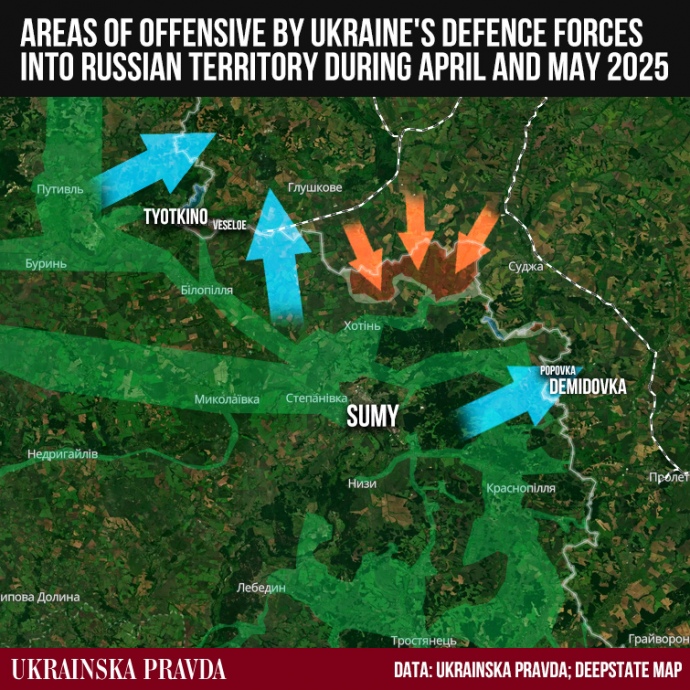
Commander-in-Chief Oleksandr Syrskyi deployed his reserve forces to storm Russian territory, including the 225th and 425th Assault Battalions. The latter, better known as Skala, recently became home to Ukraine's first motorcycle company.
The precise objective of the operation in Belgorod Oblast remains unclear. However, according to military sources, the Tyotkino–Vesyoloye offensive aimed to reach the settlement of Glushkovo – over 10 kilometres into Russian territory. One commander involved in the operation said the objective was unrealistic from the start, primarily due to a severe shortage of reinforcement units – the ones meant to defend positions after the 225th and 425th had broken through.
When asked whether they were advancing on Tyotkino, one soldier replied: "We’re running into the same brick wall again and again", referring to repeated assaults launched without the capacity to hold ground.
"I heard that the command was trying to create a buffer zone, but with the resources we have, it's practically impossible. Also, since the Russians are fighting on their own territory, they're committing more forces than they do on ours. It's constant assaults, constant. That's why I think these manoeuvres were more of a political move – to show our presence on Russian soil. Perhaps to allow the commander-in-chief to save face or to gain leverage in future talks," a commander currently serving near Sumy told Ukrainska Pravda.
As far as Ukrainska Pravda is aware, the offensive actions in both Belgorod and Kursk oblasts did not succeed in the desired results. Even near Tyotkino, where Ukraine had some partial success, the assaults eventually stopped.
"The Russians reinforced with elite paratroopers, but some of our units declined to take up positions to secure the flanks. Our battalion was exhausted after a month of fighting, so we’re mostly defending now," a soldier who took part in the Tyotkino offensive told Ukrainska Pravda.
Even before the final withdrawal from Kursk Oblast and the launch of new offensives on Russian territory, the Russians began assaulting areas near Sumy Oblast and gradually expanding their control. Initially, they moved south from the border into the Yunakivka area, then began pushing westward towards Bilovody, Vodolahy and neighbouring settlements.
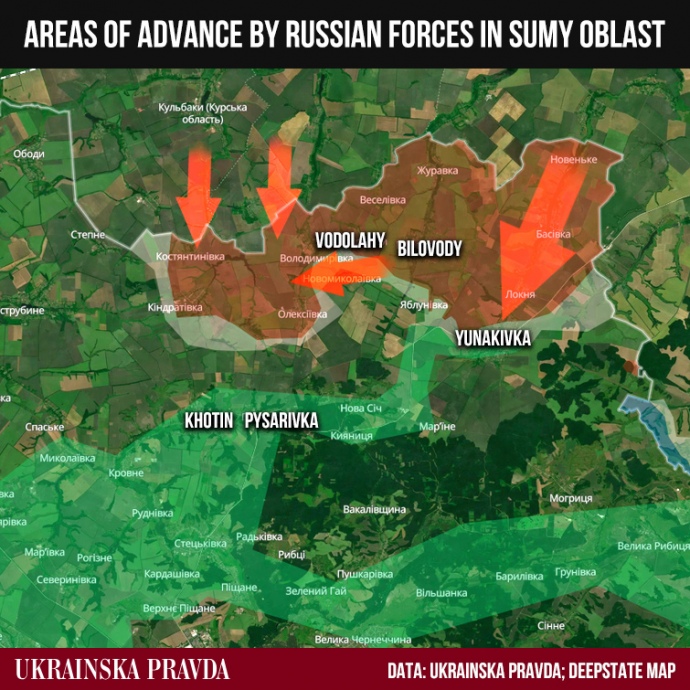
A local resident – and officer in the 17th Heavy Mechanised Brigade – expressed surprise, and even frustration, that the public only learned about the Russian advance near Sumy Oblast in May or June. He claimed the Russian military had started pressing on border villages like Novenke, Zhuravka and Basivka back in late winter or early spring.
On 13 March, during the withdrawal from Kursk, Ukrainska Pravda was just a few kilometres from the border and spoke to local troops who said Russian soldiers had already entered Basivka on ATVs. Basivka is the second village from the border.
"People think the Russians did it all in a week, but it's been going on since mid-February. DeepState just didn't update that section for a long time. But the trend didn't change as they were advancing the whole time. They were on the outskirts of Loknia by early May, possibly even earlier, though DeepState only marked it as captured on 7 June," a soldier from the 17th Brigade told Ukrainska Pravda.
Over more than three months, Russian forces have captured about a dozen small villages along the northeastern border of Sumy Oblast. According to DeepState, the total area occupied in Sumy Oblast is nearly 200 square kilometres. For comparison, that's about one-fifth the size of the area Ukraine briefly captured in Kursk Oblast during last summer's offensive. The following section explores how Russian forces succeeded in this advance, and what the situation looks like now in the occupied zones.
Before moving on to what is happening there now, it is worth noting that DeepState has also marked two small areas further south of Yunakivka – near Sadky and Oleksandriia – as Russian-occupied. However, there is currently no available information about those areas.
Two servicemen defending the Myropillia front – a village 30 kilometres from Sumy – told Ukrainska Pravda that they had observed a build-up of Russian troops across the border, near the village of Gornal in Kursk Oblast.
"It's too early to tell whether they're just trying to distract us or preparing for an offensive. But if they assault with the same number of soldiers as in Yunakivka, there's a chance the same scenario will repeat. Fortifications are a problem. You can't stay in houses for long as they'll be hit with guided bombs. And our supply routes aren't well protected," said a soldier currently serving near Myropillia.
"If the Russians start moving toward Sumy from the other side – Sadky, Myropillia – it would be a problem. There are a lot of forests there, and now everything is green – once you’re in the trees, you’re invisible. Intercepted communications suggest they’ve already deployed four additional units to Sumy Oblast," adds the chief sergeant of a UAV unit stationed in the region.
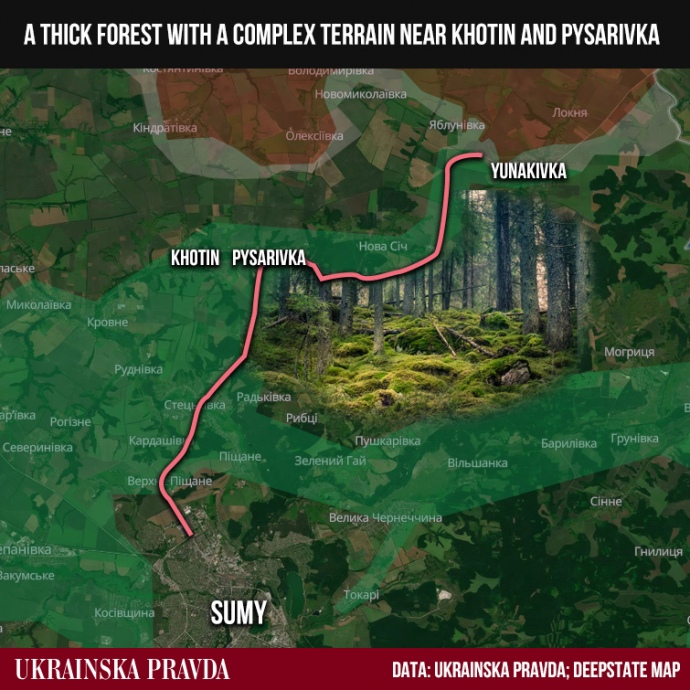
According to our conversations with military sources, preventing Russian troops from entering another dense forest south of Khotin and Pysarivka is currently essential. Once entrenched, the forest’s dense vegetation masks everything – from troop movements to dugouts – making it difficult to dislodge them. It is also difficult to operate FPV drones in the forest because the trees interfere with the radio signal.
In essence, if we let the Russians into the forest near Khotin and Pysarivka, we will get a second Serebrianka Forest [a forest in Luhansk Oblast where intense fighting has been going on since autumn 2022 – ed.]. Perhaps an even more difficult battlefield, because the forest in Sumy Oblast is broad-leaved and has deep ravines.
What is happening in the active zone of Russia's Sumy offensive
While preparing this text, we encountered two radically contrasting views on the Russian advance near Yunakivka: one from civilians, the other from the military.
Most Sumy civilians we spoke to expressed a similar opinion: that there has been no major breakthrough, there is no heavy equipment in the captured villages that could reach Sumy, so there is no need to exaggerate the risks. The city itself is not currently under threat.
By contrast, nearly all military personnel stationed near the border and the vicinity of Yunakivk, as well as those in command of these units – including paratroopers and border guards – were far less optimistic. They described the situation to us as "difficult", "critical", "chaotic", and, in the words of one soldier, "super sh*tty". They reported shortages of personnel, effective FPV teams, fibre optic drones, fortifications, prepared positions, mined approaches and inter-unit coordination.
The villages of Khotin and Pysarivka, located on the main road between Yunakivka and Sumy, are, according to the military personnel we spoke with, fully within reach of advancing Russian forces.
How have the Russians been able to advance so successfully in Sumy Oblast in recent months?
Firstly, several of Ukraine’s most combat-ready brigades were withdrawn from the Russian offensive zone along the border and Yunakivka – some to assault on Russia’s Tyotkino, others were deployed to Donetsk Oblast, where a major Russian offensive is anticipated this summer.
Instead, Ukraine’s Kursk military group was given weak, newly formed units. As far as Ukrainska Pravda is aware, one of these brigades entered Sumy Oblast without any knowledge of combat operations and only a handful of drones.
"We need reserves, we need strong FPV drone crews," explains an experienced fighter from one of the Airborne Forces brigades.
On the Russian side, their most effective UAV unit – Rubicon – is actively operating on the Sumy front. It focuses on disrupting logistics and shooting down reconnaissance aircraft and bombers. As Ukrainian pilots say, the Russians are currently hitting most targets with drones equipped with optical sensors.
Secondly, sources from four different units – either previously stationed in the now-occupied areas or closely familiar with them – unanimously agree on one point: there was no continuous line of defence near Khotin, Pysarivka or Yunakivka. Only isolated trenches and dugouts.
Ukraine did not use the time of the Kursk operation to strengthen its border in Sumy Oblast.
"When we were stationed at the Russian positions, we were very surprised that they had 6-8 kilometres of underground trenches, all leading to the border and to a checkpoint. They had fortified their border very well. But here in Sumy Oblast, there is nothing at all... You have to do something in a hurry. Just the other day, my men were defending dugouts that dated back to 2014. It rained, and they were flooded up to their waists."
"When the Kursk formation was standing, we could have used our imagination and created an underground world in Sumy Oblast. But no one did. If we had stretched nets over the roads earlier, the situation in Kursk might have played out differently," a chief sergeant of one of the UAV units who previously fought in Kursk and now operates in Sumy Oblast told UP indignantly.
"There was nothing concrete. Full-scale fortifications could have been built, but nothing was done," confirmed a source in the 17th Brigade.
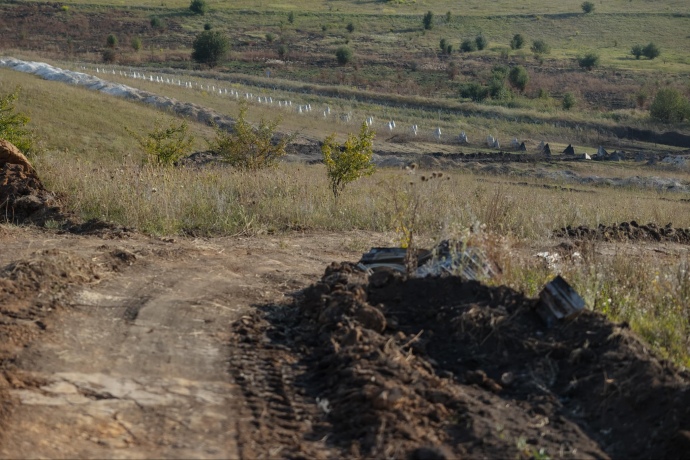
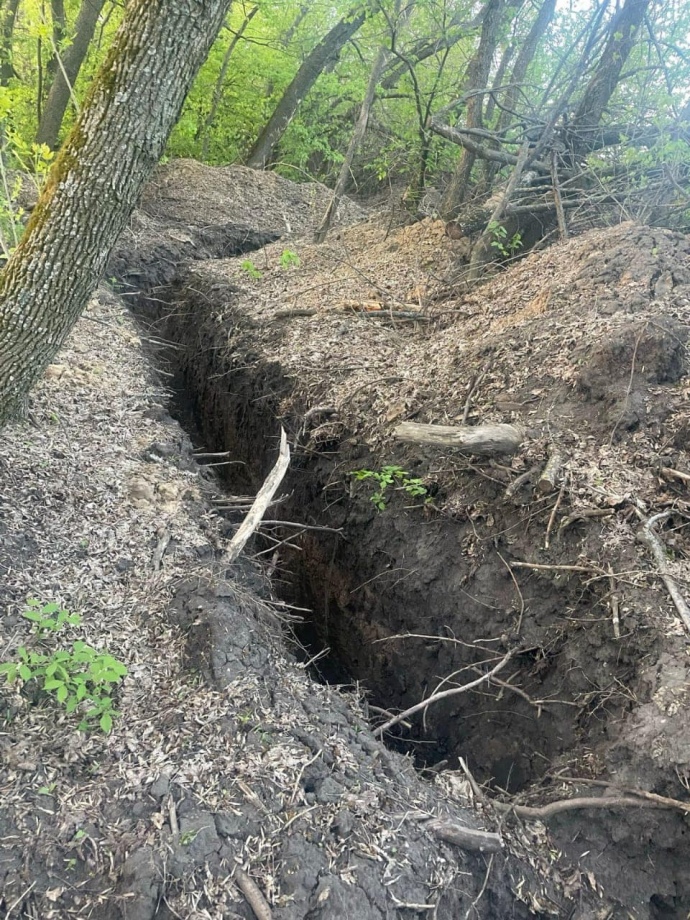
A narrow, uncovered dugout in the Ukrainian village of Bilovody, four kilometres from the border with Russia
Thirdly, protective nets against Russian FPV drones were installed far too late in Sumy Oblast. Some sections of the road still haven’t been covered at all. On those that have, there are one and a half metre gaps between the net and the ground, which has occasionally allowed Russian drones to slip underneath and strike Ukrainian vehicles.
To reduce exposure during movements, Ukrainian defence units in Sumy Oblast are now keeping personnel in positions for extended periods. Gone are the days when UAV operators could simply rotate in and out within 24 hours.
Are the Russians planning to attack Sumy itself?
None of our sources can answer this question. The only thing they are certain of is that the Russians are currently stretching the front line in Sumy Oblast as much as possible in order to draw more reserves of Ukraine’s defence forces here. In particular, they are intensifying their attacks towards two villages – Pysarivka and Yunakivka. Capturing Pysarivka would allow the Russians to cut off the main road from Sumy to Yunakivka, and capturing Yunakivka itself would give them control over a key border settlement.
The Russians are five kilometres away from Pysarivka, and they are already on the outskirts of Yunakivka. Border guards flying drones over Yunakivka recorded Russians entering the centre of the village on motorcycles on 7–8 June. On 10 June, Ukrainian DeepState analysts, who update their map with a delay, marked about a third of Yunakivka as a "grey zone".
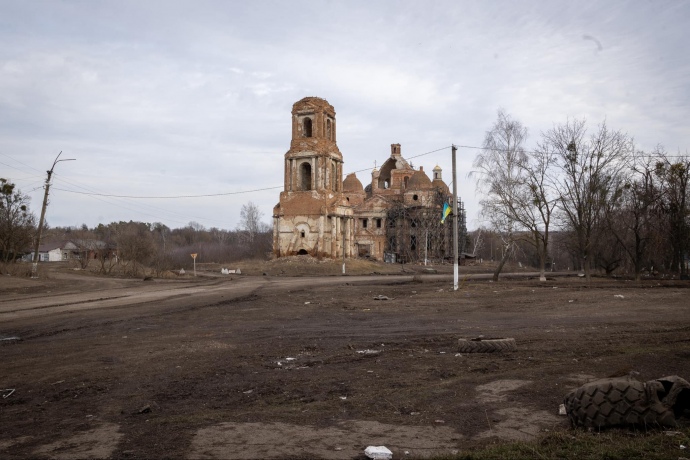
According to the military, there is currently no heavy equipment in the area of Sumy Oblast captured by the Russians; the most that could be seen was a mortar. The Russians move in small assault groups and most of the time, they stay in villages, inside houses. Ukrainska Pravda have not yet had any information on take-off points for the drones.
Recently, the Russians, like the Ukrainian army, have been using heavy night bombers and ground-based robotic systems to deliver ammunition, food and the aforementioned mortar.
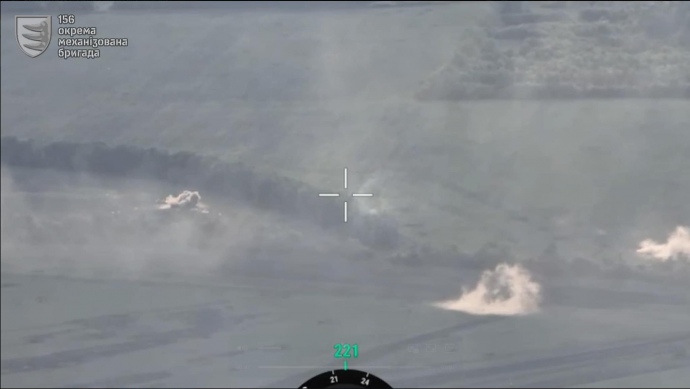
Is there a threat to Sumy? If yes, what is it?
A total of 55,000 people, basically all residents, including 8,000 children, have been evacuated from the 60 villages and towns along the border of Sumy Oblast during the mandatory evacuation which began in 2023.
There are currently no grounds for evacuation from Sumy itself, which is now located 20 kilometres from the front line (like Kramatorsk), according to Oleh Hryhorov, the recently appointed head of Sumy Oblast Military Administration. He assured us that the city has an evacuation plan, several evacuation routes have been developed, and they will be used if necessary.
However, Hryhorov says there is no need for this at the moment. Hryhorov is convinced that the defence forces will not let the Russians near the city.
"We understand that the situation on the front line is difficult, but it is controlled by our Armed Forces. We also understand that, in addition to the confrontation on the battlefield, the enemy is trying to spread panic among civilians. I am convinced that the strike on 3 June [on Sumy] was both a Russian terrorist attack against civilians and their attempt to increase panic. Our Armed Forces have my complete trust and I have no doubt of their combat capability and capacity; they are doing their job with dedication," Hryhorov said.
The Russian army opened fire on cars at traffic lights in Sumy’s centre on the morning of 3 June, killing three people. Three other victims of the attack, a 17-year-old teenager, an 86-year-old woman and a 43-year-old man, died in hospital. The latter's daughter, seven-year-old Masha, was transported to Okhmatdyt National Children's Specialised Hospital in Kyiv with fragments in her lungs.
Local media, the Oblast Military Administration, and later President Zelenskyy reported in the first hours after the attack that the Russians had attacked the city with a long-range multiple-launch rocket system (MLRS). Sumy residents and journalists speculated on social media if it was the Russian Tornado (MLRS), which can fire at a range of 120 kilometres. They say that no new threat to the city has been identified – so there’s no need to escalate the situation. But this is probably not the case.
Sources of one of the law enforcement agencies told Ukrainska Pravda, which was later confirmed by the Office of the Prosecutor General, that the Russians struck Sumy not with a Tornado but with a BM-21 Grad self-propelled MLRS, which has a range of 20 and in some cases 40 kilometres.
The Russians targeted the city centre with a 122-millimetre extended-range 9M521 rocket. These highly-explosive fragmentation rockets are designed for use against infantry, or unarmoured or lightly armoured vehicles. Fired from Grad or the upgraded Tornado-G systems, a single salvo can launch up to 40 rockets, each containing around 1,000 fragments. The maximum range is 40 km.
Sources in law enforcement told Ukrainska Pravda that the Grad strike had been launched from Russian territory, confirming that no heavy equipment, artillery, or MLRS is present in Russian-occupied villages in Sumy Oblast. Measuring 30-40 kilometres from the strike point in Sumy, the Grad system was likely positioned in Russian villages such as Sinyak, Kulbaki, or Novoivanovka to the north, or Guevo or Gornali to the east.
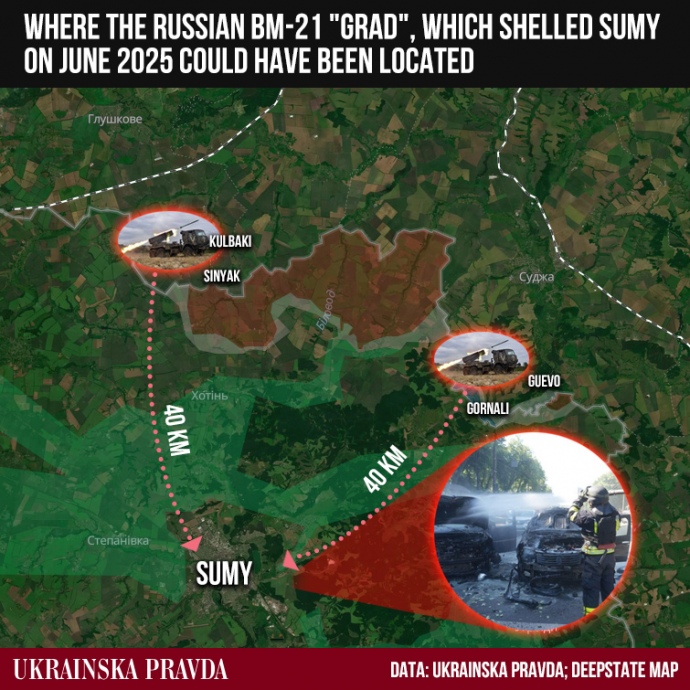
What do we mean by that? That the Russians were able to afford to move the Grad system almost to the border and launched attacks from it, while the Ukrainian units did not have the time to detect it or work on it. And yes, this is a completely different level of risk for Sumy itself.
On the other hand, the MLRS attacks on Sumy have not yet become common, so it is likely that the attack on 3 June is another way of intimidating the civilian population and an attempt to force Ukraine to compromise in the negotiations. They are basically saying: "We’re already reaching Sumy with our MLRS and you risk losing even more if you don’t agree to our terms."
However, even the most large-scale and painful strikes of Russia on Sumy, Kyiv or any other city do not yet push the "red lines" of Ukraine. They only force Ukrainians to fight for their cities even harder.
The last thing to say in the context of the security situation in Sumy is that Russian fibre-optic drones, at least for now, are not a threat to citizens.
Russian fibre-optic FPV drones’ operating range is approximately 15 kilometres, and the distance from extreme Russian positions to Sumy is 18-20 kilometres. The drone's take-off point is always located significantly deeper than an infantryman's extreme trench.
"Everyone measures from the grey zone or from the edge of the captured area and says it is 20-25 kilometres to Sumy! But first of all, the take-off point is located at least five kilometres from the line of contact, so if the Russians are 20-25 kilometres from Sumy, then the drone is 35 kilometres away. Secondly, the further the fibre-optic FPV drone flies, the less load it can carry. What are you going to carry to the outskirts of Sumy? An F-1 grenade? It won't do much damage. That’s why it makes no sense to waste a fibre-optic drone just to scare some civilian in the rear," explains the aforementioned senior sergeant from one of the UAV units.
Meanwhile, Russians are already claiming on their Telegram channels that they are preparing to launch fibre optics with a range of 50 kilometres. If they really start using them, and if this technology works, the situation may change. However, it will take them at least several months to implement such a technique.
***
"The General Staff of the Armed Forces of Ukraine has expanded the front line. Instead of concentrating their forces in Dnipropetrovsk and Donetsk Oblast, they have resorted to actions on the Kursk front, which have now turned into the Sumy operation. We need new forces to perform operations on the new front.
The idea of ‘blinding the enemy we hit there while they hit here’ simply does not work – Russia has more manpower, missiles and ammunition," said a high-level commander currently deployed in Donetsk Oblast, expressing frustration over the situation in Sumy.
He reflects a view within the military that the incursion into Kursk Oblast should have been fast, both in its entry and its withdrawal. The offensive in Belgorod Oblast and in Tyotkino only extends the defence forces along the entire front line, which already lacks resources. While Ukraine excels in bold, rapid operations, it struggles to sustain long-term defensive positions.
Units in both Sumy and Donetsk oblasts face similar problems: weak reserves, unprotected and inefficient logistics, inadequate fortifications, and a deficit in both the quantity and quality of drones.
Some of these issues may still be solvable, and had they been addressed earlier, the situation in Sumy might have looked very different.
You can donate to the defence on the Sumy frontier by supporting fundraising for an all-terrain vehicle for local border guards. They will help the military quickly get to their positions and deliver everything they need.
Author: Olha Kyrylenko, Ukrainska Pravda
Translation: Tetiana Buchkovska, Yelyzaveta Khodatska and Yuliia Kravchenko
Editing: Charlotte Guillou-Clerc
Review: Susan McDonald