Russia's summer frontline offensive: where will they advance, and what factors weaken the Ukrainian defence forces' positions?


Despite all the talk of peace negotiations, Russia has no intention of stopping its advance and is preparing to continue the war.
So says Ukraine’s President Volodymyr Zelenskyy, and it’s confirmed by the reports from the General Staff of the Armed Forces of Ukraine every evening, which indicate that the number of combat clashes along the front line remains consistently high – approximately 200 per day.
It’s evidenced, too, by the stabilisation points of the Ukrainian brigades based in critical frontline areas, which are full of wounded soldiers.
Summer is just ahead of us, and it is the perfect time for a new offensive. Rain and snow cause equipment to get bogged down, drones have poor visibility, and soldiers get wet and cold, whereas dry weather is always good for offensives and advances. The grass and the trees and bushes in leaf make movement in wooded areas practically invisible.
At this stage in the war, in the summer of 2025, only one side has the potential to attack, and that, unfortunately, is Russia.
However, not all of our sources are convinced that the Russian army is preparing for an offensive this summer, whether a sudden strike like the one in Kharkiv Oblast of May 2024, or a creeping and exhausting push like the offensive following the fall of Avdiivka.
Russia may simply keep combat operations at their current intensity – around 170 combat clashes per day across the entire front line, according to Hlib Voloskyi, an analyst at the Come Back Alive Foundation. This number has remained roughly the same since April 2025, following a slight decline in Russian pressure in February and March.
In this article, Ukrainska Pravda explains where Russia may attack this summer and what factors are currently weakening the positions of the Ukrainian defence forces on the front line.
Kostiantynivka, Druzhkivka and Pokrovsk: where is Russia aiming for this summer, and how?
Ukrainska Pravda sources among senior commanders in the Ukrainian defence forces strongly believe that the Russians are most likely to focus their offensive this summer on Donetsk Oblast (rather than Sumy Oblast, where the Russians are actively advancing and consolidating their positions on Ukrainian territory along the border).
In the event of an offensive, the Russians will rapidly advance on two fronts: Kramatorsk and Pokrovsk. These areas represent the majority of Donetsk Oblast that remains under Ukrainian control and include the most densely populated and heavily industrialised cities.
Special mention should be made of the Kramatorsk agglomeration – the four large cities along the H-20 highway, Kostiantynivka, Druzhkivka, Kramatorsk and Sloviansk, where at least 200,000 to 300,000 civilians still live.
Since 2022, these cities have effectively become the backbone of a large part of the Ukrainian forces in Donetsk region, serving as a base for deployment and support. Any approach by Russian forces towards even one of these cities will pose a threat to all the others.
Let’s take a closer look at the two fronts where Russia is likely to advance.
The Kramatorsk front. As early as March or April, it was possible to say that Kostiantynivka, the closest city to the line of contact in the Kramatorsk agglomeration, would be a target of the Russian summer offensive in Donetsk Oblast.
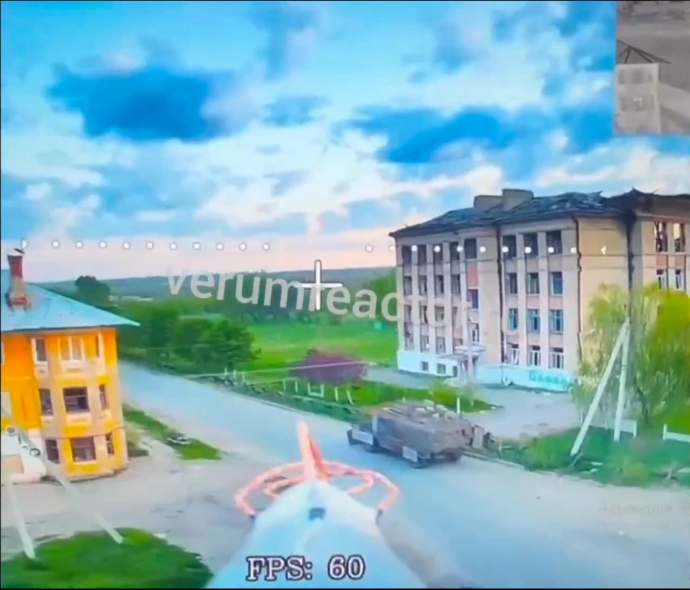
This was evidenced by several things: increased attacks, insignificant but regular advances by the Russians from the south and south-west, and the first appearance of Russian FPV (First Person View) drones in the city. For example, a video of a Russian drone flying right in through the open back door of a Ukrainian armoured vehicle on the outskirts of Kostiantynivka went viral on all the military social media channels. Previously, Russian drones could not have afforded to fly so close to the city.
Now, their FPVs fly over Kostiantynivka using both fibre optic cables and analogue signals, controlling all the access roads to the city.
In May, the situation around Kostiantynivka escalated and somewhat shifted. In addition to Russian movements from the south – that is, from the Toretsk-Sukha Balka-Kalynove area – and relatively steady pressure from the east via Chasiv Yar, new attacks also began from the west.
Russian forces broke through the Pokrovsk-Kostiantynivka road in the Malynivka-Nova Poltavka-Novoolenivka area, creating a threatening salient over 10 km long and roughly the same width. It is equidistant from Pokrovsk and Kostiantynivka, giving rise to the risk of a simultaneous Russian advance towards both cities.
As of late May and early June, the Russians are actively conducting assaults within this salient with reinforced infantry, motorcycles and even armoured vehicles. The distance from the salient to the outskirts of Kostiantynivka is 10-12 km.
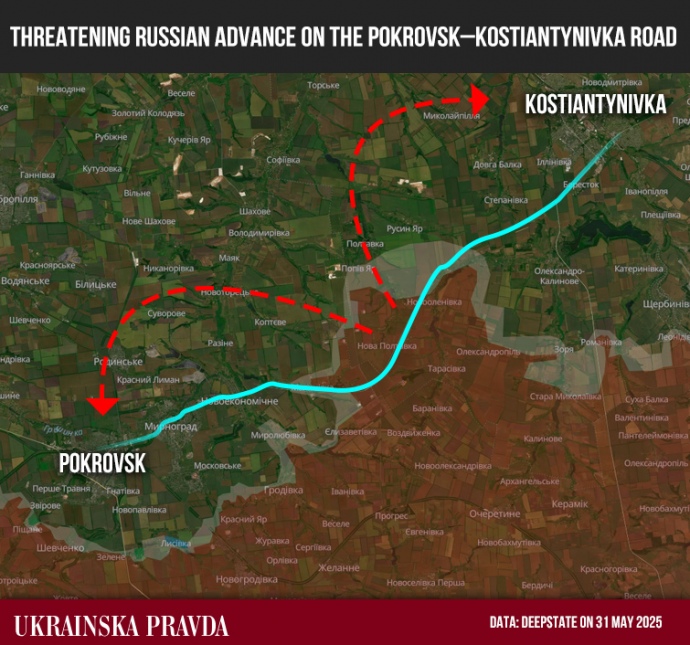
A Russian advance towards Pokrovsk and Kostiantynivka is, unfortunately, not the only threat that the growth of this salient could entail.
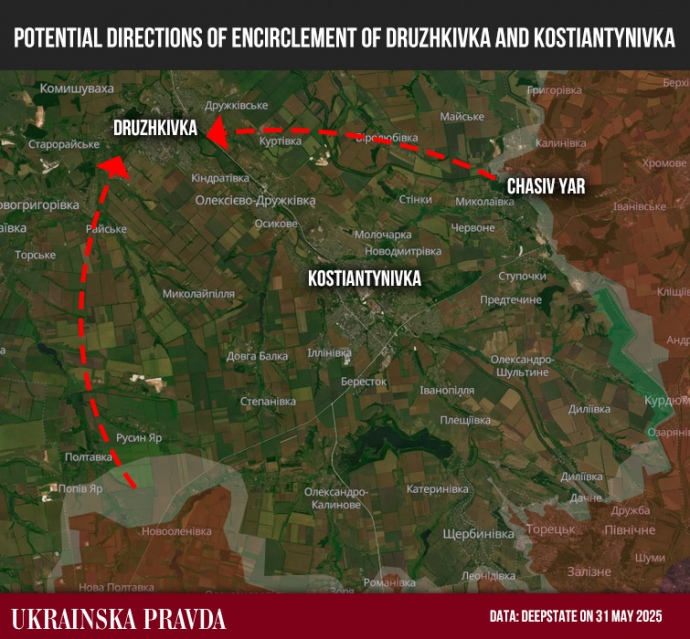
Ukrainska Pravda sources on the Kramatorsk front suggest that this salient could potentially develop into a further Russian advance northwards and the capture of another major city – Druzhkivka. This will serve as a pincer to surround Kostiantynivka and Druzhkivka from the west, while the Russians form another pincer moving from Chasiv Yar in the east.
By doing this, the Russians will be able to "bite off" half of the Kramatorsk agglomeration without getting involved in urban warfare. This can be considered their best-case scenario for this summer.
"By increasing their efforts on the salient between Pokrovsk and Kostiantynivka, the Russians could advance towards Torske, which is west of Druzhkivka, and on the other side, they could advance towards Druzhkivka from Chasiv Yar. And this whole piece of territory could be a big problem if the Russians are not stopped. Why would they go into Kostiantynivka if they can do more? This will put Druzhkivka and all our supply routes under threat," a source familiar with the situation said.
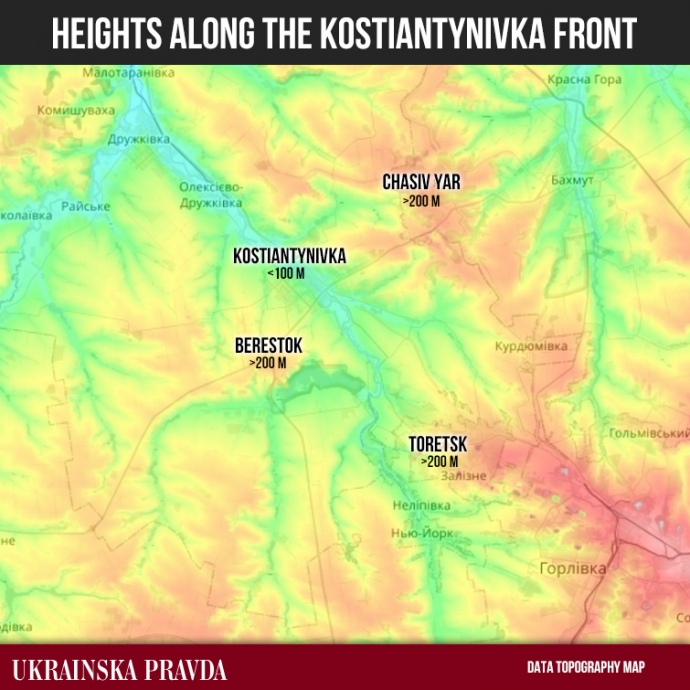
"If the Russians can reach Druzhkivka, they will do so. If not, they will at least try to establish fire control over the roads to Kostiantynivka, from Pokrovsk on one side and Kramatorsk on the other. One of the problems is that Kostiantynivka is located in a lowland area that lies around the heights of Chasiv Yar and Toretsk. If they take control of these heights, it will be very easy for them to establish fire control over both the city and the logistics routes," Come Back Alive analyst Hlib Voloskyi explains.
Therefore, the notional minimum objective for the Russian forces on the Kramatorsk front may be to capture the remaining high ground in Toretsk and Chasiv Yar, which would enable them to bring the road to Kostiantynivka under fire control. This would require them to approach within 5-7 km of the road to allow for effective mortar strikes.
The Pokrovsk front. Although the Russians have partly shifted their focus towards Kostiantynivka, they are unlikely to abandon their offensive operations on the Pokrovsk front, Voloskyi told UP.
Firstly, as mentioned above, the Russians could use the salient along the Pokrovsk-Kostiantynivka road to approach Pokrovsk from the east or form an eastern pincer to encircle the city (although Pokrovsk being surrounded still seems an unlikely scenario).
Secondly, Russian troops continue to apply pressure south of Pokrovsk – in and around the village of Shevchenko – and are intensively conducting assaults to the south-west of the city, in the area of Novooleksandrivka, Kotliarivka and Troitske. These villages are located near the administrative border with Dnipropetrovsk Oblast, and this particular section is currently the most sensitive.
There are less than two kilometres remaining until the war spreads to the neighbouring oblast – a scenario which now appears more realistic than the encirclement of Pokrovsk itself. The Russian troops closest to Dnipropetrovsk Oblast are near the village of Novomykolaiivka.
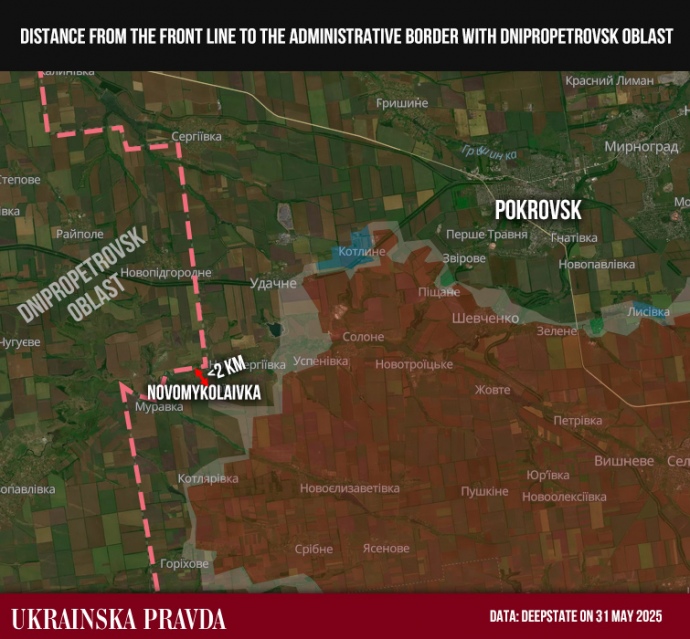
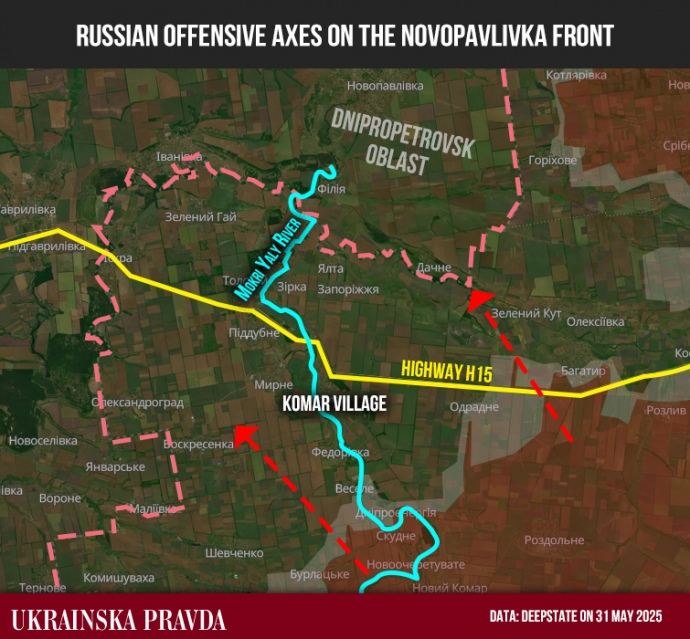
South of Pokrovsk, there is another front worth watching – the Novopavlivka front (formerly known as the Kurakhove and Velyka Novosilka front). Russian activity in this sector is expected around late June or early July, according to a UP source on the front.
Here the Russians are attempting to advance along the Mokri Yaly River towards the village of Komar and the H-15 highway in order to again approach Dnipropetrovsk Oblast and extend the fighting into the oblast from this side as well.
What factors are weakening the defence forces' position in the east?
As of spring 2025, there are four key issues that are complicating the situation for the frontline defence forces and slowing their response to Russian actions. Broadly speaking, two of these problems are familiar and two are new.
The long-standing issues are the minimal replenishment of personnel and – increasingly evident at the end of this spring – the shortage of artillery shells. UP has learned that the current monthly shell allocation for all units deployed along the front line from Kharkiv Oblast to Donetsk Oblast – and that includes dozens of brigades – is equivalent to what just 10 to 20 howitzers had available to fire during the defence of Bakhmut. In other words, it is critically low.
In the context of this ammunition shortage, it is also worth noting that a huge amount of munitions was expended during Ukraine’s offensive on Russia’s Kursk Oblast. The Kursk forces received dozens of times more ammunition than the units defending Kharkiv and Donetsk oblasts.
"We’re hardly firing at all now," said a UP source from one of the operational tactical groupings in the east. "The whole front is holding thanks to the drone operators. They use drones to lay mines, destroy targets – they do everything with them. Only the Bohdanas are still working."
"I’m currently receiving five 120mm mortar rounds per day for the whole battalion when for effective defence I should be receiving 30 rounds for just one mortar," adds an officer from one of the brigades positioned on the Pokrovsk front.
One of the "new" problems, so to speak, is that the Ukrainian armed forces lag behind the Russians in terms of both the quantity and quality of drones. This is particularly disheartening given that it is the Ukrainians who have always led the way in technological progress.
Most Ukrainian drones delivered to the front don’t work "straight out of the box" – they require modifications in workshops that are often paid for by the soldiers themselves (there is no official separate budget for this). Meanwhile, the Russians often receive ready-to-use drones operating on non-standard frequencies that cannot be jammed by Ukrainian electronic warfare systems.
The use of fibre-optic drones is not yet widespread in Ukraine. Even the strongest brigades only began fundraising for drones with optical guidance relatively recently, and very few units are actually flying them.
The issue of lagging behind in drone development was all too evident this winter when the Russians used FPV drones, including some with fibre-optic control, to effectively cut off the main supply road to the Ukrainian group in Kursk Oblast, a move which hastened the withdrawal of Ukrainian forces from Russian territory.
Having disrupted Ukrainian logistics in Sumy and Kursk oblasts, the most capable Russian drone operators – including Rubikon, one of the most famous Russian units – have relocated to Donetsk Oblast. Soldiers from the Kramatorsk and Pokrovsk fronts have confirmed this to UP.
This is why since late April, there have been regular reports in Ukrainian military chats of Russian drone strikes on lorries and pickups 20 and sometimes even 30 km away from the front line. Such incidents have occurred along what was previously considered a rear-area route, the Kramatorsk-Dobropillia road, and near the Sloviansk entry sign. On 27 May, Russian FPV drones reportedly targeted the city of Sloviansk itself for the first time.
The Russians are systematically – and unfortunately quite effectively – working to cut off the defence forces’ supply routes. There are fewer and fewer usable roads left in Donetsk Oblast. Some sections of road have already become extremely dangerous.
Ukrainian drone operators used to be able to drive to strategic positions, but for several months now they have been walking there, just like the infantry, explains Yevhen Cherepnia, commander of a UAV platoon in the 2nd Motorised Infantry Battalion of the 93rd Brigade.
"The enemy has significantly increased both the quantity and quality of its UAVs, and this could play a decisive role in their summer offensive, if it takes place," Commander Cherepnia says. "We need to counter Russian drone pilots the same way they counter ours. When artillery appeared, counter-battery warfare followed. We need to do the same with drones. Shooting down drones in the sky is like shooting down shells – not very effective.
We need to target the pilots themselves: at the very least destroy their equipment, and ideally kill them. Within each brigade, we should create separate reconnaissance and strike UAV crews with the best equipment and the best drones. Ordinary crews like ours can’t do this – all our resources are spent repelling assaults."
In some brigades, technical intelligence units are specifically tasked with locating enemy drone launch sites. They might identify several dozen in a month. One National Guard unit interviewed by our team discovered 140 such sites over three months. However, only around 20 were targeted.
The reason is that Russian drone launch sites are often located too far away – for example, 20 km from Ukrainian UAV crews – making them difficult to reach.
Another factor is that some Russian pilots are not actually at the launch sites – they remain in safer positions, while the drones are launched by sappers or other crew members. So this tactic may not cause significant damage to the drone crews themselves.
The fourth problem highlighted by UP’s sources in military circles – and to a large extent the decisive one – is micromanagement by the General Staff, particularly by Commander-in-Chief Oleksandr Syrskyi.
The commander-in-chief tries to control everything – from the appointment of the new commander of the 59th Brigade (which reports to Commander of Unmanned Systems Forces Vadym Sukharevskyi) to the placement of an infantry position on a specific front.
"Instead of planning strategic and operational actions, Syrskyi is writing combat orders regarding the regaining of section-level positions," one informed source in the defence forces said. "The General Staff, going against logic, common sense and official regulations, is sending out coordinates for where a squad-level position should be placed. Determining a squad’s position is the task of a platoon commander at most! Not only that – these orders come with the clarification that if you do not place the position there, you will face criminal liability."
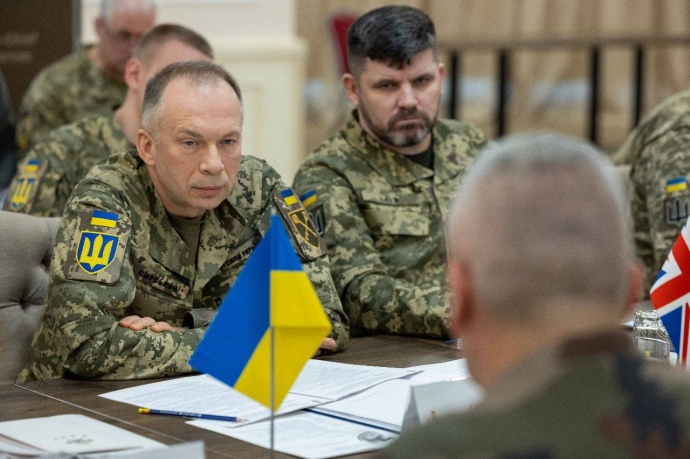
This not only ties the hands of the tactical, operational tactical and operational strategic groups who should be managing combat operations with knowledge of the local situation. It also slows down the making of critically important decisions.
Ukrainska Pravda has learned that it was suggested to Syrskyi that the defensive line near Kostiantynivka, Donetsk Oblast, should be restructured in order to free up forces for containment operations in an area under greater threat. But this suggestion was rejected.
"Because how on earth can we leave anywhere? Us being forced to give up a settlement? And the fact that the front line could be shortened due to features of the terrain, such as a natural barrier like a reservoir, is of no interest to anyone," one informed source in the defence forces told UP.
Another officer reported to have been constrained by Syrskyi in matters of troop management is the Commander of the Ground Forces, Mykhailo Drapatyi. On 1 June, following yet another Russian strike on a training ground, Drapatyi submitted a letter of resignation, but Syrskyi has not yet accepted it.
Syrskyi and Drapatyi have a rather cold working relationship. Three unrelated UP sources have confirmed that the commander-in-chief frequently considers his own decisions to be better and has shut Drapatyi off from certain responsibilities.
Some of our sources say there are differences in views regarding the future course of the defence forces’ actions: Syrskyi believes that Ukrainian troops should go on the offensive, while Drapatyi thinks there is insufficient capacity for offensive operations and that a defensive stance is necessary. Some sources are convinced that either Syrskyi or the President’s Office fears Drapatyi as a competitor, since he has a reputation among the troops as a humane and strong commander.
"When Syrskyi was commander of the Khortytsia Operational Strategic Group, he had significantly more authority than Drapatyi has now," one of the previously cited sources says with evident emotion. "Syrskyi had the power to appoint any official in the Ground Forces; he alone decided where reinforcements would be sent, where reserves would be deployed. But Drapatyi is working with minimal resources. Syrskyi still decides where 10, 20, or even 100 troops are deployed after training, who joins which corps – even though that should be the Ground Forces’ responsibility! He is deliberately and consciously tying Drapatyi’s hands. Why? To show that Drapatyi has failed?"
***
"I don’t believe the Russian summer offensive has strong prospects," Voloskyi said at the end of his conversation with UP. "It definitely won’t result in a strategic breakthrough or a deep advance. I’m also sceptical about them being able to reach the administrative borders of Donetsk Oblast in the coming months."
In the worst-case scenario for Ukraine, Russian forces could advance a few dozen kilometres through wooded areas and end up getting bogged down in prolonged urban fighting – in Kostiantynivka, Druzhkivka or Pokrovsk. Alternatively, they might get as far as villages in Dnipropetrovsk Oblast.
Unfortunately Russia has no lack of resources, and that applies to both manpower and weaponry. This enables them to fight, or rather carry out assaults, on several fronts at once.
Author: Olha Kyrylenko
Translation: Myroslava Zavadska, Anna Kybukevych
Editing: Charlotte Guillou-Clerc, Teresa Pearce